Goserelin
JFDA label: Zoladex L.A
Mechanism of Action
Goserelin (a gonadotropin-releasing hormone [GnRH] analog) causes an initial increase in luteinizing hormone (LH) and follicle stimulating hormone (FSH), chronic administration of goserelin results in a sustained suppression of pituitary gonadotropins. Serum testosterone falls to levels comparable to surgical castration. The exact mechanism of this effect is unknown, but may be related to changes in the control of LH or down-regulation of LH receptors.
Indications
Approved
- Breast cancer, advanced (3.6 mg only)
- Endometrial thinning (3.6 mg only)
- Endometriosis (3.6 mg only)
- Prostate cancer, advanced (3.6 mg or 10.8 mg)
- Prostate cancer, stage B2 to C (3.6 mg or 10.8 mg)
Off-label
- Breast cancer, advanced (second-line endocrine-based combination therapy)
- Prevention of early menopause during chemotherapy for early stage hormone receptor negative breast cancer
Contraindications
Source: Lexicomp
- Additional contraindications (not in the US labeling): Undiagnosed vaginal bleeding, pregnancy, breastfeeding Absolute
- Hypersensitivity to goserelin, GnRH, GnRH agonist analogues, or any component of the formulation Absolute
- pregnancy (except if using for palliative treatment of advanced breast cancer) Absolute
Adverse Reactions
Cardiac disorders (6)
Very Common peripheral edema · Vasodilatation
Common cardiac arrhythmia, migraine, dizziness, malaise, chills, hair disease, pruritus, alopecia, skin discoloration, xeroderma · cardiac failure · Edema · hypertension
Nervous system disorders (6)
Very Common depression · dyspareunia · emotional lability · Headache · insomnia · pain
Renal and urinary disorders (8)
Very Common breast atrophy · breast hypertrophy · decrease in erectile frequency · genitourinary signs and symptoms · pelvic symptoms · sexual disorder · Vaginitis
Common Renal insufficiency
Blood and lymphatic system disorders (1)
Very Common Tumor flare
Metabolism and nutrition disorders (6)
Very Common decreased libido · Hot flash · increased libido
Common gout, gastric ulcer, mastalgia, uterine hemorrhage, vulvovaginitis, breast swelling (males >1% to 1% to Hematologic & oncologic: Anemia (males >1% to Hypersensitivity: Hypersensitivity reaction · Gynecomastia · hirsutism
Gastrointestinal disorders (2)
Very Common Abdominal pain · nausea
Skin and subcutaneous tissue disorders (3)
Very Common acne vulgaris · Diaphoresis · seborrhea
Musculoskeletal and connective tissue disorders (7)
Very Common Decreased bone mineral density · weakness
Common arthralgia · arthropathy · hypertonia · leg cramps · Myalgia
Eye disorders (2)
Common Amblyopia · dry eye syndrome
Infections and infestations (2)
Very Common Infection
Common Sepsis
General disorders and administration site conditions (1)
Common Fever
Respiratory, thoracic and mediastinal disorders (9)
Common bronchitis · chronic obstructive pulmonary disease · cough · epistaxis · flu-like symptoms · pharyngitis · rhinitis · sinusitis · Upper respiratory tract infection
Dosing
Source: Lexicomp
Warnings & Precautions
Source: Lexicomp
Cervical resistance
Cervical resistance may be increased; use caution when dilating the cervix for endometrial ablation.
Decreased bone density
Has been reported in women and may be irreversible; use caution if other risk factors are present; evaluate and institute preventive treatment if necessary.
Hypercalcemia
Hypercalcemia has been reported in prostate and breast cancer patients with bone metastases. Initiate appropriate management if hypercalcemia occurs.
Hyperglycemia
Hyperglycemia has been reported in males and may manifest as diabetes or worsening of preexisting diabetes (worsening glycemic control). Monitor blood glucose and HbA1c and manage diabetes appropriately.
Hypersensitivity
Hypersensitivity reactions (including acute anaphylactic reactions) and antibody formation may occur; monitor.
Injection site injury
Injection site and vascular injury, including pain, hematoma, hemorrhage and hemorrhagic shock (requiring blood transfusions or surgical intervention) have been reported with goserelin. Use extra caution when administering to patients with a low BMI and/or to patients receiving full dose anticoagulation. Use caution while injecting goserelin into the anterior abdominal wall (due to the proximity of underlying inferior epigastric artery and its branches). Monitor for signs/symptoms of abdominal hemorrhage. Inform patient to immediately report abdominal pain, abdominal distention, dyspnea, dizziness, hypotension, and/or altered level of consciousness.
Pituitary apoplexy
Rare cases of pituitary apoplexy (frequently secondary to pituitary adenoma) have been observed with GnRH agonist administration (onset from 1 hour to usually • Tumor flare: Transient increases in serum testosterone (in men with prostate cancer) and estrogen (in women with breast cancer) may result in a worsening of disease signs and symptoms (tumor flare) during the first few weeks of treatment. Some patients experienced a temporary worsening of bone pain, which may be managed symptomatically. Spinal cord compression and urinary tract obstruction have been reported when used for prostate cancer; closely observe patients for symptoms (eg, ureteral obstruction, weakness, paresthesias) in first few weeks of therapy. Manage with standard treatment; consider orchiectomy for extreme cases. Disease-related concerns:
Cardiovascular disease
Androgen deprivation therapy may increase the risk for cardiovascular disease (Levine, 2010). An increased risk for MI, sudden cardiac death, and stroke has been observed. Monitor for signs/symptoms of cardiovascular disease; manage according to current clinical practice. Androgen deprivation therapy may cause prolongation of the QT/QTc interval; evaluate risk versus benefit in patients with congenital long QT syndrome, heart failure, frequent electrolyte abnormalities, and in patients taking medication known to prolong the QT interval. Correct electrolytes prior to initiation and consider periodic electrolyte and ECG monitoring. Concurrent drug therapy issues:
Drug-drug interactions
Potentially significant interactions may exist, requiring dose or frequency adjustment, additional monitoring, and/or selection of alternative therapy. Consult drug interactions database for more detailed information. Special populations:
Obese patients
A decreased AUC may be observed when using the 3-month implant in obese patients. Monitor testosterone levels if desired clinical response is not observed.
Underweight patients
Use extra care when administering to patients with a low BMI.
Women
Women of childbearing potential should not receive therapy until pregnancy has been excluded. Nonhormonal contraception is recommended during therapy and for 12 weeks after therapy is discontinued. Chronic administration may result in effects on reproductive function due to antigonadotropic properties. Dosage form specific issues:
Implant removal
If removal is necessary, implant may be located by ultrasound.
Pregnancy & Lactation
Pregnancy
Adverse events were observed in animal reproduction studies. Goserelin induces hormonal changes which increase the risk for fetal loss and use is contraindicated in pregnancy unless being used for palliative treatment of advanced breast cancer. Breast cancer: If used for the palliative treatment of breast cancer during pregnancy, the potential for increased fetal loss should be discussed with the patient. Endometriosis, endometrial thinning: Use is contraindicated during pregnancy. Women of childbearing potential should not receive therapy until pregnancy has been excluded. Nonhormonal contraception is recommended for premenopausal women during therapy and for 12 weeks after therapy is discontinued. Although ovulation is usually inhibited and menstruation may stop, pregnancy prevention is not ensured during goserelin therapy. Changes in reproductive function may occur following chronic administration.
Lactation
It is not known if goserelin is present in breast milk, although goserelin is inactivated when used orally. Due to the potential for serious adverse reactions in the breastfed infant, a decision should be made to discontinue breast-feeding or to discontinue the drug, taking into account the importance of treatment to the mother.
Monitoring
| Clinical pearl | Monitor blood glucose and HbA1c (periodically), bone mineral density, serum calcium, cholesterol/lipids; monitor for signs/symptoms of abdominal hemorrhage following injection. Prostate cancer: Consider periodic ECG and electrolyte monitoring. Monitor for weakness, paresthesias, tumor flare, urinary tract obstruction, and spinal cord compression in first few weeks of therapy. |
|---|
Chemistry & Properties
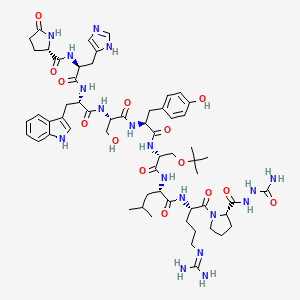
| Formula | C59H84N18O14 |
|---|---|
| Molecular weight | 1269.43 g/mol |
| IUPAC name | (2S)-N-[(2S)-1-[[(2S)-1-[[(2S)-1-[[(2S)-1-[[(2R)-1-[[(2S)-1-[[(2S)-1-[(2S)-2-[(carbamoylamino)carbamoyl]pyrrolidin-1-yl]-5-(diaminomethylideneamino)-1-oxopentan-2-yl]amino]-4-methyl-1-oxopentan-2-yl]amino]-3-[(2-methylpropan-2-yl)oxy]-1-oxopropan-2-yl]amino]-3-(4-hydroxyphenyl)-1-oxopropan-2-yl]amino]-3-hydroxy-1-oxopropan-2-yl]amino]-3-(1H-indol-3-yl)-1-oxopropan-2-yl]amino]-3-(1H-imidazol-5-yl)-1-oxopropan-2-yl]-5-oxopyrrolidine-2-carboxamide |
| CAS | 65807-02-5 |
| PubChem CID | 5311128 |
| InChIKey | BLCLNMBMMGCOAS-URPVMXJPSA-N |
SMILES
CC(C)C[C@H](NC(=O)[C@@H](COC(C)(C)C)NC(=O)[C@H](Cc1ccc(O)cc1)NC(=O)[C@H](CO)NC(=O)[C@H](Cc1c[nH]c2ccccc12)NC(=O)[C@H](Cc1cnc[nH]1)NC(=O)[C@@H]1CCC(=O)N1)C(=O)N[C@@H](CCCNC(=N)N)C(=O)N1CCC[C@H]1C(=O)NNC(N)=OBiology & Pharmacokinetics
Pharmacokinetics
| BBB penetrant | No |
|---|
Transporters
BCRP (Inhibitor)BSEP (Inhibitor)BSEP (Inhibitor)MRP1 (Inhibitor)MRP2 (Inhibitor)MRP3 (Inhibitor)MRP4 (Inhibitor)OATP1B1 (Inhibitor)OATP1B3 (Inhibitor)P-gp (Inhibitor)P-gp (Substrate)
Drug–drug interactions (100+, DDInter)
| Interacting drug | Severity | Management |
|---|---|---|
| Amiodarone | major | |
| Amisulpride | major | |
| Anagrelide | major | |
| Arsenic trioxide | major | |
| Bedaquiline | major | |
| Bepridil | major | |
| Cabozantinib | major | |
| Ceritinib | major | |
| Cisapride | major | |
| Citalopram | major | |
| Clozapine | major | |
| Crizotinib | major | |
| Disopyramide | major | |
| Dofetilide | major | |
| Dolasetron | major | |
| Dronedarone | major | |
| Droperidol | major | |
| Efavirenz | major | |
| Escitalopram | major | |
| Fingolimod | major | |
| Gatifloxacin | major | |
| Grepafloxacin | major | |
| Halofantrine | major | |
| Haloperidol | major | |
| Ibutilide | major | |
| Iloperidone | major | |
| Ivabradine | major | |
| Ivosidenib | major | |
| Lefamulin | major | |
| Levacetylmethadol | major | |
| Lumefantrine | major | |
| Macimorelin | major | |
| Mesoridazine | major | |
| Methadone | major | |
| Mifepristone | major | |
| Moxifloxacin | major | |
| Nilotinib | major | |
| Osimertinib | major | |
| Ozanimod | major | |
| Panobinostat | major |
Showing 40 of 100+.
Registered Products (2)
| Brand | Form / strength | Pack | Agent | Citizen (JOD) |
|---|---|---|---|---|
| Zoladex Depot | Pre-filled Syringe 3.6 mg | 1 PFS | Shawi & Rushedat Drug Store | — |
| Zoladex L.A | Implant 10.8 mg | 1 depot | Shawi & Rushedat Drug Store | — |