Lenvatinib
JFDA label: Lenvima
Mechanism of Action
Lenvatinib is a multitargeted tyrosine kinase inhibitor of vascular endothelial growth factor (VEGF) receptors VEGFR1 (FLT1), VEGFR2 (KDR), VEGFR3 (FLT4), fibroblast growth factor (FGF) receptors FGFR1, 2, 3, and 4, platelet derived growth factor receptor alpha (PDGFRα), KIT, and RET. Inhibition of these receptor tyrosine kinases leads to decreased tumor growth and slowing of cancer progression. Combining lenvatinib with everolimus has demonstrated increased antiangiogenic and antitumor activity by decreasing human endothelial cell proliferation, tube formation, and VEGF signaling (in vitro) compared to either drug alone.
Indications
Approved
- Renal cell carcinoma, advanced
- Thyroid cancer, differentiated
Off-label
- Hepatocellular carcinoma (advanced)
Contraindications
Source: Lexicomp
- Hypersensitivity to lenvatinib or any component of the formulation Absolute
- There are no contraindications listed in the manufacturer’s US labeling Absolute
Adverse Reactions
Cardiac disorders (7)
Very Common Hypertension · peripheral edema
Common Hypotension · prolonged Q-T interval on ECG · pulmonary embolism · reduced ejection fraction · thromboembolic complications
Nervous system disorders (6)
Very Common dizziness · Fatigue · headache · insomnia · mouth pain · voice disorder
Hepatobiliary disorders (4)
Common Hyperbilirubinemia · increased serum alkaline phosphatase · increased serum ALT · increased serum AST
Renal and urinary disorders (4)
Very Common Proteinuria · Renal insufficiency · urinary tract infection
Common Increased serum creatinine
Blood and lymphatic system disorders (2)
Very Common Hemorrhage
Common Decreased platelet count
Metabolism and nutrition disorders (11)
Very Common Increased thyroid stimulating hormone level · weight loss
Common Dehydration · hypercalcemia · hypercholesterolemia · hyperkalemia · hypoalbuminemia · hypocalcemia · hypoglycemia · hypokalemia · hypomagnesemia
Gastrointestinal disorders (14)
Very Common abdominal pain · constipation · decreased appetite · Diarrhea · dysgeusia · dyspepsia · nausea · stomatitis · vomiting · xerostomia
Common gastrointestinal fistula · increased serum amylase · increased serum lipase · Infection of mouth
Skin and subcutaneous tissue disorders (4)
Very Common alopecia · Palmar-plantar erythrodysesthesia · skin rash
Common Hyperkeratosis
Musculoskeletal and connective tissue disorders (2)
Very Common Arthralgia · myalgia
Respiratory, thoracic and mediastinal disorders (3)
Very Common Cough · epistaxis
Common Pulmonary edema
Dosing
Source: Lexicomp
Warnings & Precautions
Source: Lexicomp
Cardiac effects
Hypertension, including grade 3 and 4 toxicity, occurred in patients treated with lenvatinib in clinical trials; the median time to onset of new or worsening hypertension was 16 to 35 days. Blood pressure should be controlled prior to initiating therapy; monitor frequently throughout treatment. Other cardiac events, such as decreased left or right ventricular function, decreased ejection fraction (EF), cardiac failure, or pulmonary edema, were also reported, including grades 2, 3, and 4 events. In patients with thyroid cancer, decreased ejection fraction was the most commonly reported of these events; some patients experienced greater than 20% EF reduction. Monitor for signs/symptoms of cardiac decompensation. QT/QTc prolongation was also observed in lenvatinib-treated patients, including prolongation >500 msec and increases >60 msec from baseline. Monitor and correct electrolyte abnormalities in all patients; obtain electrocardiograms in patients with congenital long QT syndrome, heart failure, bradyarrhythmias, or in those on concomitant medications known to prolong the QT interval. Cardiac effects may require therapy interruption, dosage reduction, or discontinuation.
Endocrine effects
Lenvatinib impairs exogenous thyroid suppression. In patients with differentiated thyroid cancer and a normal thyroid stimulating hormone (TSH) level at baseline, TSH elevations were observed in over half of lenvatinib-treated patients. Grades 1 and 2 hypothyroidism occurred in renal cell cancer patients receiving lenvatinib and everolimus; TSH elevations occurred in over half of in patients with a normal or low TSH at baseline. Monitor TSH levels at baseline and at least monthly; adjust thyroid hormone therapy or manage hypothyroidism as clinically necessary.
Gastrointestinal perforation/fistula
Gastrointestinal perforation, fistula formation, or abscess were reported in a small percentage of patients in clinical trials. Discontinue use in patients who develop perforation or life-threatening fistula.
Gastrointestinal toxicity
Lenvatinib is associated with a moderate emetic potential; antiemetics are recommended to prevent nausea and vomiting (Hesketh 2017). Nausea, vomiting, and diarrhea were commonly observed. Initiate appropriate management prior to therapy interruption or dosage reduction; initiate active management of diarrhea and other gastrointestinal symptoms for grade 1 or higher events. Monitor closely for dehydration; dehydration or hypovolemia due to diarrhea and vomiting are risk factors for renal toxicity. Diarrhea may require treatment interruption, dose reduction, and or discontinuation. The incidence of diarrhea is higher in when lenvatinib is used in combination with everolimus; recurrent diarrhea occurred despite dose reduction. Diarrhea was the most common reason for dose reduction or treatment interruption in patients with renal cell cancer.
Hemorrhage
Hemorrhagic events (most frequently epistaxis) occurred in over one-third of lenvatinib-treated patients. Serious tumor-related bleeding events (including cases of fatal hemorrhage) have been observed in clinical trials and postmarketing surveillance. Serious and fatal carotid artery hemorrhages were reported more frequently in patients with anaplastic thyroid carcinoma (ATC) than with other tumor types. Safety and efficacy of lenvatinib have not been established in the treatment of ATC. Consider the risk of hemorrhage associated with tumor infiltration/invasion of major blood vessels. Monitor for bleeding; may require therapy interruption, dosage reduction, or discontinuation.
Hepatotoxicity
Elevations in transaminases (including grade 3 or greater events) were observed. There have been case reports of hepatic failure (some fatal) and acute hepatitis with single-agent lenvatinib. Monitor liver function tests at baseline and throughout therapy. May require therapy interruption, dosage reduction, or discontinuation. If hepatic failure occurs, discontinue treatment.
Hypocalcemia
An increased incidence of hypocalcemia (including grade 3 events) was observed in lenvatinib-treated patients compared to the control group in clinical trials. Calcium replacement therapy and dosage interruption or reduction generally corrected hypocalcemia. Monitor serum calcium levels at least monthly; replace calcium as necessary. May require therapy interruption or dosage reduction.
Palmar-plantar erythrodysesthesia
Palmar-plantar erythrodysesthesia (usually grades 1 to 2) was observed in nearly one-third of patients receiving lenvatinib.
Renal toxicity
Proteinuria (including grade 3 toxicity) was commonly observed. Monitor for proteinuria at baseline and periodically throughout therapy. If urine dipstick for proteinuria is 2+, obtain a 24-hour urine protein. Withhold treatment for proteinuria ≥2 g/24 hours; resume at a reduced dose when proteinuria is • Reversible posterior leukoencephalopathy syndrome: Reversible posterior leukoencephalopathy syndrome (RPLS) has occurred (rarely). If RPLS diagnosis is confirmed through MRI, interrupt treatment until fully resolved. Therapy may resume at a reduced dose or be discontinued, depending on the severity and persistence of neurologic symptoms.
Thromboembolic events
Arterial thromboembolic events, including grade 3 or greater events, have been reported. Discontinue treatment if arterial thrombosis occurs; the safety of resuming therapy after such an event has not been established. Lenvatinib has not been studied in patients who have had an arterial thromboembolic event within the preceding 6 months. Concurrent drug therapy issues:
Drug-drug interactions
Potentially significant interactions may exist, requiring dose or frequency adjustment, additional monitoring, and/or selection of alternative therapy. Consult drug interactions database for more detailed information.
Pregnancy & Lactation
Pregnancy
Adverse events were observed in animal reproduction studies. Based on the mechanism of action, lenvatinib may cause fetal harm if administered in pregnancy. Females of reproductive potential should use effective contraception during lenvatinib treatment and for at least 2 weeks after completion of therapy.
Lactation
It is not known if lenvatinib is present in breast milk. The manufacturer recommends that breastfeeding be discontinued during therapy.
Monitoring
| Clinical pearl | Liver function tests (at baseline, every 2 weeks for 2 months, and at least monthly thereafter); renal function; electrolytes; serum calcium at least monthly; TSH levels at baseline and monthly or as clinically indicated; monitor for proteinuria at baseline and periodically during treatment (urine dipstick; if 2+ then 24-hour urine protein); monitor blood pressure after 1 week, then every 2 weeks for 2 months, and at least monthly thereafter; electrocardiogram in select patients; monitor for signs/symptoms of cardiac decompensation, arterial thrombosis, reversible posterior leukoencephalopathy syndrome, GI perforation/fistula, hemorrhagic events, GI toxicity, and dehydration. Monitor adherence. |
|---|
Chemistry & Properties
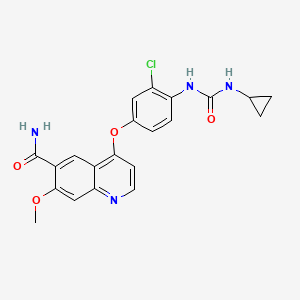
| Formula | C21H19ClN4O4 |
|---|---|
| Molecular weight | 426.86 g/mol |
| IUPAC name | 4-[3-chloro-4-(cyclopropylcarbamoylamino)phenoxy]-7-methoxyquinoline-6-carboxamide |
| CAS | 417716-92-8 |
| PubChem CID | 9823820 |
| InChIKey | WOSKHXYHFSIKNG-UHFFFAOYSA-N |
| logP | 4.07 (XLogP 2.8) |
| Polar surface area | 115.57 Ų |
| H-bond acceptors / donors | 5 / 3 |
| Drug-likeness (QED) | 0.55 |
| Lipinski violations | 0 |
SMILES
COc1cc2nccc(Oc3ccc(NC(=O)NC4CC4)c(Cl)c3)c2cc1C(N)=OBiology & Pharmacokinetics
Pharmacokinetics predicted
| Bioavailability | 10.0% |
|---|---|
| Half-life | 1.746 h |
| Volume of distribution | 0.927 L/kg |
| Protein binding | 98.8% |
| BBB penetrant | No |
Enzyme interactions
| Enzyme | Role | Detail |
|---|---|---|
| CYP1A2 | Inhibitor | — |
| CYP1A2 | Substrate | — |
| CYP2B6 | Inhibitor | — |
| CYP2C19 | Inhibitor | — |
| CYP2C8 | Inhibitor | — |
| CYP2C9 | Inhibitor | — |
| CYP2D6 | Substrate | — |
| CYP3A4 | Substrate | — |
Receptor binding (top 2)
| Target | Action | Affinity |
|---|---|---|
| kinase insert domain receptor (KDR) | Inhibitor | pIC50 8.4 |
| fms related receptor tyrosine kinase 4 (FLT4) | Inhibitor | pIC50 8.3 |
Transporters
BCRP (Inhibitor)BCRP (Inhibitor)BSEP (Inhibitor)MDR1 (Inhibitor)MRP1 (Inhibitor)OAT1 (Inhibitor)OAT3 (Inhibitor)OATP1B1 (Inhibitor)OATP1B1 (Inhibitor)OATP1B3 (Inhibitor)OATP1B3 (Inhibitor)P-gp (Inhibitor)BCRP (Substrate)MDR1 (Substrate)P-gp (Substrate)
Drug–drug interactions (100+, DDInter)
| Interacting drug | Severity | Management |
|---|---|---|
| Amiodarone | major | |
| Amisulpride | major | |
| Anagrelide | major | |
| Arsenic trioxide | major | |
| Bedaquiline | major | |
| Bepridil | major | |
| Cabozantinib | major | |
| Ceritinib | major | |
| Chloroquine | major | |
| Cisapride | major | |
| Citalopram | major | |
| Clozapine | major | |
| Crizotinib | major | |
| Disopyramide | major | |
| Dofetilide | major | |
| Dolasetron | major | |
| Dronedarone | major | |
| Droperidol | major | |
| Efavirenz | major | |
| Escitalopram | major | |
| Fingolimod | major | |
| Gatifloxacin | major | |
| Grazoprevir | major | |
| Grepafloxacin | major | |
| Halofantrine | major | |
| Haloperidol | major | |
| Hydroxychloroquine | major | |
| Ibutilide | major | |
| Iloperidone | major | |
| Ivabradine | major | |
| Ivosidenib | major | |
| Lefamulin | major | |
| Leflunomide | major | |
| Levacetylmethadol | major | |
| Lomitapide | major | |
| Lumefantrine | major | |
| Macimorelin | major | |
| Mesoridazine | major | |
| Methadone | major | |
| Mifepristone | major |
Showing 40 of 100+.
Registered Products (2)
| Brand | Form / strength | Pack | Agent | Citizen (JOD) |
|---|---|---|---|---|
| Lenvima | Capsule 4 mg | 30 cap | Nairoukh Drug Store | — |
| Lenvima | Capsule 10 mg | 30 cap | Nairoukh Drug Store | — |