Acrivastine
JFDA label: Semprex Capsules
Mechanism of Action
Antagonist of Histamine H1 receptor — Histamine H1 receptor antagonist
| Target | Action | Gene / class |
|---|---|---|
| Histamine H1 receptor efficacy | ANTAGONIST | HRH1 |
Indications
Approved
- Hypersensitivity — allergic disease
Contraindications
Source: Lexicomp
- Hypersensitivity to pseudoephedrine, acrivastine, other alkylamine antihistamines such as chlorpheniramine, or any component of the formulation Absolute
- severe hypertension, severe coronary artery disease Absolute
- use with or within 14 days of MAO inhibitors Absolute
Adverse Reactions
Nervous system disorders (3)
Common dizziness · Insomnia · nervousness
Renal and urinary disorders (1)
Common Dysmenorrhea
Gastrointestinal disorders (3)
Common dyspepsia · nausea · Xerostomia
Other (2)
Very Common Central nervous system: Headache · drowsiness
Respiratory, thoracic and mediastinal disorders (2)
Common cough · Pharyngitis
Dosing
Source: Lexicomp
Warnings & Precautions
Source: Lexicomp
CNS depression
May cause CNS depression, which may impair physical or mental abilities; patients must be cautioned about performing tasks which require mental alertness (eg, operating machinery or driving). Disease-related concerns:
Cardiovascular disease
Use with caution in patients with cardiovascular disease (including hypertension and ischemic heart disease); contraindicated with severe disease.
Diabetes
Use with caution in patients with diabetes mellitus.
Increased intraocular pressure/glaucoma
Use with caution in patients with increased intraocular pressure or glaucoma.
Prostatic hyperplasia/urinary obstruction
Use with caution in patients with prostatic hyperplasia and/or GU obstruction.
Pyloroduodenal obstruction
Use with caution in patients with pyloroduodenal obstruction (including stenotic peptic ulcer).
Renal impairment
Use with caution in patients with renal impairment; avoid use in patients with CrCl ≤48 mL/minute.
Thyroid dysfunction
Use with caution in patients with thyroid dysfunction. Concurrent drug therapy issues:
Sedatives
Effects may be potentiated when used with other sedative drugs or ethanol. Special populations:
Elderly
Use with caution in the elderly; may be more sensitive to adverse effects.
Pregnancy & Lactation
Pregnancy
Teratogenic effects were not observed in animal reproduction studies with this combination; therefore, the manufacturer classifies acrivastine/pseudoephedrine as pregnancy category B. The use of antihistamines for the treatment of rhinitis during pregnancy is generally considered to be safe at recommended doses. Information related to the use of acrivastine during pregnancy is limited; therefore, other agents are preferred. Also refer to the Pseudoephedrine monograph for additional information.
Lactation
It is not known if acrivastine is excreted into breast milk. According to the manufacturer, the decision to continue or discontinue breast-feeding during therapy with this combination product should take into account the risk of exposure to the infant and the benefits of treatment to the mother. Pseudoephedrine is excreted into breast milk; refer to the Pseudoephedrine monograph for additional information.
Chemistry & Properties
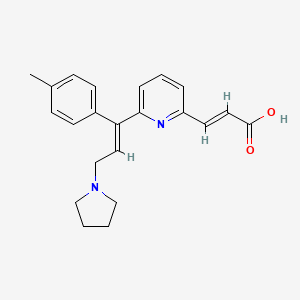
| Formula | C22H24N2O2 |
|---|---|
| Molecular weight | 348.45 g/mol |
| IUPAC name | (E)-3-[6-[(E)-1-(4-methylphenyl)-3-pyrrolidin-1-ylprop-1-enyl]-2-pyridinyl]prop-2-enoic acid |
| CAS | 87848-99-5 |
| PubChem CID | 5284514 |
| InChIKey | PWACSDKDOHSSQD-IUTFFREVSA-N |
| logP | 4.02 (XLogP 1.6) |
| Polar surface area | 53.43 Ų |
| H-bond acceptors / donors | 3 / 1 |
| Drug-likeness (QED) | 0.80 |
| Lipinski violations | 0 |
SMILES
Cc1ccc(/C(=C\CN2CCCC2)c2cccc(/C=C/C(=O)O)n2)cc1Biology & Pharmacokinetics
Pharmacokinetics
| BBB penetrant | No (logBB -1.14) |
|---|
Enzyme interactions
| Enzyme | Role | Detail |
|---|---|---|
| CYP1A2 | Substrate | — |
Transporters
BCRP (Inhibitor)BSEP (Inhibitor)MRP1 (Inhibitor)OATP1B1 (Inhibitor)OATP1B3 (Inhibitor)P-gp (Inhibitor)MDR1 (Substrate)P-gp (Substrate)
Drug–drug interactions (100+, DDInter)
| Interacting drug | Severity | Management |
|---|---|---|
| Potassium chloride | major | |
| Potassium citrate | major | |
| Sodium oxybate | major | |
| Topiramate | major | |
| Zonisamide | major | |
| Acetylcholine | moderate | |
| Aclidinium | moderate | |
| Alimemazine | moderate | |
| Amantadine | moderate | |
| Amitriptyline | moderate | |
| Amoxapine | moderate | |
| Apomorphine | moderate | |
| Apraclonidine | moderate | |
| Aripiprazole | moderate | |
| Asenapine | moderate | |
| Atropine | moderate | |
| Azatadine | moderate | |
| Belladonna | moderate | |
| Benzatropine | moderate | |
| Biperiden | moderate | |
| Botulinum Toxin Type B | moderate | |
| Botulinum toxin type A | moderate | |
| Brexanolone | moderate | |
| Brexpiprazole | moderate | |
| Brimonidine (ophthalmic) | moderate | |
| Brimonidine (topical) | moderate | |
| Brompheniramine | moderate | |
| Candida albicans | moderate | |
| Carbamoylcholine (ophthalmic) | moderate | |
| Carbinoxamine | moderate | |
| Cariprazine | moderate | |
| Chlorcyclizine | moderate | |
| Chlorpheniramine | moderate | |
| Chlorpromazine | moderate | |
| Clemastine | moderate | |
| Clidinium | moderate | |
| Clomipramine | moderate | |
| Clozapine | moderate | |
| Coccidioides immitis spherule | moderate | |
| Cyclizine | moderate |
Showing 40 of 100+.
Registered Products (1)
| Brand | Form / strength | Pack | Agent | Citizen (JOD) |
|---|---|---|---|---|
| Semprex Capsules | Capsule 8 mg | 24 cap | Suleiman Tannous & Sons Co. Ltd | 1.640 |