Bupivacaine
🧬 Cross-allergy: Amide local anesthetics
JFDA label: Bucaine 0.25% Vial
- Obstetrical anesthesia:
Mechanism of Action
Blocker of Sodium channel protein type 4 subunit alpha — Sodium channel protein type IV alpha subunit blocker
| Target | Action | Gene / class |
|---|---|---|
| Sodium channel protein type 4 subunit alpha efficacy | BLOCKER | SCN4A |
Indications
Approved
- 0.25%
- 0.5%
- 0.75% (not for obstetrical anesthesia)
Contraindications
Source: Lexicomp
- Additional contraindications (not in US labeling): Obstetric paracervical block anesthesia Absolute
- Hypersensitivity to bupivacaine hydrochloride, amide-type local anesthetics, or any component of the formulation Absolute
- obstetrical paracervical block anesthesia Note: Use as intravenous regional anesthesia (Bier block) is considered contraindicated per accepted clinical practice due to reports of cardiac arrest and death Absolute
- severe shock and in heart block where there is inflammation and/or sepsis near the proposed injection site Absolute
Adverse Reactions
Cardiac disorders (6)
Not Known Bradycardia · cardiac arrest · heart block · hypotension · palpitations · ventricular arrhythmia
Nervous system disorders (3)
Not Known Anxiety · dizziness · restlessness
Immune system disorders (2)
Not Known Anaphylactoid reaction · hypersensitivity reaction (urticaria, pruritus, angioedema)
Gastrointestinal disorders (2)
Not Known Nausea · vomiting
Musculoskeletal and connective tissue disorders (2)
Not Known Chondrolysis (continuous intra-articular administration) · weakness
Eye disorders (2)
Not Known Blurred vision · miosis
Ear and labyrinth disorders (1)
Not Known Tinnitus
Other (4)
Not Known and are often due to accelerated absorption from the injection site · Incidence of adverse reactions is difficult to define. Most effects are dose related · or slow metabolic degradation. The development of any central nervous system symptoms may be an early indication of more significant toxicity (seizure) · unintentional intravascular injection
Respiratory, thoracic and mediastinal disorders (2)
Not Known Apnea · hypoventilation (usually associated with unintentional subarachnoid injection during high spinal anesthesia)
Dosing
Source: Lexicomp
Warnings & Precautions
Source: Lexicomp
Cardiovascular effects
Bupivacaine-containing products have been associated with rare occurrences of arrhythmias, cardiac arrest, and death.
Intra-articular infusion related chondrolysis
Continuous intra-articular infusion of local anesthetics after arthroscopic or other surgical procedures is not an approved use; chondrolysis (primarily shoulder joint) has occurred following infusion, with some patients requiring arthroplasty or shoulder replacement.
Respiratory arrest
Local anesthetics have been associated with rare occurrences of sudden respiratory arrest, especially when administered near the head or neck.
Seizures
Convulsions due to systemic toxicity leading to cardiac arrest have also been reported, presumably following unintentional intravascular injection or administration near the head or neck. Disease-related concerns:
Cardiovascular disease
Use with caution in patients with cardiovascular disease including patients with hypotension or heart block.
Hepatic impairment
Use with caution in patients with hepatic impairment. Special populations:
Acutely ill patients
Use with caution in acutely ill patients; dose reduction may be required.
Debilitated patients
Use with caution in debilitated patients; dose reduction may be required.
Elderly
Use with caution in the elderly; dose reduction may be required. Dosage form specific issues:
Obstetrical anesthesia
The 0.75% concentration is not recommended for obstetrical anesthesia; cardiac arrest with difficult resuscitation or death has occurred.
Preservative-containing solutions
Do not use solutions containing preservatives for caudal or epidural block.
Sodium metabisulfite
May contain sodium metabisulfite; use caution in patients with asthma or a sulfite allergy. Other warnings/precautions:
Administration
Intravascular injections should be avoided; aspiration should be performed prior to administration; the needle must be repositioned until no return of blood can be elicited by aspiration; however, absence of blood in the syringe does not guarantee that intravascular injection has been avoided. Intravenous regional anesthesia (Bier block) is not recommended; cardiac arrest and death have occurred with this method of administration.
Test dose
A test dose is recommended prior to epidural administration (prior to initial dose) and all reinforcing doses with continuous catheter technique.
Trained personnel
Clinicians using local anesthetic agents should be well trained in diagnosis and management of emergencies that may arise from the use of these agents. Resuscitative equipment, oxygen, and other resuscitative drugs should be available for immediate use.
Pregnancy & Lactation
Pregnancy
Adverse events were observed in animal reproduction studies. Bupivacaine crosses the placenta. Bupivacaine is approved for use at term in obstetrical anesthesia or analgesia. [U.S. Boxed Warning]: The 0.75% is not recommended for obstetrical anesthesia. Bupivacaine 0.75% solutions have been associated with cardiac arrest following epidural anesthesia in obstetrical patients and use of this concentration is not recommended for this purpose. Use in obstetrical paracervical block anesthesia is contraindicated.
Lactation
Bupivacaine is excreted in breast milk. Due to the potential for serious adverse reactions in the nursing infant, a decision should be made whether to discontinue nursing or to discontinue the drug, taking into account the importance of treatment to the mother.
Monitoring
| Clinical pearl | Vital signs, state of consciousness; signs of CNS toxicity |
|---|
Chemistry & Properties
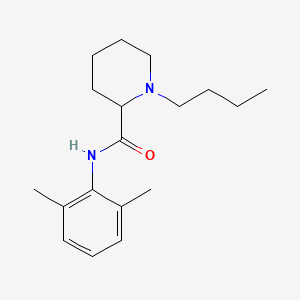
| Formula | C18H28N2O |
|---|---|
| Molecular weight | 288.44 g/mol |
| IUPAC name | 1-butyl-N-(2,6-dimethylphenyl)piperidine-2-carboxamide |
| CAS | 2180-92-9 |
| PubChem CID | 2474 |
| InChIKey | LEBVLXFERQHONN-UHFFFAOYSA-N |
| logP | 3.9 (XLogP 3.4) |
| Polar surface area | 32.34 Ų |
| H-bond acceptors / donors | 2 / 1 |
| Drug-likeness (QED) | 0.89 |
| Lipinski violations | 0 |
SMILES
CCCCN1CCCCC1C(=O)Nc1c(C)cccc1CBiology & Pharmacokinetics
Pharmacokinetics
| BBB penetrant | No |
|---|
Enzyme interactions
| Enzyme | Role | Detail |
|---|---|---|
| CYP1A2 | Substrate | — |
| CYP2B6 | Inhibitor | — |
| CYP2C19 | Substrate | — |
| CYP2D6 | Inhibitor | — |
| CYP2D6 | Substrate | — |
| CYP3A4 | Substrate | — |
Receptor binding (top 2)
| Target | Action | Affinity |
|---|---|---|
| Nav1.5 (SCN5A) | Channel blocker | pIC50 5.7 |
| Kv1.5 (KCNA5) | Channel blocker | pKd 5.4 |
Transporters
BCRP (Inhibitor)BCRP (Inhibitor)BSEP (Inhibitor)BSEP (Inhibitor)MRP1 (Inhibitor)MRP2 (Inhibitor)MRP3 (Inhibitor)MRP4 (Inhibitor)OATP1B1 (Inhibitor)OATP1B3 (Inhibitor)OATP1B3 (Inhibitor)P-gp (Inhibitor)OCT1 (Substrate)P-gp (Substrate)
Drug–drug interactions (17, DDInter)
| Interacting drug | Severity | Management |
|---|---|---|
| Aprepitant | moderate | |
| Benzocaine (topical) | moderate | |
| Cinchocaine (topical) | moderate | |
| Cocaine (nasal) | moderate | |
| Cocaine (topical) | moderate | |
| Fostamatinib | moderate | |
| Lidocaine (ophthalmic) | moderate | |
| Lidocaine (topical) | moderate | |
| Lorlatinib | moderate | |
| Morphine (liposomal) | moderate | |
| Oxybuprocaine (ophthalmic) | moderate | |
| Sirolimus | moderate | |
| Tacrolimus | moderate | |
| Temsirolimus | moderate | |
| Tetracaine (ophthalmic) | moderate | |
| Tetracaine (topical) | moderate | |
| Hyaluronidase | minor |
Registered Products (11)
| Brand | Form / strength | Pack | Agent | Citizen (JOD) |
|---|---|---|---|---|
| Betolina 2.5 mg/1ml Solution for inj | Injection 2.5 mg/1 ml | 1 vial pack varies | MS PHARMA/JORDAN | — |
| Betolina 2.5 mg/1ml Solution for inj | Injection 2.5 mg/1 ml | 5 vial pack varies | MS PHARMA/JORDAN | — |
| Betolina 5mg/1ml Solution For Inj | Injection 5 mg/1 ml | 1 vial pack varies | MS PHARMA/JORDAN | — |
| Betolina 5mg/1ml Solution For Inj | Injection 5 mg/1 ml | 5 vial pack varies | MS PHARMA/JORDAN | — |
| Betolina Spinal Heavy 20mg/4ml solution for injection | Injection 20 mg/4 ml | 5 vial | MS PHARMA/JORDAN | — |
| Bucaine | Vial 2.5 mg/ml | 1 vial | Hikma Pharmaceuticals Co.Ltd/Jordan | — |
| Bucaine 0.5% Vials(20ml) | Vial 5 mg/ml | 1 vial | Hikma Pharmaceuticals Co.Ltd/Jordan | — |
| Bucaine Heavy | Ampoule 5 mg/ml | 5 amp | HIKMA PHARMACEUTICALS - JORDAN | — |
| MARCAINE SPINAL HEAVY (hyperbaric) | Injection 5 mg/ml | 4 ml | Shawi & Rushedat Drug Store | — |
| Marcaine | Powder for Injection 0.5 % | 20 ml | Shawi & Rushedat Drug Store | — |
| Surgicaine | Injection 0.5 %, 0.0091 mg/ml | 50 Catrridges | Ajyal Al Ghad Al Jadeed Drug Store | — |