Cefotaxime
🧬 Cross-allergy: Cephalosporins
JFDA label: Taxime 500mg IV/IM Powder for injection IV/IM INJ
Mechanism of Action
Inhibits bacterial cell wall synthesis by binding to one or more of the penicillin-binding proteins (PBPs) which in turn inhibits the final transpeptidation step of peptidoglycan synthesis in bacterial cell walls, thus inhibiting cell wall biosynthesis. Bacteria eventually lyse due to ongoing activity of cell wall autolytic enzymes (autolysins and murein hydrolases) while cell wall assembly is arrested. Cefotaxime has activity in the presence of some beta-lactamases, both penicillinases and cephalosporinases, of gram-negative and gram-positive bacteria. Enterococcus species may be intrinsically resistant to cefotaxime. Most extended-spectrum beta-lactamase (ESBL)-producing and carbapenemase-producing isolates are resistant to cefotaxime.
Indications
Approved
- Bacteremia/Septicemia
- Bone or joint infections
- CNS infections
- Genitourinary infections
- Gynecologic infections
- Intra-abdominal infections
- Lower respiratory tract infections
- Skin and skin structure infections
- Surgical prophylaxis
Off-label
- Acute bacterial rhinosinusitis
- Bacterial enteric infections in HIV-infected patients (empiric treatment) (adolescents and adults)
- Bite wounds (animal)
- Community-acquired pneumonia (children)
- Disseminated gonococcal infection (DGI) (infants)
- Endocarditis, treatment (pediatric)
- Gonococcal scalp abscesses (infants)
- Gonococcal, disseminated infection (arthritis and arthritis-dermatitis syndrome)
- Lyme neuroborreliosis
- Skin and soft tissue necrotizing infections
Antimicrobial Spectrum
Expected / intrinsic spectrum (EUCAST breakpoints & labels) — not local resistance. Source: EUCAST v16 · curated · openfda-label.
Bacteria
| Organism | Activity | MIC |
|---|---|---|
| Bacteroides fragilis | Active | — |
| Chlamydia trachomatis | Active | — |
| Clostridium difficile | Active | — |
| Enterobacter cloacae | Susceptible | 1.0 mg/L |
| Enterobacterales | Susceptible | 1.0 mg/L |
| Enterococcus faecalis | Active | — |
| Escherichia coli | Susceptible | 1.0 mg/L |
| Fusobacterium nucleatum | Active | — |
| Haemophilus influenzae | Susceptible | 0.125 mg/L |
| Haemophilus influenzae | Susceptible | 0.125 mg/L |
| Haemophilus parainfluenzae | Active | — |
| Klebsiella pneumoniae | Susceptible | 1.0 mg/L |
| Moraxella catarrhalis | Susceptible | 1.0 mg/L |
| Morganella morganii | Active | — |
| Neisseria gonorrhoeae | Susceptible | 0.125 mg/L |
| Neisseria meningitidis | Susceptible | 0.125 mg/L |
| Neisseria meningitidis | Susceptible | 0.125 mg/L |
| Pasteurella multocida | Susceptible | 0.03 mg/L |
| Proteus mirabilis | Active | — |
| Proteus vulgaris | Active | — |
| Providencia rettgeri | Active | — |
| Providencia stuartii | Active | — |
| Salmonella spp. | Susceptible | 1.0 mg/L |
| Salmonella typhi | Active | — |
| Serratia marcescens | Active | — |
| Staphylococcus aureus | Active | — |
| Staphylococcus epidermidis | Active | — |
| Streptococcus pneumoniae | Susceptible | 0.5 mg/L |
| Streptococcus pneumoniae | Susceptible | 0.5 mg/L |
| Streptococcus pyogenes | Active | — |
| Vibrio spp. | Susceptible | 0.25 mg/L |
| Viridans group streptococci | Susceptible | 0.5 mg/L |
| Enterobacter cloacae | Resistant | 2.0 mg/L |
| Escherichia coli | Resistant | 2.0 mg/L |
| Klebsiella pneumoniae | Resistant | 2.0 mg/L |
| Streptococcus pneumoniae | Resistant | 2.0 mg/L |
Class profile
| gramStatus | Both |
|---|---|
| spectrumBreadth | Broad |
| atypicalCoverage | No |
| isBactericidal | 1 |
| moaCategory | Cell wall synthesis inhibitor (beta-lactam, 3rd generation cephalosporin) |
| pdIndex | Time-dependent |
| postAntibioticEffect | None |
| mrsaCoverage | 0 |
| resistanceMechanisms | ESBL production,AmpC beta-lactamase |
Contraindications
Source: Lexicomp
- Hypersensitivity to cefotaxime, any component of the formulation, or other cephalosporins Absolute
Adverse Reactions
Blood and lymphatic system disorders (1)
Common Eosinophilia
Gastrointestinal disorders (4)
Common Colitis · diarrhea · nausea · vomiting
Skin and subcutaneous tissue disorders (2)
Common Pruritus · skin rash
General disorders and administration site conditions (5)
Common Fever · Induration at injection site · inflammation at injection site · pain at injection site · tenderness at injection site
Dosing
Source: Lexicomp
Warnings & Precautions
Source: Lexicomp
Arrhythmia
A potentially life-threatening arrhythmia has been reported in patients who received a rapid (• Granulocytopenia: Granulocytopenia and more rarely agranulocytosis may develop during prolonged treatment (>10 days).
Penicillin allergy
Use with caution in patients with a history of penicillin allergy, especially IgE-mediated reactions (eg, anaphylaxis, angioedema, urticaria).
Superinfection
Prolonged use may result in fungal or bacterial superinfection, including C. difficile-associated diarrhea (CDAD) and pseudomembranous colitis; CDAD has been observed >2 months postantibiotic treatment.
Tissue inflammation
Minimize tissue inflammation by changing infusion sites when needed. Disease-related concerns:
Colitis
Use with caution in patients with a history of colitis.
Renal impairment
Use with caution in patients with renal impairment; dosage adjustment may be required. Concurrent drug therapy issues:
Drug-drug interactions
Potentially significant interactions may exist, requiring dose or frequency adjustment, additional monitoring, and/or selection of alternative therapy. Consult drug interactions database for more detailed information.
Pregnancy & Lactation
Pregnancy
Adverse events have not been observed in animal reproduction studies. Cefotaxime crosses the human placenta and can be found in fetal tissue. An increase in most types of birth defects was not found following first trimester exposure to cephalosporins. During pregnancy, peak cefotaxime serum concentrations are decreased and the serum half-life is shorter. Cefotaxime is approved for use in women undergoing cesarean section (consult current guidelines for appropriate use).
Lactation
Low concentrations of cefotaxime are found in breast milk. The manufacturer recommends that caution be exercised when administering cefotaxime to nursing women. Nondose-related effects could include modification of bowel flora. The pregnancy-related changes in cefotaxime pharmacokinetics continue into the early postpartum period.
Monitoring
| Efficacy | Culture and susceptibility testing; clinical resolution (temperature, WBC, CRP, procalcitonin) |
|---|---|
| Toxicity | Renal function (dose adjustment in renal impairment); hepatic function for hepatically cleared agents; signs of C. difficile infection (diarrhoea) |
| Clinical pearl | Culture results guide de-escalation to narrower-spectrum therapy. Review antibiotic appropriateness at 48–72 h (antimicrobial stewardship). |
| Counseling | Complete the full course. Report persistent diarrhoea, rash, or lack of improvement after 48–72 h. |
Chemistry & Properties
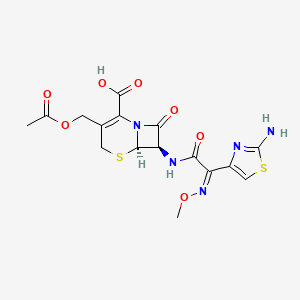
| Formula | C16H17N5O7S2 |
|---|---|
| Molecular weight | 455.47 g/mol |
| IUPAC name | (6R,7R)-3-(acetyloxymethyl)-7-[[(2Z)-2-(2-amino-1,3-thiazol-4-yl)-2-methoxyiminoacetyl]amino]-8-oxo-5-thia-1-azabicyclo[4.2.0]oct-2-ene-2-carboxylic acid |
| CAS | 63527-52-6 |
| PubChem CID | 5742673 |
| InChIKey | GPRBEKHLDVQUJE-QSWIMTSFSA-N |
| logP | -0.62 (XLogP -1.4) |
| Polar surface area | 173.51 Ų |
| H-bond acceptors / donors | 11 / 3 |
| Drug-likeness (QED) | 0.21 |
| Lipinski violations | 1 |
SMILES
CO/N=C(\C(=O)N[C@@H]1C(=O)N2C(C(=O)O)=C(COC(C)=O)CS[C@H]12)c1csc(N)n1Biology & Pharmacokinetics
Pharmacokinetics
| BBB penetrant | No |
|---|
Enzyme interactions
| Enzyme | Role | Detail |
|---|---|---|
| CYP2C8 | Inhibitor | — |
Transporters
BCRP (Inhibitor)BSEP (Inhibitor)BSEP (Inhibitor)MRP1 (Inhibitor)MRP2 (Inhibitor)MRP3 (Inhibitor)MRP4 (Inhibitor)OAT1 (Inhibitor)OAT2 (Inhibitor)OAT3 (Inhibitor)OAT4 (Inhibitor)OATP1B1 (Inhibitor)OATP1B1 (Inhibitor)OATP1B3 (Inhibitor)OATP1B3 (Inhibitor)P-gp (Inhibitor)PEPT1 (Inhibitor)PEPT2 (Inhibitor)OAT (Substrate)OAT1 (Substrate)OAT2 (Substrate)OAT3 (Substrate)OAT4 (Substrate)P-gp (Substrate)PEPT1 (Substrate)
Drug–drug interactions (14, DDInter)
| Interacting drug | Severity | Management |
|---|---|---|
| Amikacin | moderate | |
| Amikacin (liposome) | moderate | |
| Chloramphenicol | moderate | |
| Dicoumarol | moderate | |
| Ethinylestradiol | moderate | |
| Gentamicin | moderate | |
| Kanamycin | moderate | |
| Mycophenolic acid | moderate | |
| Neomycin | moderate | |
| Pemetrexed | moderate | |
| Picosulfuric acid | moderate | |
| Porfimer sodium | moderate | |
| Streptomycin | moderate | |
| Warfarin | moderate |
Registered Products (12)
| Brand | Form / strength | Pack | Agent | Citizen (JOD) |
|---|---|---|---|---|
| Cefotax 0.5 gm Vial | Vial as Sodium 0.5 g | 1 vial | AL-Faiasel Drug Store | 1.590 |
| Cefotax 1gm Vial | Vial as Sodium 1 g | 1 vial | AL-Faiasel Drug Store | 2.490 |
| Primocef | Ampoule 500 mg | 1 vial | Professional Drug Store | 2.950 |
| Taxime | Ampoule 500 mg, 1 % | 1 amp pack varies | Pharma International Company/ Jordan | 3.100 |
| Taxime 500mg IV/IM Powder for injection IV/IM INJ | Powder for Injection 500 mg, 1 % | 5 ml pack varies | Pharma International Company/ Jordan | 3.100 |
| Primocef 1gm I.M Injection | Powder for Injection 1 g | 1 vial pack varies | Professional Drug Store | 5.370 |
| Primocef 1gm I.V Inj | Powder for Injection 1 g | 1 amp pack varies | Professional Drug Store | 5.370 |
| Taxime 1gm | Ampoule 1 g, 1 % | 5 ml pack varies | Pharma International Company/ Jordan | 5.830 |
| Taxime 1gm Powder For IV Injection | Powder for Injection 1 g | 1 vial pack varies | Pharma International Company/ Jordan | 5.830 |
| Taxime1g IV/IM Powder for injection IV/IM INJ | Powder for Injection 1 g, 1 % | 5 ml pack varies | Pharma International Company/ Jordan | 5.830 |
| Taxime 500mg IV/IM Powder for injection IV/IM INJ | Powder for Injection 500 mg | 10 vial | Pharma International Company/ Jordan | 27.900 |
| Taxime1g IV/IM Powder for injection IV/IM INJ | Powder for Injection 1 g | 10 vial pack varies | Pharma International Company/ Jordan | 52.470 |