Chloramphenicol
JFDA label: Phenidexoline
- Blood dyscrasias:
Mechanism of Action
Inhibitor of Bacterial 70S ribosome — Bacterial 70S ribosome inhibitor
| Target | Action | Gene / class |
|---|---|---|
| Bacterial 70S ribosome efficacy | INHIBITOR |
Indications
Approved
- Serious infections
Antimicrobial Spectrum
Expected / intrinsic spectrum (EUCAST breakpoints & labels) — not local resistance. Source: EUCAST v16.
Bacteria
| Organism | Activity | MIC |
|---|---|---|
| Haemophilus influenzae | Susceptible | 2.0 mg/L |
| Neisseria meningitidis | Susceptible | 2.0 mg/L |
Contraindications
Source: Lexicomp
- Hypersensitivity to chloramphenicol or any component of the formulation Absolute
- bacterial prophylaxis Absolute
- treatment of trivial or viral infections Absolute
Adverse Reactions
Nervous system disorders (4)
Not Known Confusion · delirium · depression · headache
Blood and lymphatic system disorders (6)
Not Known Aplastic anemia · bone marrow depression · granulocytopenia · hypoplastic anemia · pancytopenia · thrombocytopenia
Immune system disorders (3)
Not Known Anaphylaxis · angioedema · hypersensitivity reaction
Gastrointestinal disorders (6)
Not Known Diarrhea · enterocolitis · glossitis · nausea · stomatitis · vomiting
Skin and subcutaneous tissue disorders (2)
Not Known Skin rash · urticaria
Eye disorders (1)
Not Known Optic neuritis
General disorders and administration site conditions (2)
Not Known Drug toxicity (Gray syndrome) · fever
Dosing
Source: Lexicomp
Warnings & Precautions
Source: Lexicomp
Blood dyscrasias
Serious and fatal blood dyscrasias (aplastic anemia, hypoplastic anemia, thrombocytopenia, and granulocytopenia) have occurred after both short-term and prolonged therapy; do not use for minor infections or when less potentially toxic agents are effective. Monitor CBC frequently in all patients; discontinue if evidence of myelosuppression. Irreversible bone marrow suppression may occur weeks or months after therapy. Avoid prolonged or repeated courses of treatment.
Gray syndrome
Characterized by cyanosis, abdominal distention, vasomotor collapse (often with irregular respiration), and death. Reaction appears to be associated with serum levels ≥50 mcg/mL (Powell 1982).
Superinfection
Prolonged use may result in fungal or bacterial superinfection, including C. difficile-associated diarrhea (CDAD) and pseudomembranous colitis; CDAD has been observed >2 months postantibiotic treatment. Disease-related concerns:
Hepatic impairment
Use with caution; reduced dosage and serum concentration monitoring is recommended.
Renal impairment
Use with caution; reduced dosage and serum concentration monitoring is recommended. Concurrent drug therapy issues:
Drug-drug interactions
Potentially significant interactions may exist, requiring dose or frequency adjustment, additional monitoring, and/or selection of alternative therapy. Consult drug interactions database for more detailed information. Special populations:
Glucose 6-phosphate dehydrogenase deficiency
Use with caution in patients with glucose 6-phosphate dehydrogenase deficiency.
Neonates
Use in premature and full-term neonates and infants has resulted in “gray syndrome" characterized by cyanosis, abdominal distention (with or without emesis), vasomotor collapse (often with irregular respiration), and death; progression of symptoms is rapid; prompt termination of therapy required. Reaction may result from drug accumulation caused by immature hepatic or renal function in neonates and infants.
Pregnancy & Lactation
Pregnancy
Animal reproduction studies have not been conducted. Chloramphenicol crosses the placenta producing cord concentrations approaching maternal serum concentrations. An increased risk of teratogenic effects has not been associated with the use of chloramphenicol in pregnancy (Czeizel 2000; Heinonen 1977). "Gray Syndrome" has occurred in premature infants and newborns receiving chloramphenicol. Chloramphenicol may be used as an alternative agent for the treatment of Rocky Mountain spotted fever in pregnant women although caution should be used when administration occurs during the third trimester (CDC [Biggs 2016]).
Lactation
Chloramphenicol and its inactive metabolites are present in breast milk. Chloramphenicol is well absorbed following oral administration; however, metabolism and excretion are highly variable in infants and children. The half-life is also significantly prolonged in low birth weight infants (Powell 1982). Due to the potential for serious adverse reactions in the breastfed infant, the manufacturer recommends a decision be made to discontinue breastfeeding or to discontinue the drug, taking into a
LactMed: monitor the infant.
Monitoring
| Clinical pearl | CBC with differential (baseline and every 2 days during therapy), periodic hepatic and renal function tests, serum drug concentration |
|---|
Chemistry & Properties
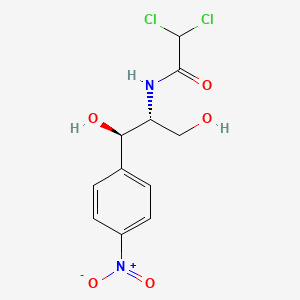
| Formula | C11H12Cl2N2O5 |
|---|---|
| Molecular weight | 323.13 g/mol |
| IUPAC name | 2,2-dichloro-N-[(1R,2R)-1,3-dihydroxy-1-(4-nitrophenyl)propan-2-yl]acetamide |
| CAS | 56-75-7 |
| PubChem CID | 5959 |
| InChIKey | WIIZWVCIJKGZOK-RKDXNWHRSA-N |
| logP | 0.91 (XLogP 1.1) |
| Polar surface area | 112.7 Ų |
| H-bond acceptors / donors | 5 / 3 |
| Drug-likeness (QED) | 0.41 |
| Lipinski violations | 0 |
SMILES
O=C(N[C@H](CO)[C@H](O)c1ccc([N+](=O)[O-])cc1)C(Cl)ClBiology & Pharmacokinetics
Pharmacokinetics predicted
| Bioavailability | 10.0% |
|---|---|
| Half-life | 1.734 h |
| Volume of distribution | 0.952 L/kg |
| Protein binding | 59.9% |
| BBB penetrant | No |
Enzyme interactions
| Enzyme | Role | Detail |
|---|---|---|
| CYP3A4 | Inhibitor | Ki 10.600000000000003 µM |
Transporters
BCRP (Inhibitor)BSEP (Inhibitor)BSEP (Inhibitor)MDR1 (Inhibitor)MRP1 (Inhibitor)MRP3 (Inhibitor)MRP4 (Inhibitor)OAT1 (Inhibitor)OATP1B1 (Inhibitor)OATP1B1 (Inhibitor)OATP1B3 (Inhibitor)OCT1 (Inhibitor)P-gp (Inhibitor)MDR1 (Substrate)P-gp (Substrate)
Drug–drug interactions (100+, DDInter)
| Interacting drug | Severity | Management |
|---|---|---|
| Avapritinib | major | |
| Benzhydrocodone | major | |
| Brigatinib | major | |
| Butorphanol | major | |
| Cisapride | major | |
| Cladribine | major | |
| Clozapine | major | |
| Deferiprone | major | |
| Encorafenib | major | |
| Entrectinib | major | |
| Everolimus | major | |
| Flibanserin | major | |
| Guanfacine | major | |
| Hydrocodone | major | |
| Ivacaftor | major | |
| Lemborexant | major | |
| Levacetylmethadol | major | |
| Lomitapide | major | |
| Lonafarnib | major | |
| Lurbinectedin | major | |
| Naloxegol | major | |
| Neratinib | major | |
| Oliceridine | major | |
| Oxycodone | major | |
| Pemigatinib | major | |
| Pexidartinib | major | |
| Pimozide | major | |
| Selpercatinib | major | |
| Selumetinib | major | |
| Siponimod | major | |
| Tazemetostat | major | |
| Typhoid vaccine (live) | major | |
| Vibrio cholerae CVD 103-HgR strain live antigen (live) | major | |
| Abemaciclib | moderate | |
| Acalabrutinib | moderate | |
| Acetohexamide | moderate | |
| Adalimumab | moderate | |
| Aflibercept | moderate | |
| Aldesleukin | moderate | |
| Alemtuzumab | moderate |
Showing 40 of 100+.
Registered Products (8)
| Brand | Form / strength | Pack | Agent | Citizen (JOD) |
|---|---|---|---|---|
| Iso Miphenicol | Solution 0.5 % | 10 ml | Petra Drug Store | 0.360 |
| Chloramphenicol E/D | Ophthalmic Solution 0.5 % | 10 ml | AL Razi Drug Store | 0.840 |
| Phenicol 0.5% Eye Drops | Ophthalmic Solution 5 mg/ml | 10 ml | Amman Pharmaceutical Indusries | 1.010 |
| Chloroptic E/D | Ophthalmic Solution 0.5 % | 10 ml | Arab Company for Medical & Agricultural Products | 1.180 |
| Phenicol eye ointment | Ointment 1 % | 5 g tube | Amman Pharmaceutical Industries Co | 1.250 |
| Otocol ear drops | Eye/Ear Drops 50 mg, 50 mg | 10 ml | Amman Pharmaceutical Indusries | 1.430 |
| Phenidex eye drops | Ophthalmic Solution 0.5 %, 0.1 % | 10 ml | Amman Pharmaceutical Indusries | 1.840 |
| Phenidexoline | Solution 0.5 %, 0.025 %, 0.1 % | 10 ml | Amman Pharmaceutical Industries Co | 2.210 |