Chlorpheniramine
Mechanism of Action
Competes with histamine for H1-receptor sites on effector cells in the gastrointestinal tract, blood vessels, and respiratory tract
Indications
Approved
- Allergic symptoms, allergic rhinitis, urticaria, pruritus
Off-label
- Motion sickness
Contraindications
Source: Lexicomp
- Hypersensitivity to chlorpheniramine maleate or any component of the formulation Absolute
- bladder neck obstruction Absolute
- during acute asthmatic attacks Absolute
- narrow-angle glaucoma Absolute
- pyloroduodenal obstruction. Avoid use in premature and term newborns due to possible association with SIDS. OTC labeling: When used for self-medication, do not use to make a child sleep Absolute
- stenosing peptic ulcer Absolute
- symptomatic prostate hypertrophy Absolute
Adverse Reactions
Nervous system disorders (6)
Very Common Drowsiness (slight to moderate)
Common Dizziness · excitability · fatigue · headache · nervousness
Renal and urinary disorders (2)
Common Polyuria · Urinary retention
Metabolism and nutrition disorders (1)
Common Weight gain
Gastrointestinal disorders (5)
Common Abdominal pain · diarrhea · increased appetite · nausea · xerostomia
Musculoskeletal and connective tissue disorders (2)
Common Arthralgia · weakness
Eye disorders (1)
Common Diplopia
Respiratory, thoracic and mediastinal disorders (2)
Very Common Thickening of bronchial secretions
Common Pharyngitis
Dosing
Source: Lexicomp
Warnings & Precautions
Source: Lexicomp
CNS depression
May cause CNS depression, which may impair physical or mental abilities; patients must be cautioned about performing tasks which require mental alertness (eg, operating machinery or driving). Disease-related concerns:
Cardiovascular disease
Use with caution in patients with cardiovascular disease (including hypertension and ischemic heart disease).
Increased intraocular pressure
Use with caution in patients with increased intraocular pressure.
Prostatic hyperplasia/urinary obstruction
Use with caution in patients with prostatic hyperplasia and/or GU obstruction.
Respiratory disease
Use with caution in patients with asthma or other chronic breathing disorders.
Thyroid dysfunction
Use with caution in patients with thyroid dysfunction. Concurrent drug therapy issues:
Sedatives
Effects may be potentiated when used with other sedative drugs or ethanol. Special populations:
Pediatric
Antihistamines may cause excitation in young children. Not for OTC use in children Dosage form specific issues:
Benzyl alcohol and derivatives
Some dosage forms may contain sodium benzoate/benzoic acid; benzoic acid (benzoate) is a metabolite of benzyl alcohol; large amounts of benzyl alcohol (≥99 mg/kg/day) have been associated with a potentially fatal toxicity (“gasping syndrome”) in neonates; the “gasping syndrome” consists of metabolic acidosis, respiratory distress, gasping respirations, CNS dysfunction (including convulsions, intracranial hemorrhage), hypotension, and cardiovascular collapse (AAP ["Inactive" 1997]; CDC, 1982); some data suggests that benzoate displaces bilirubin from protein binding sites (Ahlfors, 2001); avoid or use dosage forms containing benzyl alcohol derivative with caution in neonates. See manufacturer’s labeling.
Pregnancy & Lactation
Pregnancy
Maternal chlorpheniramine use has generally not resulted in an increased risk of birth defects (Aselton 1985; Gilboa 2009; Heinonen 1977; Jick 1981). Antihistamines may be used for the treatment of rhinitis, urticaria, and pruritus with rash in pregnant women (although second generation antihistamines may be preferred) (Angier 2010; Murase 2014; Wallace 2008; Zuberbier 2014). Antihistamines are not recommended for treatment of pruritus associated with intrahepatic cholestasis in pregnancy (Ambros-Rudolph 2011; Kremer 2011).
Lactation
Chlorpheniramine is excreted into breast milk. In general, first generation antihistamines should be used with caution in breast-feeding women and nursing infants should be monitored for irritability or drowsiness. Second generation antihistamines are preferred (Butler 2014). Antihistamines may temporarily decrease maternal serum prolactin concentrations when administered prior to the establishment of nursing (Messinis 1985).
Chemistry & Properties
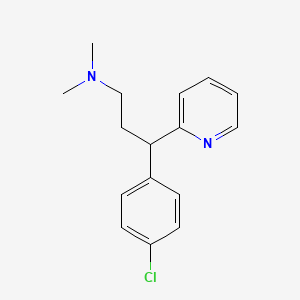
| Formula | C16H19ClN2 |
|---|---|
| Molecular weight | 274.8 g/mol |
| IUPAC name | 3-(4-chlorophenyl)-N,N-dimethyl-3-pyridin-2-ylpropan-1-amine |
| CAS | 132-22-9 |
| PubChem CID | 2725 |
| InChIKey | SOYKEARSMXGVTM-UHFFFAOYSA-N |
| logP | 3.82 (XLogP 3.4) |
| Polar surface area | 16.13 Ų |
| H-bond acceptors / donors | 2 / 0 |
| Drug-likeness (QED) | 0.82 |
| Lipinski violations | 0 |
SMILES
CN(C)CCC(c1ccc(Cl)cc1)c1ccccn1Biology & Pharmacokinetics
Pharmacokinetics
| BBB penetrant | Yes (logBB 1.53) |
|---|
Enzyme interactions
| Enzyme | Role | Detail |
|---|---|---|
| CYP2C19 | Substrate | — |
| CYP2C9 | Substrate | — |
| CYP2D6 | Substrate | — |
| CYP3A4 | Substrate | — |
Receptor binding (top 6)
| Target | Action | Affinity |
|---|---|---|
| HISTAMINE H1 (HRH1) | Binding | pKi 8.6 |
| H1 receptor (HRH1) | Antagonist | pKi 8.1 |
| 5-HT Transporter (SLC6A4) | Binding | pKi 7.8 |
| Dopamine Transporter (SLC6A3) | Binding | pKi 6.0 |
| Norepinephrine transporter | Binding | pKi 5.8 |
| HISTAMINE H4 (HRH4) | Binding | pKi 5.5 |
Transporters
BCRP (Inhibitor)BSEP (Inhibitor)BSEP (Inhibitor)MATE1 (Inhibitor)MATE2 (Inhibitor)MDR1 (Inhibitor)MRP1 (Inhibitor)MRP2 (Inhibitor)MRP3 (Inhibitor)MRP4 (Inhibitor)OATP1B1 (Inhibitor)OATP1B3 (Inhibitor)OCT2 (Inhibitor)OCTN2 (Inhibitor)P-gp (Inhibitor)MDR1 (Substrate)P-gp (Substrate)
Drug–drug interactions (100+, DDInter)
| Interacting drug | Severity | Management |
|---|---|---|
| Dextropropoxyphene | major | |
| Potassium chloride | major | |
| Potassium citrate | major | |
| Sodium oxybate | major | |
| Topiramate | major | |
| Zonisamide | major | |
| Abiraterone | moderate | |
| Acetylcholine | moderate | |
| Aclidinium | moderate | |
| Acrivastine | moderate | |
| Alfentanil | moderate | |
| Alimemazine | moderate | |
| Alprazolam | moderate | |
| Amantadine | moderate | |
| Amitriptyline | moderate | |
| Amobarbital | moderate | |
| Amoxapine | moderate | |
| Apomorphine | moderate | |
| Apraclonidine | moderate | |
| Aripiprazole | moderate | |
| Asenapine | moderate | |
| Atropine | moderate | |
| Azatadine | moderate | |
| Azelastine (nasal) | moderate | |
| Baclofen | moderate | |
| Belladonna | moderate | |
| Benzatropine | moderate | |
| Benzhydrocodone | moderate | |
| Berotralstat | moderate | |
| Biperiden | moderate | |
| Botulinum Toxin Type B | moderate | |
| Botulinum toxin type A | moderate | |
| Brexanolone | moderate | |
| Brexpiprazole | moderate | |
| Brimonidine (ophthalmic) | moderate | |
| Brimonidine (topical) | moderate | |
| Brivaracetam | moderate | |
| Bromocriptine | moderate | |
| Brompheniramine | moderate | |
| Buprenorphine | moderate |
Showing 40 of 100+.
Registered Products (11)
| Brand | Form / strength | Pack | Agent | Citizen (JOD) |
|---|---|---|---|---|
| Hatso Childrens cough | Suspension 100 mg/5 ml, 1 mg/5 ml, 15 mg/5 ml, 5 mg/5 ml | 100 ml | Pharma International Company/ Jordan | 0.800 |
| Hatso Chlidrens Cold | Suspension 100 mg/5 ml, 1 mg/5 ml, 15 mg/5 ml | 100 ml | Pharma International Company/ Jordan | 0.800 |
| SNIP TAB | Tablet 325 mg, 1 mg, 15 mg | 20 tab pack varies | Al Hilal Drug Store | 0.940 |
| Rhinostop syrup | Syrup 100 mg/5 ml, Maleate 1 mg/5 ml, 20 mg/5 ml | 100 ml | THE JORDANIAN PHARMACEUTICAL MANUFACTURING COMPANY/JORDAN | 0.970 |
| Fludrex Syrup | Syrup 120 mg, 0.75 mg/5 ml, 15 mg | 120 ml | Sun Set Drug Store | 1.050 |
| Rhinostop tablet | Tablet 250 mg, Maleate 2.5 mg, 60 mg | 20 tab pack varies | THE JORDANIAN PHARMACEUTICAL MANUFACTURING COMPANY/JORDAN | 1.250 |
| SNIP TAB | Tablet 325 mg, 1 mg, 15 mg | 30 tab pack varies | Al Hilal Drug Store | 1.410 |
| Revanin Cold & Flu Caplets | Tablet 500 mg, Maleate 2 mg, 30 mg | 20 Caplet | The Arab Pharmaceutical Manufactruing Co. | 1.520 |
| Rhinostop tablet | Tablet 250 mg, Maleate 2.5 mg, 60 mg | 30 tab pack varies | THE JORDANIAN PHARMACEUTICAL MANUFACTURING COMPANY/JORDAN | 1.880 |
| Panadol Cold & Flu | Tablet 500 mg, 2 mg, 30 mg | 24 tab | Sukhtian Group | 2.290 |
| Rhinostop tablet | Tablet 250 mg, Maleate 2.5 mg, 60 mg | 1000 tab pack varies | THE JORDANIAN PHARMACEUTICAL MANUFACTURING COMPANY/JORDAN | 53.130 |