Dopamine
JFDA label: Dopamine HCL
- Antidote for peripheral ischemia:
Mechanism of Action
Stimulates both adrenergic and dopaminergic receptors, lower doses are mainly dopaminergic stimulating and produce renal and mesenteric vasodilation, higher doses also are both dopaminergic and beta1-adrenergic stimulating and produce cardiac stimulation and renal vasodilation; large doses stimulate alpha-adrenergic receptors
Indications
Approved
- Cardiogenic shock
- Hemodynamic support
- Inotropic support in advanced heart failure
- Sepsis and septic shock
Off-label
- Heart block unresponsive to atropine or pacing
- Symptomatic bradycardia
Contraindications
Source: Lexicomp
- Hypersensitivity to sulfites (commercial preparation contains sodium bisulfite) Absolute
- pheochromocytoma Absolute
- uncorrected tachyarrhythmias Absolute
- ventricular fibrillation Absolute
Adverse Reactions
Cardiac disorders (12)
Not Known Angina pectoris · atrial fibrillation · bradycardia · ectopic beats · hypertension · hypotension · palpitations · tachycardia · vasoconstriction · ventricular arrhythmia · ventricular conduction · widened QRS complex on ECG
Nervous system disorders (2)
Not Known Anxiety · headache
Renal and urinary disorders (2)
Not Known Azotemia · Polyuria
Metabolism and nutrition disorders (1)
Not Known Increased serum glucose (usually not above normal limits)
Gastrointestinal disorders (2)
Not Known Nausea · vomiting
Skin and subcutaneous tissue disorders (2)
Not Known Gangrene (high dose) · piloerection
Eye disorders (2)
Not Known Increased intraocular pressure · mydriasis
General disorders and administration site conditions (1)
Not Known Tissue necrosis
Respiratory, thoracic and mediastinal disorders (1)
Not Known Dyspnea
Dosing
Source: Lexicomp
Warnings & Precautions
Source: Lexicomp
Arrhythmias
May cause increases in heart rate, increasing the risk of tachycardia and other tachyarrhythmias including ventricular arrhythmias (Tisdale 1995). In heart transplant candidates, institute appropriate measures to protect patient against risks of sudden cardiac death (Young 2000).
Extravasation
Vesicant; ensure proper needle or catheter placement prior to and during infusion. Avoid extravasation; infuse into a large vein if possible. Avoid infusion into leg veins. Watch IV site closely. [US Boxed Warning]: If extravasation occurs, infiltrate the area with diluted phentolamine (5 to 10 mg in 10 to 15 mL of saline) with a fine hypodermic needle. Phentolamine should be administered as soon as possible after extravasation is noted to prevent sloughing/necrosis. Disease-related concerns:
Cardiovascular disease
Use with caution in patients with cardiovascular disease, cardiac arrhythmias and/or occlusive vascular disease.
Active myocardial ischemia/post-myocardial infarction
Use with caution in patients with active myocardial ischemia or recent myocardial infarction; may increase myocardial oxygen consumption.
Electrolyte imbalance
Correct electrolyte disturbances, especially hypokalemia or hypomagnesemia, prior to use and throughout therapy to minimize the risk of arrhythmias (ACC/AHA/ESC [Zipes 2006]; Tisdale 1995).
Shock
The use of dopamine in adult patients with shock (majority of patients had septic shock) demonstrated a higher incidence of adverse events (eg, tachyarrhythmias) (De Backer 2010). Higher 28-day mortality was also seen in patients with septic shock with the use of dopamine as compared to norepinephrine (De Backer 2012; Vasu 2012). Concurrent drug therapy issues:
Monoamine oxidase inhibitors (MAO-I)
Use with extreme caution in patients taking MAO inhibitors; prolong hypertension may result from concurrent use. Dosage form specific issues:
Sodium metabisulfite
Product may contain sodium metabisulfite. Other warnings/precautions:
Appropriate use
Assure adequate circulatory volume to minimize need for vasoconstrictors when used in hemodynamic support. Avoid hypertension; monitor blood pressure closely and adjust infusion rate.
Long-term therapy
According to the ACCF/AHA 2013 heart failure guidelines, long-term use of intravenous inotropic therapy without a specific indication or for reasons other than palliation is potentially harmful (ACCF/AHA [Yancy 2013]).
Pregnancy & Lactation
Pregnancy
Adverse events have been observed in some animal reproduction studies. It is not known if dopamine crosses the placenta. Medications used for the treatment of cardiac arrest in pregnancy are the same as in the non-pregnant woman. Appropriate medications should not be withheld due to concerns of fetal teratogenicity. Dopamine use during the post-resuscitation phase may be considered; however, the effects of vasoactive medications on the fetus should also be considered. Doses and indications should follow current Advanced Cardiovascular Life Support guidelines (Jeejeebhoy [AHA] 2015).
Lactation
It is not known if dopamine is present in breast milk. The manufacturer recommends that caution be exercised when administering dopamine to breastfeeding women.
Monitoring
| Clinical pearl | Blood pressure, ECG, heart rate, CVP, RAP, MAP; serum glucose, renal function; urine output; if pulmonary artery catheter is in place, monitor CI, PCWP, SVR, and PVR Consult individual institutional policies and procedures. |
|---|
Chemistry & Properties
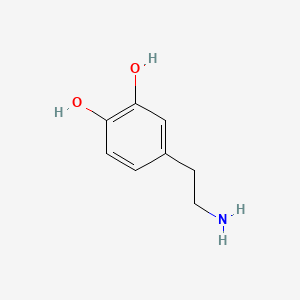
| Formula | C8H11NO2 |
|---|---|
| Molecular weight | 153.18 g/mol |
| IUPAC name | 4-(2-aminoethyl)benzene-1,2-diol |
| CAS | 51-61-6 |
| PubChem CID | 681 |
| InChIKey | VYFYYTLLBUKUHU-UHFFFAOYSA-N |
| logP | 0.6 (XLogP -1.0) |
| Polar surface area | 66.48 Ų |
| H-bond acceptors / donors | 3 / 3 |
| Drug-likeness (QED) | 0.54 |
| Lipinski violations | 0 |
SMILES
NCCc1ccc(O)c(O)c1Biology & Pharmacokinetics
Pharmacokinetics predicted
| Bioavailability | 70.0% |
|---|---|
| Half-life | 2.121 h |
| Volume of distribution | 0.755 L/kg |
| Protein binding | 4.7% |
| BBB penetrant | No |
Enzyme interactions
| Enzyme | Role | Detail |
|---|---|---|
| CYP1A2 | Substrate | — |
| CYP2C19 | Substrate | — |
| CYP2C9 | Substrate | — |
| CYP2D6 | Substrate | — |
Receptor binding (top 19)
| Target | Action | Affinity |
|---|---|---|
| DOPAMINE D4 (DRD4) | Binding | pKi 8.2 |
| D4 receptor (DRD4) | Agonist | pKi 7.6 |
| DOPAMINE D3 (DRD3) | Binding | pKi 7.5 |
| D3 | Binding | pKi 7.2 |
| DOPAMINE D4.4 | Binding | pKi 7.2 |
| DOPAMINE D5 (DRD5) | Binding | pKi 6.6 |
| DOPAMINE D2 (DRD2) | Binding | pKi 6.6 |
| D5 receptor (DRD5) | Agonist | pKi 6.6 |
| DOPAMINE D4.2 | Binding | pKi 6.6 |
| Norepinephrine transporter | Binding | pKi 6.5 |
| TA1 (TRAR1) | Binding | pKi 6.4 |
| D4 | Binding | pKi 6.2 |
| Dopamine2-like | Binding | pKi 6.1 |
| DOPAMINE D1 (DRD1) | Binding | pKi 6.0 |
| DOPAMINE D2 Long (DRD2) | Binding | pKi 5.8 |
Transporters
BCRP (Inhibitor)BCRP (Inhibitor)BSEP (Inhibitor)BSEP (Inhibitor)MRP1 (Inhibitor)OATP1B1 (Inhibitor)OATP1B1 (Inhibitor)OATP1B3 (Inhibitor)OCT1 (Inhibitor)OCT2 (Inhibitor)OCTN2 (Inhibitor)P-gp (Inhibitor)OCT1 (Substrate)OCT2 (Substrate)OCT3 (Substrate)P-gp (Substrate)
Drug–drug interactions (81, DDInter)
| Interacting drug | Severity | Management |
|---|---|---|
| Cocaine (nasal) | major | |
| Cocaine (topical) | major | |
| Doxepin | major | |
| Iobenguane (I-131) | major | |
| Methylene blue | major | |
| Ozanimod | major | |
| Procarbazine | major | |
| Acarbose | moderate | |
| Acetohexamide | moderate | |
| Albiglutide | moderate | |
| Alimemazine | moderate | |
| Alogliptin | moderate | |
| Canagliflozin | moderate | |
| Chlorpropamide | moderate | |
| Dapagliflozin | moderate | |
| Desmopressin | moderate | |
| Diatrizoate | moderate | |
| Diethylpropion | moderate | |
| Doxapram | moderate | |
| Dulaglutide | moderate | |
| Empagliflozin | moderate | |
| Ertugliflozin | moderate | |
| Exenatide | moderate | |
| Fludeoxyglucose (18F) | moderate | |
| Formoterol | moderate | |
| Glimepiride | moderate | |
| Glipizide | moderate | |
| Glyburide | moderate | |
| Indacaterol | moderate | |
| Insulin aspart (aspart protamine) | moderate | |
| Insulin aspart (aspart) | moderate | |
| Insulin degludec | moderate | |
| Insulin detemir | moderate | |
| Insulin glargine | moderate | |
| Insulin glulisine | moderate | |
| Insulin human | moderate | |
| Insulin human (inhalation, rapid acting) | moderate | |
| Insulin human (isophane) | moderate | |
| Insulin human (regular) | moderate | |
| Insulin human (zinc extended) | moderate |
Showing 40 of 81.
Registered Products (7)
| Brand | Form / strength | Pack | Agent | Citizen (JOD) |
|---|---|---|---|---|
| Domine 40 mg / ml Amp | Ampoule 40 mg/ml | 5 amp | Hikma Pharmaceuticals Co.Ltd/Jordan | — |
| Dopamine Fresenius | Ampoule 200 mg/5 ml | 1 amp pack varies | Sun Set Drug Store | — |
| Dopamine Fresenius | Suspension 200 mg/5 ml | 5 ml pack varies | Sun Set Drug Store | — |
| Dopamine HCL | Ampoule 50 mg/5 ml | 5 amp pack varies | Al Hilal Drug Store | — |
| Dopamine HCL | Ampoule 50 mg/5 ml | 30 amp pack varies | Al Hilal Drug Store | — |
| Dopamine HCL | Ampoule 50 mg/5 ml | 10 amp pack varies | Al Hilal Drug Store | — |
| Dopamine HCL | Ampoule 50 mg/5 ml | 50 amp pack varies | Al Hilal Drug Store | — |