Epirubicin
JFDA label: Epirubicin Sol for Inf
- Experienced physician:
- Extravasation:
- Myocardial toxicity:
- Secondary malignancy:
- Hepatic impairment:
- Bone marrow suppression:
Mechanism of Action
Epirubicin is an anthracycline antineoplastic agent; known to inhibit DNA and RNA synthesis by steric obstruction after intercalating between DNA base pairs; active throughout entire cell cycle. Intercalation triggers DNA cleavage by topoisomerase II, resulting in cytocidal activity. Also inhibits DNA helicase, and generates cytotoxic free radicals.
Indications
Approved
- Breast cancer, adjuvant treatment
Off-label
- Esophageal cancer
- Gastric cancer
- Osteosarcoma
- Soft tissue sarcoma
Contraindications
Source: Lexicomp
- Additional contraindications (not in the US labeling): Marked persistent myelosuppression induced by prior treatment with other chemotherapy agents or by radiotherapy Absolute
- Hypersensitivity to epirubicin, other anthracyclines, anthracenediones, or any component of the formulation Absolute
- cardiomyopathy and/or heart failure, recent myocardial infarction, severe arrhythmias Absolute
- previous treatment with anthracyclines up to the maximum cumulative dose Absolute
- severe hepatic impairment Absolute
Adverse Reactions
Cardiac disorders (16)
Not Known atrioventricular block · bradycardia · bundle branch block · cardiac arrhythmia · cardiac failure · cardiomyopathy · Decreased left ventricular ejection fraction · ECG abnormality · myocarditis · non-specific T wave on ECG · sinus tachycardia · ST segment changes on ECG · tachyarrhythmia · thromboembolism · ventricular premature contractions · ventricular tachycardia
Nervous system disorders (1)
Not Known Lethargy
Hepatobiliary disorders (3)
Not Known Ascites · hepatomegaly · increased serum transaminases
Renal and urinary disorders (1)
Not Known Menopause (premature or early)
Blood and lymphatic system disorders (8)
Not Known acute lymphocytic leukemia · acute myelocytic leukemia · anemia · febrile neutropenia · leukopenia · myelodysplastic syndrome · Neutropenia · thrombocytopenia
Immune system disorders (1)
Not Known Hypersensitivity reaction
Metabolism and nutrition disorders (2)
Not Known Amenorrhea · hot flash
Gastrointestinal disorders (9)
Not Known abdominal pain · anorexia · diarrhea · esophagitis · mucositis · Nausea and vomiting · neutropenic enterocolitis · stomatitis · toxic megacolon
Skin and subcutaneous tissue disorders (3)
Not Known Alopecia · skin changes · skin rash
Infections and infestations (1)
Not Known Infection
General disorders and administration site conditions (2)
Not Known Fever · Injection site reaction
Respiratory, thoracic and mediastinal disorders (2)
Not Known Dyspnea · pulmonary edema
Dosing
Source: Lexicomp
Warnings & Precautions
Source: Lexicomp
Bone marrow suppression
May cause severe myelosuppression, including leukopenia, thrombocytopenia, and anemia. Myelosuppression is the dose-limiting toxicity. Obtain baseline and periodic blood counts. Patients should recover from myelosuppression due to prior chemotherapy treatment before beginning treatments. Severe neutropenia and severe infections may require supportive care.
Extravasation
For IV administration only. Vesicant; if extravasation occurs, severe local tissue damage and necrosis may occur. Not for IM or SubQ use. Injection into a small vein or repeated administration in the same vein may result in venous sclerosis. Ensure proper needle or catheter placement prior to and during infusion. Avoid extravasation. If perivenous infiltration occurs, immediately discontinue infusion and restart in another vein.
Gastrointestinal toxicity
Epirubicin is associated with a moderate to high emetic potential (depending on regimen); antiemetics are recommended to prevent nausea and vomiting (Dupuis 2011; Hesketh 2017; Roila 2016).
Myocardial toxicity
Myocardial toxicity, including fatal heart failure (HF) may occur, particularly in patients who have received prior anthracyclines (or anthracenediones), prior or concomitant radiotherapy to the mediastinal/pericardial area, who have preexisting cardiac disease (active or dormant), or with concomitant cardiotoxic medications. Cardiotoxicity may be concurrent or delayed (months to years after treatment). The risk of HF is ~0.9% at a cumulative dose of 550 mg/m2, ~1.6% at a cumulative dose of 700 mg/m2, and ~3.3% at a cumulative dose of 900 mg/m2. Cardiotoxicity may also occur at lower cumulative doses or without risk factors. The risk of delayed cardiotoxicity increases more steeply with cumulative doses >900 mg/m2, and this dose should be exceeded only with extreme caution. The maximum cumulative dose used in adjuvant studies was 720 mg/m2. Cardiotoxicity is dose-limiting. Early toxicity may consist of tachyarrhythmias, including sinus tachycardia, premature ventricular contractions, and ventricular tachycardia, as well as bradycardia. Electrocardiographic changes including ST-T wave changes, atrioventricular and bundle-branch block have also been reported. These effects are not necessarily predictive of subsequent delayed cardiotoxicity. Delayed toxicity is typically caused by cardiomyopathy which presents as decreased left ventricular ejection fraction (LVEF) and/or signs/symptoms of HF (eg, tachycardia, dyspnea, pulmonary edema, edema, hepatomegaly, ascites, pleural effusi
Secondary malignancy
Treatment with anthracyclines (including epirubicin) may increase the risk of secondary acute myeloid leukemia (AML). AML is more common when given in combination with other antineoplastic agents, in patients who have received multiple courses of previous chemotherapy, or with escalated anthracycline doses. In breast cancer patients, the risk for treatment-related AML or myelodysplastic syndrome (MDS) was estimated at 0.27% at 3 years, 0.46% at 5 years, and 0.55% at 8 years after treatment. The latency period for secondary leukemias may be short (1 to 3 years).
Thromboembolic events
Thrombophlebitis and thromboembolic phenomena (including pulmonary embolism) have occurred.
Tumor lysis syndrome
May cause tumor lysis syndrome (TLS). Although TLS does not generally occur in patients with breast cancer, if TLS risk is suspected, consider monitoring serum uric acid, potassium, calcium, phosphate and serum creatinine after initial administration; hydration and antihyperuricemic prophylaxis may minimize potential TLS complications. Disease-related concerns:
Hepatic impairment
Dosage reduction is recommended in patients with mild-to-moderate hepatic impairment; use is not recommended in severe hepatic impairment. Evaluate hepatic function at baseline and during treatment. Epirubicin is predominantly hepatically eliminated; impaired hepatic function may lead to increased exposure and toxicity.
Renal impairment
Dosage reduction is recommended in patients with serum creatinine >5 mg/dL. Evaluate renal function at baseline and during treatment. Has not been studied in patients on dialysis. Concurrent drug therapy issues:
Drug-drug interactions
Potentially significant interactions may exist, requiring dose or frequency adjustment, additional monitoring, and/or selection of alternative therapy. Consult drug interactions database for more detailed information. Special populations:
Elderly
Women ≥70 years of age should be closely monitored for toxicity.
Pediatric
Children may be at increased risk for developing acute and delayed cardiotoxicity; long-term periodic cardiac function monitoring is recommended.
Radiation recipients
Epirubicin may have radiosensitizing activity; radiation recall (inflammatory) has also been reported. Other warnings/precautions:
Appropriate use
Patients should recover from acute toxicities (stomatitis, myelosuppression, infections) prior to initiating treatment. Assess baseline labs (blood counts, bilirubin, ALT, AST, serum creatinine) and cardiac function (with LVEF). Prophylactic antibiotics should be administered with the CDF-120 regimen.
Experienced physician
Should be administered under the supervision of an experienced cancer chemotherapy physician.
Immunizations
Patients should not be immunized with live viral vaccines during or shortly after treatment. Inactivated vaccines may be administered (response may be diminished).
Pregnancy & Lactation
Pregnancy
Adverse events were observed in animal reproduction studies. Women of childbearing potential should be advised to use effective contraception and avoid becoming pregnant during treatment. Men undergoing treatment should use effective contraception. Epirubicin may cause irreversible amenorrhea in premenopausal women. Limited information is available from a retrospective study of women who received epirubicin (in combination with cyclophosphamide or weekly as a single-agent) during the second or third (prior to week 35) trimester for the treatment of pregnancy-associated breast cancer (Ring 2005) and from a study of women who received epirubicin (weekly as a single-agent) at gestational weeks 16 through 30 for the treatment of pregnancy-associated breast cancer (Peccatori 2009). Some pharmacokinetic properties of epirubicin may be altered in pregnant women (van Hasselt 2014). The European Society for Medical Oncology (ESMO) has published guidelines for diagnosis, treatment, and follow-
Lactation
It is not known if epirubicin is present in human breast milk; however, other anthracyclines are present in breast milk. Due to the potential for serious adverse reactions in the breastfed infant, the manufacturer recommends a decision be made to discontinue breastfeeding or to discontinue the drug, taking into account the importance of treatment to the mother.
Monitoring
| Clinical pearl | Baseline and repeated measurements of CBC with differential, liver function tests, serum creatinine, electrolytes, ECG, and LVEF. The method used for assessment of LVEF (echocardiogram or MUGA) should be consistent during routine monitoring. Monitor injection site during infusion for possible extravasation or local reactions. |
|---|
Chemistry & Properties
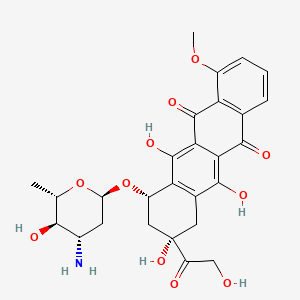
| Formula | C27H29NO11 |
|---|---|
| Molecular weight | 543.53 g/mol |
| IUPAC name | (7S,9S)-7-[(2R,4S,5R,6S)-4-amino-5-hydroxy-6-methyloxan-2-yl]oxy-6,9,11-trihydroxy-9-(2-hydroxyacetyl)-4-methoxy-8,10-dihydro-7H-tetracene-5,12-dione |
| CAS | 56420-45-2 |
| PubChem CID | 41867 |
| InChIKey | AOJJSUZBOXZQNB-VTZDEGQISA-N |
| logP | 0.0 (XLogP 1.3) |
| Polar surface area | 206.07 Ų |
| H-bond acceptors / donors | 12 / 6 |
| Drug-likeness (QED) | 0.24 |
| Lipinski violations | 3 |
SMILES
COc1cccc2c1C(=O)c1c(O)c3c(c(O)c1C2=O)C[C@@](O)(C(=O)CO)C[C@@H]3O[C@H]1C[C@H](N)[C@@H](O)[C@H](C)O1Biology & Pharmacokinetics
Pharmacokinetics
| BBB penetrant | No |
|---|
Enzyme interactions
| Enzyme | Role | Detail |
|---|---|---|
| CYP2B6 | Inhibitor | — |
Transporters
BCRP (Inhibitor)BSEP (Inhibitor)BSEP (Inhibitor)MRP1 (Inhibitor)MRP3 (Inhibitor)MRP4 (Inhibitor)OATP1B1 (Inhibitor)OATP1B3 (Inhibitor)P-gp (Inhibitor)BCRP (Substrate)MDR1 (Substrate)MRP1 (Substrate)P-gp (Substrate)
Drug–drug interactions (100+, DDInter)
| Interacting drug | Severity | Management |
|---|---|---|
| Adalimumab | major | |
| Amiodarone | major | |
| Amisulpride | major | |
| Anagrelide | major | |
| Arsenic trioxide | major | |
| Bacillus calmette-guerin substrain tice live antigen | major | |
| Baricitinib | major | |
| Bedaquiline | major | |
| Bepridil | major | |
| Cabozantinib | major | |
| Ceritinib | major | |
| Certolizumab pegol | major | |
| Chloroquine | major | |
| Cimetidine | major | |
| Cisapride | major | |
| Citalopram | major | |
| Cladribine | major | |
| Clozapine | major | |
| Crizotinib | major | |
| Deferiprone | major | |
| Disopyramide | major | |
| Dofetilide | major | |
| Dolasetron | major | |
| Dronedarone | major | |
| Droperidol | major | |
| Efavirenz | major | |
| Escitalopram | major | |
| Etanercept | major | |
| Fingolimod | major | |
| Gatifloxacin | major | |
| Golimumab | major | |
| Grepafloxacin | major | |
| Halofantrine | major | |
| Haloperidol | major | |
| Hydroxychloroquine | major | |
| Ibutilide | major | |
| Iloperidone | major | |
| Infliximab | major | |
| Ivabradine | major | |
| Ivosidenib | major |
Showing 40 of 100+.
Registered Products (12)
| Brand | Form / strength | Pack | Agent | Citizen (JOD) |
|---|---|---|---|---|
| Anthracin | Injection 10 mg/ml | 5 ml | Sun Set Drug Store | — |
| Ciazil | Vial 2 mg/ml | 1 vial pack varies | Orient Montreal Drug Store | — |
| Ciazil | Vial 2 mg/ml | 1 vial pack varies | Orient Montreal Drug Store | — |
| EPIRUBICIN EBEWE | Suspension 10 mg/5 ml | 1 vial | Sabbagh Drug Store | — |
| EPIRUBICIN EBEWE VIALS | Vial 50 mg/25 ml | 1 vial | Sabbagh Drug Store | — |
| Epirubicin Sol for Inf | Solution 2 mg/ml | 1 vial pack varies | Sabbagh Drug Store | — |
| Epirubicin Sol for Inf | Solution 2 mg/ml | 1 vial pack varies | Sabbagh Drug Store | — |
| Epirubicin Thymoorgan | Vial 10 mg/5 ml | 1 vial | Hikma Pharmaceuticals Co.Ltd/Jordan | — |
| Epirubicin Thymoorgan | Vial 50 mg/25 ml | 1 vial | Hikma Pharmaceuticals Co.Ltd/Jordan | — |
| Epirubicin Thymoorgan | Tablet 200 mg/100 ml | 1 tab | Hikma Pharmaceuticals Co.Ltd/Jordan | — |
| FARMORUBICIN Rapid Dissolution | Vial 50 mg | 1 vial | Petra Drug Store | — |
| FARMORUBICIN Rapid Dissolution | Ampoule 10 mg/5 ml | 1 vial | Petra Drug Store | — |