Eribulin
JFDA label: Halaven 1mg/2ml
Mechanism of Action
Eribulin is a non-taxane microtubule inhibitor which is a halichondrin B analog. It inhibits the growth phase of the microtubule by inhibiting formation of mitotic spindles causing mitotic blockage and arresting the cell cycle at the G2/M phase; suppresses microtubule polymerization yet does not affect depolymerization.
Indications
Approved
- Breast cancer, metastatic
- Liposarcoma, unresectable or metastatic
Contraindications
Source: Lexicomp
- There are no contraindications listed in the manufacturer’s labeling. Canadian labeling (not in the US labeling): Hypersensitivity to eribulin mesylate, halichondrin B, or its chemical derivatives Absolute
Adverse Reactions
Cardiac disorders (2)
Very Common Peripheral edema
Common Hypotension (≥5% to Central nervous system: Anxiety (≥5% to Dermatologic: Skin rash (≥5% to Endocrine & metabolic: Hyperglycemia (≥5% to Gastrointestinal: Dysgeusia (≥5% to Hematologic & oncologic: Th
Nervous system disorders (3)
Very Common Fatigue · headache · peripheral neuropathy
Hepatobiliary disorders (2)
Very Common Increased serum ALT · increased serum AST
Renal and urinary disorders (1)
Very Common Urinary tract infection
Blood and lymphatic system disorders (2)
Very Common anemia · Neutropenia
Metabolism and nutrition disorders (4)
Very Common hypocalcemia · Hypokalemia · hypophosphatemia · weight loss
Gastrointestinal disorders (8)
Very Common abdominal pain · anorexia · constipation · decreased appetite · diarrhea · Nausea · stomatitis · vomiting
Skin and subcutaneous tissue disorders (1)
Very Common Alopecia
Musculoskeletal and connective tissue disorders (6)
Very Common arthralgia · back pain · limb pain · myalgia · ostealgia · Weakness
General disorders and administration site conditions (1)
Very Common Fever
Respiratory, thoracic and mediastinal disorders (2)
Very Common Cough · dyspnea
Dosing
Source: Lexicomp
Warnings & Precautions
Source: Lexicomp
Bone marrow suppression
Hematologic toxicity, including severe neutropenia and neutropenic fever, has occurred. Neutropenic sepsis (fatal) has also been reported (case reports). May require treatment delay and dosage reduction. A higher incidence of grade 4 neutropenia and neutropenic fever occurred in patients with ALT or AST >3 x ULN or bilirubin >1.5 x ULN. Monitor complete blood counts prior to each dose; more frequently if severe cytopenias develop. Patients with baseline neutrophils 3 were not included in clinical studies.
Peripheral neuropathy
Peripheral neuropathy commonly occurs. Peripheral neuropathy may be prolonged (>1 year in 5% of metastatic breast cancer patients and >60 days in close to 60% of liposarcoma patients); over 60% of liposarcoma patients with peripheral neuropathy had not recovered within a median follow-up of ~6 months in one clinical trial. The median time to the first occurrence of peripheral neuropathy (any severity) in liposarcoma patients was 5 months (range: 3.5 to 9 months). Monitor for signs of peripheral motor or sensory neuropathy. May require treatment delay or discontinuation. Some patients may have preexisting neuropathy due to prior chemotherapy; monitor closely for worsening neuropathy.
QT prolongation
QT prolongation was observed on day 8 of eribulin therapy (in an uncontrolled study). Monitor ECG in patients with heart failure, bradyarrhythmia, with concomitant medication known to prolong the QT interval, or with electrolyte imbalance. Correct hypokalemia and hypomagnesemia prior to treatment; monitor electrolytes periodically during treatment. Avoid use in patients with congenital long QT syndrome. Disease-related concerns:
Hepatic impairment
Dosage reduction required in patients with mild to moderate (Child-Pugh class A or B) hepatic impairment; use has not been studied in patients with severe hepatic impairment. Transaminase or bilirubin elevations are associated with a higher incidence of grade 4 neutropenia and neutropenic fever.
Renal impairment
Dosage reduction required in patients with moderate or severe renal impairment (CrCl 15 to 49 mL/minute). Concurrent drug therapy issues:
Drug-drug interactions
Potentially significant interactions may exist, requiring dose or frequency adjustment, additional monitoring, and/or selection of alternative therapy. Consult drug interactions database for more detailed information. Other warnings/precautions:
International issues
Some products available internationally may have vial strength and dosing expressed as the base (instead of as the salt). Refer to prescribing information for specific dosing information.
Pregnancy & Lactation
Pregnancy
Adverse effects were observed in animal reproduction studies. Based on its mechanism of action, eribulin would be expected to cause fetal harm if administered during pregnancy. Women of reproductive potential should use effective contraception to avoid pregnancy during eribulin treatment and for at least 2 weeks following the last eribulin dose; males with female partners of reproductive potential should use effective contraception during eribulin treatment and for 3.5 months following the last dose. The Canadian labeling recommends effective contraception during and for at least 3 months after treatment in women of reproductive potential.
Lactation
It is not known if eribulin is excreted in breast milk. Due to the potential for serious adverse reactions in the nursing infant, breastfeeding is not recommended by the manufacturer during eribulin treatment and for 2 weeks after the last dose.
Monitoring
| Clinical pearl | CBC with differential prior to each dose (increase frequency with grades 3/4 cytopenias); renal and liver function tests; serum electrolytes, including potassium and magnesium. Assess for peripheral neuropathy prior to each dose. Monitor ECG in patients with heart failure, bradyarrhythmia, with concomitant medication known to prolong the QT interval, and electrolyte abnormalities (eg, hypokalemia, hypomagnesemia). |
|---|
Chemistry & Properties
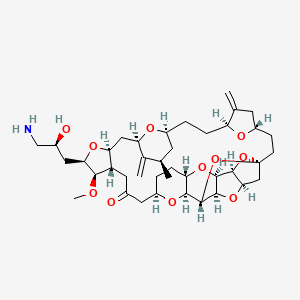
| Formula | C40H59NO11 |
|---|---|
| Molecular weight | 729.91 g/mol |
| IUPAC name | (1S,3S,6S,9S,12S,14R,16R,18S,20R,21R,22S,26R,29S,31R,32S,33R,35R,36S)-20-[(2S)-3-amino-2-hydroxypropyl]-21-methoxy-14-methyl-8,15-dimethylidene-2,19,30,34,37,39,40,41-octaoxanonacyclo[24.9.2.13,32.13,33.16,9.112,16.018,22.029,36.031,35]hentetracontan-24-one |
| CAS | 253128-41-5 |
| PubChem CID | 11354606 |
| InChIKey | UFNVPOGXISZXJD-JBQZKEIOSA-N |
| logP | 3.44 (XLogP 1.1) |
| Polar surface area | 146.39 Ų |
| H-bond acceptors / donors | 12 / 2 |
| Drug-likeness (QED) | 0.41 |
| Lipinski violations | 2 |
SMILES
C=C1C[C@@H]2CC[C@@]34C[C@H]5O[C@H]6[C@@H](O3)[C@H]3O[C@H](CC[C@@H]3O[C@H]6[C@H]5O4)CC(=O)C[C@@H]3[C@@H](OC)[C@@H](C[C@H](O)CN)O[C@H]3C[C@H]3O[C@@H](CC[C@@H]1O2)C[C@@H](C)C3=CBiology & Pharmacokinetics
Pharmacokinetics predicted
| Bioavailability | 70.0% |
|---|---|
| Half-life | 2.812 h |
| Volume of distribution | 1.647 L/kg |
| Protein binding | 54.0% |
| BBB penetrant | No |
Enzyme interactions
| Enzyme | Role | Detail |
|---|---|---|
| CYP2C19 | Substrate | — |
Receptor binding (top 1)
| Target | Action | Affinity |
|---|---|---|
| tubulin beta class I (TUBB) | Inhibitor | pIC50 8.2 |
Transporters
BCRP (Inhibitor)BCRP (Inhibitor)BSEP (Inhibitor)BSEP (Inhibitor)MATE1 (Inhibitor)MDR1 (Inhibitor)MRP1 (Inhibitor)MRP2 (Inhibitor)MRP4 (Inhibitor)OAT1 (Inhibitor)OAT3 (Inhibitor)OATP1B1 (Inhibitor)OATP1B1 (Inhibitor)OATP1B3 (Inhibitor)OATP1B3 (Inhibitor)OCT1 (Inhibitor)OCT2 (Inhibitor)P-gp (Inhibitor)BCRP (Substrate)BSEP (Substrate)MATE1 (Substrate)MDR1 (Substrate)MRP2 (Substrate)OAT1 (Substrate)OAT3 (Substrate)OATP (Substrate)OATP1B1 (Substrate)OATP1B3 (Substrate)OCT1 (Substrate)OCT2 (Substrate)P-gp (Substrate)
Drug–drug interactions (100+, DDInter)
| Interacting drug | Severity | Management |
|---|---|---|
| Adalimumab | major | |
| Amiodarone | major | |
| Amisulpride | major | |
| Anagrelide | major | |
| Arsenic trioxide | major | |
| Bacillus calmette-guerin substrain tice live antigen | major | |
| Baricitinib | major | |
| Bedaquiline | major | |
| Bepridil | major | |
| Cabozantinib | major | |
| Ceritinib | major | |
| Certolizumab pegol | major | |
| Chloroquine | major | |
| Cisapride | major | |
| Citalopram | major | |
| Cladribine | major | |
| Clozapine | major | |
| Crizotinib | major | |
| Deferiprone | major | |
| Disopyramide | major | |
| Dofetilide | major | |
| Dolasetron | major | |
| Dronedarone | major | |
| Droperidol | major | |
| Efavirenz | major | |
| Escitalopram | major | |
| Etanercept | major | |
| Fingolimod | major | |
| Gatifloxacin | major | |
| Golimumab | major | |
| Grepafloxacin | major | |
| Halofantrine | major | |
| Haloperidol | major | |
| Hydroxychloroquine | major | |
| Ibutilide | major | |
| Iloperidone | major | |
| Infliximab | major | |
| Ivabradine | major | |
| Ivosidenib | major | |
| Lefamulin | major |
Showing 40 of 100+.
Registered Products (1)
| Brand | Form / strength | Pack | Agent | Citizen (JOD) |
|---|---|---|---|---|
| Halaven | Vial 0.44 mg/ml | 1 vial | Nairoukh Drug Store | — |