Hydroxyzine
JFDA label: Atarax Syrup
Mechanism of Action
Competes with histamine for H1-receptor sites on effector cells in the gastrointestinal tract, blood vessels, and respiratory tract (Simons 1994). Possesses skeletal muscle relaxing, bronchodilator, antihistamine, antiemetic, and analgesic properties.
Indications
Approved
- Allergic conditions
- Antiemetic
- Anxiety
- Intramuscular
- Oral
- Perioperative adjunct
- Peripartum adjunct
- Pruritus
Contraindications
Source: Lexicomp
- Additional contraindications (not in US labeling): Oral: Hypersensitivity to other piperazine derivatives, aminophylline or ethylenediamine Absolute
- Hypersensitivity to hydroxyzine or any component of the formulation Absolute
- asthmatics who have previously experienced a serious anti-histamine induced adverse bronchopulmonary effect Absolute
- concomitant use with other QT interval prolonging drugs or with CYP3A4/5 inhibitors Absolute
- early pregnancy Absolute
- family history of sudden cardiac death Absolute
- history of history of cardiac arrhythmias Absolute
- prolonged QT interval Additional contraindications: Oral: Hypersensitivity to cetirizine or levocetirizine Injection: SubQ, intra-arterial, or IV administration Absolute
- significant bradycardia Absolute
- significant electrolyte imbalance (eg, hypokalemia, hypomagnesemia) Absolute
Adverse Reactions
Nervous system disorders (1)
Not Known Drowsiness (transient)
Gastrointestinal disorders (1)
Not Known Xerostomia
Respiratory, thoracic and mediastinal disorders (1)
Not Known Respiratory depression (high doses)
Dosing
Source: Lexicomp
Warnings & Precautions
Source: Lexicomp
Acute generalized exanthematous pustulosis
May rarely cause acute generalized exanthematous pustulosis (AGEP), a serious skin reaction involving fever, pustules and large areas of edematous erythema. Discontinue at first sign of skin rash, worsening of pre-existing skin reactions or any other sign of hypersensitivity; if signs or symptoms suggest AGEP, do not resume therapy.
CNS depression
May cause CNS depression, which may impair physical or mental abilities; patients must be cautioned about performing tasks that require mental alertness (eg, operating machinery, driving).
QT prolongation/torsades de pointes
Has been reported, with the majority occurring in patients with other risk factors for QT prolongation/torsades de pointes (eg, preexisting cardiac disease, electrolyte imbalances, concomitant arrhythmogenic use). Use with caution in patients with risk factors for QT prolongation, congenital long QT syndrome, a family history of long QT syndrome, other conditions that predispose to QT prolongation and ventricular arrhythmia, as well as recent myocardial infarction, uncompensated heart failure, and bradyarrhythmias. Oral hydroxyzine is contraindicated in patients with a prolonged QT interval. Disease-related concerns:
Glaucoma
Use with caution in patients with narrow-angle glaucoma; condition may be exacerbated by cholinergic blockade. Screening is recommended.
Prostatic hyperplasia/urinary stricture
Use with caution in patients with prostatic hyperplasia and/or urinary stricture.
Respiratory disease
Use with caution in patients with asthma or chronic obstructive pulmonary disease (COPD). Concurrent drug therapy issues:
Drug-drug interactions
Potentially significant interactions may exist, requiring dose or frequency adjustment, additional monitoring, and/or selection of alternative therapy. Consult drug interactions database for more detailed information. Special populations: Elderly: May cause over sedation in the elderly; initiate elderly patients on low does and monitor closely. Dosage form specific issues:
Benzyl alcohol and derivatives
Some dosage forms may contain benzyl alcohol and/or sodium benzoate/benzoic acid; benzoic acid (benzoate) is a metabolite of benzyl alcohol; large amounts of benzyl alcohol (≥99 mg/kg/day) have been associated with a potentially fatal toxicity ("gasping syndrome") in neonates; the "gasping syndrome" consists of metabolic acidosis, respiratory distress, gasping respirations, CNS dysfunction (including convulsions, intracranial hemorrhage), hypotension and cardiovascular collapse (AAP ["Inactive" 1997]; CDC 1982); some data suggest that benzoate displaces bilirubin from protein binding sites (Ahlfors 2001); avoid or use dosage forms containing benzyl alcohol and/or benzyl alcohol derivative with caution in neonates. See manufacturer's labeling.
Propylene glycol
Some dosage forms may contain propylene glycol; large amounts are potentially toxic and have been associated with hyperosmolality, lactic acidosis, seizures, and respiratory depression; use caution (AAP 1997; Zar 2007). See manufacturer's labeling. Other warnings/precautions:
Appropriate administration
Parenteral: For IM use only. Severe injection-site reactions have been reported with IM administration (eg, extensive tissue damage, necrosis, gangrene) requiring surgical intervention (including debridement, skin grafting, and amputation). SubQ, IV, and intra-arterial routes of administration are contraindicated. Intravascular hemolysis, thrombosis, and digital gangrene have been reported with IV or intra-arterial administration (Baumgartner 1979); SubQ administration may result in significant tissue damage. If inadvertent IV administration results in extravasation, stop infusion immediately and disconnect (leave cannula/needle in place); gently aspirate extravasated solution (do NOT flush the line); remove needle/cannula; elevate extremity.
Long-term use
The effectiveness of hydroxyzine for long-term use (>4 months) has not been assessed; periodically reassess use.
Pregnancy & Lactation
Pregnancy
Use of hydroxyzine early in pregnancy is contraindicated. Adverse events were observed in animal reproduction studies. Hydroxyzine crosses the placenta. Possible withdrawal symptoms have been observed in neonates following chronic maternal use of hydroxyzine during pregnancy (Prenner 1977; Serreau 2005). Hydroxyzine is approved for pre- and postpartum adjunctive therapy to reduce opioid dosage, treat anxiety, and control emesis. Hydroxyzine may be used as an antipruritic if systemic therapy is needed in pregnant women (use caution late in pregnancy) (Murase 2014); although other agents may be preferred (Powell 2015; Zuberbier 2014). Antihistamines are not recommended for treatment of pruritus associated with intrahepatic cholestasis in pregnancy (Ambros-Rudolph 2011; Kremer 2014).
Lactation
It is not known if hydroxyzine is present in breast milk. Sedation has been reported in breastfed infants exposed to hydroxyzine (Soussan 2014). Breastfeeding is not recommended by the manufacturer. In general, if a breastfed infant is exposed to a first generation antihistamine via breast milk, they should be monitored for irritability or drowsiness. When treatment with an antihistamine is needed in breastfeeding women, second generation antihistamines are preferred (Butler 2014; Powell 201
Monitoring
| Clinical pearl | Relief of symptoms, mental status, blood pressure |
|---|
Chemistry & Properties
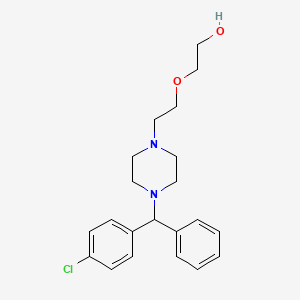
| Formula | C21H27ClN2O2 |
|---|---|
| Molecular weight | 374.91 g/mol |
| IUPAC name | 2-[2-[4-[(4-chlorophenyl)-phenylmethyl]piperazin-1-yl]ethoxy]ethanol |
| CAS | 68-88-2 |
| PubChem CID | 3658 |
| InChIKey | ZQDWXGKKHFNSQK-UHFFFAOYSA-N |
| logP | 3.06 (XLogP 3.7) |
| Polar surface area | 35.94 Ų |
| H-bond acceptors / donors | 4 / 1 |
| Drug-likeness (QED) | 0.72 |
| Lipinski violations | 0 |
SMILES
OCCOCCN1CCN(C(c2ccccc2)c2ccc(Cl)cc2)CC1Biology & Pharmacokinetics
Pharmacokinetics
| BBB penetrant | Yes (logBB 0.4) |
|---|
Enzyme interactions
| Enzyme | Role | Detail |
|---|---|---|
| CYP1A2 | Substrate | — |
| CYP2C19 | Substrate | — |
| CYP2D6 | Inhibitor | — |
| CYP3A4 | Substrate | — |
Receptor binding (top 1)
| Target | Action | Affinity |
|---|---|---|
| H1 receptor (HRH1) | Antagonist | pKi 8.7 |
Transporters
BCRP (Inhibitor)BSEP (Inhibitor)BSEP (Inhibitor)MRP1 (Inhibitor)OATP1B1 (Inhibitor)OATP1B3 (Inhibitor)P-gp (Inhibitor)MDR1 (Substrate)OATP1A2 (Substrate)P-gp (Substrate)
Drug–drug interactions (100+, DDInter)
| Interacting drug | Severity | Management |
|---|---|---|
| Anagrelide | major | |
| Arsenic trioxide | major | |
| Cabozantinib | major | |
| Ceritinib | major | |
| Chloroquine | major | |
| Cisapride | major | |
| Codeine | major | |
| Crizotinib | major | |
| Dolasetron | major | |
| Fingolimod | major | |
| Halofantrine | major | |
| Hydrocodone | major | |
| Hydroxychloroquine | major | |
| Ivosidenib | major | |
| Lumefantrine | major | |
| Macimorelin | major | |
| Morphine | major | |
| Morphine (liposomal) | major | |
| Nilotinib | major | |
| Osimertinib | major | |
| Ozanimod | major | |
| Panobinostat | major | |
| Papaverine | major | |
| Pasireotide | major | |
| Potassium chloride | major | |
| Potassium citrate | major | |
| Ribociclib | major | |
| Siponimod | major | |
| Toremifene | major | |
| Vandetanib | major | |
| Vemurafenib | major | |
| Abarelix | moderate | |
| Abiraterone | moderate | |
| Aclidinium | moderate | |
| Acrivastine | moderate | |
| Aldesleukin | moderate | |
| Alimemazine | moderate | |
| Amyl Nitrite | moderate | |
| Apalutamide | moderate | |
| Astemizole | moderate |
Showing 40 of 100+.
Registered Products (3)
| Brand | Form / strength | Pack | Agent | Citizen (JOD) |
|---|---|---|---|---|
| Atarax Tablets | Tablet 25 mg | 25 tab | Suleiman Tannous & Sons Co. Ltd | 0.780 |
| Newrax | Suspension 10 mg/5 ml | 100 ml | Al-Gadeed Pharmaceutical Industries/JORDAN | 1.260 |
| Atarax Syrup | Syrup 10 mg/5 ml | 200 ml | Suleiman Tannous & Sons Co. Ltd | 2.400 |