Nicotine
JFDA label: Nicorette Chew Gum
Mechanism of Action
Agonist of Neuronal acetylcholine receptor; alpha4/beta2 — Neuronal acetylcholine receptor; alpha4/beta2 agonist
| Target | Action | Gene / class |
|---|---|---|
| Neuronal acetylcholine receptor; alpha4/beta2 efficacy | AGONIST |
Indications
Approved
- Smoking cessation
Contraindications
Source: Lexicomp
- Hypersensitivity to nicotine or any component of the formulation. OTC labeling: Nicorette lozenge: When used for self-medication, do not use if you are allergic to soya Absolute
Adverse Reactions
Nervous system disorders (9)
Very Common Headache
Common Withdrawal syndrome
Not Known Depression · dizziness · insomnia · lack of concentration · nervousness · pain · paresthesia
Renal and urinary disorders (1)
Common Dysmenorrhea
Immune system disorders (1)
Not Known Hypersensitivity reaction
Gastrointestinal disorders (16)
Very Common dyspepsia · Inhaler: Mouth irritation
Common diarrhea · dysgeusia · Flatulence · gingival disease · hiccups · nausea · tooth enamel damage (abrasions)
Not Known Aphthous stomatitis · constipation · gingival hemorrhage · glossitis · sialorrhea · stomatitis · xerostomia
Skin and subcutaneous tissue disorders (4)
Common Acne vulgaris · burning sensation of the nose (nasal spray)
Not Known Diaphoresis · Skin rash
Musculoskeletal and connective tissue disorders (5)
Common arthralgia · Back pain · jaw pain · neck pain
Not Known myalgia
General disorders and administration site conditions (3)
Not Known Application site reaction · localized edema · localized erythema
Respiratory, thoracic and mediastinal disorders (4)
Very Common cough · Inhaler: Throat irritation · rhinitis
Common Sinusitis
Dosing
Source: Lexicomp
Warnings & Precautions
Source: Lexicomp
Cardiovascular disease
Nicotine can increase heart rate and blood pressure. The risk versus the benefits should be weighed in patients with cardiovascular or peripheral vascular diseases, specifically patients with a history of myocardial infarction and/or angina pectoris, serious cardiac arrhythmias, or vasospastic diseases (Buerger disease, Prinzmetal variant angina, Raynaud phenomena); use caution in patients with angina, hypertension, or recent MI. Discontinue use if irregular heartbeat or palpitations occur. Use caution in patients with accelerated hypertension due to the risk of malignant hypertension. Generally, avoid use during the immediate postmyocardial infarction period, in patients with serious arrhythmias, or with severe or worsening angina.
Diabetes
Use with caution in patients with insulin-dependent diabetes.
Gastrointestinal disease
Use with caution in patients with active peptic ulcer disease; healing may be delayed.
Hepatic impairment
Use with caution in patients with severe hepatic impairment; effects on metabolism unknown.
Hyperthyroidism
Use with caution in patients with hyperthyroidism.
Pheochromocytoma
Use with caution in patients with pheochromocytoma.
Renal impairment
Use with caution in patients with severe renal impairment; effects on elimination unknown. Dosage form specific issues:
Chewing gum
OTC labeling: When used for self-medication, consult a health care provider before use in patients on a sodium-restricted diet and in patients with a history of seizures. Discontinue use and consult a health care provider if mouth, teeth, or jaw problems occur.
Inhaler
Use with caution in patients with bronchospastic disease (eg, asthma, chronic pulmonary disease); may cause bronchospasm due to potential airway irritation; other forms of nicotine replacement may be preferred in patients with severe bronchospastic airway disease. Sustained use (beyond 6 months) by patients who quit smoking is not recommended.
Lozenge
OTC labeling: When used for self-medication, consult a health care provider before use in patients on a sodium-restricted diet and in patients with a history of seizures. Discontinue use and consult a health care provider if mouth problems, persistent indigestion, or severe sore throat occurs.
Nasal spray
Use of nasal product is not recommended with chronic nasal disorders (eg, allergy, rhinitis, nasal polyps, and sinusitis). Exacerbations of bronchospasm have been reported in patients with preexisting asthma; use in patients with severe reactive airway disease is not recommended. Nasal mucosa irritation may occur. Sustained use (beyond 6 months) by patients who quit smoking is not recommended.
Transdermal patch
May contain conducting metal (eg, aluminum); remove patch prior to MRI. OTC labeling: When used for self-medication, consult a health care provider before use in patients who have an allergy to adhesive tape or who have skin problems. Discontinue use and contact a health care provider if skin redness caused by the patch does not resolve after 4 days or if inflammation or rash occurs. If vivid dreams or other sleep disturbances occur, remove the patch at bedtime and apply another patch in the morning. Other warnings/precautions:
Appropriate use
Urge patients to stop smoking completely when initiating therapy.
OTC labeling
When used for self-medication, discontinue use and contact a health care provider if symptoms of nicotine overdose (eg, nausea, vomiting, dizziness, diarrhea, weakness, rapid heartbeat) or an allergic reaction (eg, difficulty breathing, rash) occurs.
Pregnancy & Lactation
Pregnancy
Nicotine crosses the placenta (HHS 2014). Maternal smoking is associated with birth defects (HHS 2014; Hachshaw 2011); the incidence of birth defects following nicotine replacement therapy may be similar (limited data) (Dhalwani 2015). Nicotine exposure via cigarette smoke may cause increased ectopic pregnancy, low birth weight, increased risk of spontaneous abortion, increased perinatal mortality; increased aortic blood flow, increased heart rate, decreased uterine blood flow, and decreased breathing have been reported in the fetus. Smoking during pregnancy is associated with sudden infant death syndrome (SIDS), an increased risk of asthma, infantile colic, and childhood obesity (ACOG 2010; HHS 2014). Women who are pregnant should be encouraged not to smoke. The use of nicotine replacement products to aid in smoking cessation has not been adequately studied in pregnant women (amount of nicotine exposure is varied). Nonpharmacologic treatments are recommended. If the benefits of nicoti
Lactation
Nicotine from cigarette smoke is present in breast milk and can be absorbed orally by the infant; hepatic clearance is likely lowest at birth. The amount of nicotine in breast milk from replacement products varies. Nicotine replacement therapy is considered to be compatible with breastfeeding if the amount of nicotine is less than that received from smoking. Use of short acting products (gum, lozenges) is preferred (Sachs 2013). The manufacturer recommends that caution be exercised when administ
Monitoring
| Clinical pearl | Signs and symptoms of nicotine toxicity (eg, severe headache, dizziness, mental confusion, disturbed hearing and vision, abdominal pain; rapid, weak and irregular pulse; salivation, nausea, vomiting, diarrhea, cold sweat, weakness) |
|---|
Chemistry & Properties
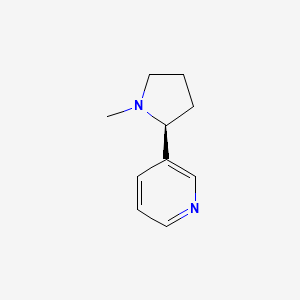
| Formula | C10H14N2 |
|---|---|
| Molecular weight | 162.24 g/mol |
| IUPAC name | 3-[(2S)-1-methylpyrrolidin-2-yl]pyridine |
| CAS | 54-11-5 |
| PubChem CID | 89594 |
| InChIKey | SNICXCGAKADSCV-JTQLQIEISA-N |
| logP | 1.85 (XLogP 1.2) |
| Polar surface area | 16.13 Ų |
| H-bond acceptors / donors | 2 / 0 |
| Drug-likeness (QED) | 0.63 |
| Lipinski violations | 0 |
SMILES
CN1CCC[C@H]1c1cccnc1Biology & Pharmacokinetics
Pharmacokinetics
| BBB penetrant | Yes (logBB 0.4) |
|---|
Enzyme interactions
| Enzyme | Role | Detail |
|---|---|---|
| CYP1A2 | Substrate | — |
| CYP2B6 | Inhibitor | — |
| CYP2B6 | Substrate | — |
| CYP2C19 | Inhibitor | — |
| CYP2C19 | Substrate | — |
| CYP2C8 | Inhibitor | — |
| CYP2C9 | Substrate | — |
| CYP2D6 | Substrate | — |
| CYP3A4 | Substrate | — |
Receptor binding (top 18)
| Target | Action | Affinity |
|---|---|---|
| Neuronal acetylcholine receptor protein alpha-4 subunit (CHRNA4) | Binding | pKi 8.8 |
| Cholinergic, Nicotinic Alpha4Beta2 | Binding | pKi 8.8 |
| nicotinic acetylcholine receptor α4 subunit (CHRNA4) | Agonist | pKi 8.7 |
| Cholinergic, Nicotinic Alpha2Beta2 | Binding | pKi 8.5 |
| Nicotinic Alpha2Beta2 | Binding | pKi 8.4 |
| Nicotinic Alpha4Beta2 | Binding | pKi 8.3 |
| Nicotinic Alpha3Beta2 | Binding | pKi 8.1 |
| Cholinergic, Nicotinic Alpha3Beta2 | Binding | pKi 8.1 |
| Nicotinic Alpha4Beta4 | Binding | pKi 7.6 |
| Nicotinic Alpha2Beta4 | Binding | pKi 7.1 |
| Cholinergic, Nicotinic Alpha3Beta4 | Binding | pKi 6.7 |
| Nicotinic Alpha7 | Binding | pKi 6.7 |
| Nicotinic Alpha3Beta4 | Binding | pKi 6.5 |
| Cholinergic, Nicotinic Alpha4Beta4 | Binding | pKi 6.4 |
| Cholinergic, Nicotinic Alpha2Beta4 | Binding | pKi 6.2 |
Transporters
BCRP (Inhibitor)BCRP (Inhibitor)BSEP (Inhibitor)BSEP (Inhibitor)MATE1 (Inhibitor)MATE2 (Inhibitor)MCT1 (Inhibitor)MRP1 (Inhibitor)MRP2 (Inhibitor)MRP3 (Inhibitor)MRP4 (Inhibitor)OATP1B1 (Inhibitor)OATP1B1 (Inhibitor)OATP1B3 (Inhibitor)OATP1B3 (Inhibitor)OATP2B1 (Inhibitor)OCT1 (Inhibitor)OCT2 (Inhibitor)OCT3 (Inhibitor)OCTN1 (Inhibitor)OCTN2 (Inhibitor)P-gp (Inhibitor)MATE1 (Substrate)MATE2 (Substrate)MDR1 (Substrate)MRP2 (Substrate)P-gp (Substrate)
Drug–drug interactions (9, DDInter)
| Interacting drug | Severity | Management |
|---|---|---|
| Alpelisib | moderate | |
| Bupropion | moderate | |
| Ceritinib | moderate | |
| Caffeine | minor | |
| Cimetidine | minor | |
| Famotidine | minor | |
| Nizatidine | minor | |
| Ranitidine | minor | |
| Ranitidine (bismuth citrate) | minor |
Registered Products (34)
| Brand | Form / strength | Pack | Agent | Citizen (JOD) |
|---|---|---|---|---|
| Nicotinell Fruit Gum | Tablet 2 ( resinate) mg | 12 tab pack varies | Nabulsi Drug Store | 1.700 |
| Nicotinell Mint Gum | Tablet 2 ( resinate) mg | 12 tab pack varies | Nabulsi Drug Store | 1.700 |
| Nicotinell Lozenges | Tablet 1 mg | 12 tab pack varies | Sukhtian Group | 2.410 |
| Nicotinell Fruit Gum | Tablet 4 (as resinate) mg | 12 tab pack varies | Nabulsi Drug Store | 2.450 |
| Nicotinell Mint Gum | Tablet 4 (as resinate) mg | 12 tab pack varies | Nabulsi Drug Store | 2.450 |
| Nicotinell Fruit Gum | Tablet 2 ( resinate) mg | 24 tab pack varies | Sukhtian Group | 3.920 |
| Nicotinell Mint Gum | Tablet 2 ( resinate) mg | 24 tab pack varies | Sukhtian Group | 3.920 |
| Nicorette Chew Gum | Chewable Tablet 2 mg | 30 tab pack varies | Al-Amad Drug Store | 4.080 |
| Nicorette Fresh Fruit | Lozenge 2 mg | 30 Gum | Al-Amad Drug Store | 4.080 |
| Nicorette Freshmint | Lozenge 2 mg | 30 Gum | Al-Amad Drug Store | 4.080 |
| Nicotinell Fruit Gum | Tablet 4 (as resinate) mg | 24 tab pack varies | Nabulsi Drug Store | 4.650 |
| Nicotinell Mint Gum | Tablet 4 (as resinate) mg | 24 tab pack varies | Nabulsi Drug Store | 4.650 |
| Nicorette Chew Gum | Chewable Tablet 4 mg | 30 tab pack varies | Al-Amad Drug Store | 5.860 |
| Nicorette Fresh Fruit | Lozenge 4 mg | 30 Gum | Al-Amad Drug Store | 5.870 |
| Nicorette Freshmint | Lozenge 4 mg | 30 Gum | Al-Amad Drug Store | 5.870 |
| Niquitin 2 mg Mint | Lozenge 2 mg | 24 Lozenges pack varies | Sukhtian Group | 6.800 |
| Niquitin 4mg Mint | Lozenge 4 mg | 24 (Lozenges) pack varies | Sukhtian Group | 6.800 |
| Nicotinell Lozenges | Tablet 1 mg | 36 tab pack varies | Sukhtian Group | 6.820 |
| Nicotinell Fruit Gum | Tablet 2 ( resinate) mg | 48 tab pack varies | Sukhtian Group | 7.690 |
| Nicotinell Mint Gum | Tablet 2 ( resinate) mg | 48 tab pack varies | Sukhtian Group | 7.690 |
| Clear Assiquit 10mg/16hr Patches | Patch 10 mg/16hr | 7 | UNITED PHARM.MFG.CO.LTD(UPM)/JORDAN | 9.210 |
| Clear Assiquit 15mg/16hr Patches | Patch 15 mg/16hr | 7 | UNITED PHARM.MFG.CO.LTD(UPM)/JORDAN | 9.210 |
| Clear Assiquit 5mg/16 hr Patches | Patch 5 mg/16hr | 7 | UNITED PHARM.MFG.CO.LTD(UPM)/JORDAN | 9.210 |
| Niquitin 2 mg Mint | Lozenge 2 mg | 48 Lozenges pack varies | Sukhtian Group | 10.100 |
| Niquitin 4mg Mint | Lozenge 4 mg | 48 (Lozenges) pack varies | Sukhtian Group | 10.100 |
| Nicorette Chew Gum | Chewable Tablet 2 mg | 105 tab pack varies | Al-Amad Drug Store | 11.770 |
| Nicorette Invisipatch 10mg/16hours | Patch 15.8 mg | 7 | Al-Amad Drug Store | 12.700 |
| Nicorette Invisipatch 15mg/16hours | Patch 23.6 mg | 7 | Al-Amad Drug Store | 12.700 |
| Nicorette Invisipatch 25mg/16 hours | Patch 39.37 mg | 7 | Al-Amad Drug Store | 12.700 |
| NICOTINELL 10CM PATCHES | Patch 17.5 mg/Patch | 7 patch | Sukhtian Group | 13.240 |
| NICOTINELL 20CM PATCHES | Patch 35 mg/Patch | 7 patch | Sukhtian Group | 13.240 |
| NICOTINELL 30CM PATCHES | Patch 52.5 mg/Patch | 7 patch | Sukhtian Group | 13.240 |
| Nicotinell Lozenges | Tablet 1 mg | 96 tab pack varies | Sukhtian Group | 14.260 |
| Nicorette Chew Gum | Chewable Tablet 4 mg | 105 tab pack varies | Al-Amad Drug Store | 14.900 |