Ranitidine
JFDA label: Zydac
Mechanism of Action
Antagonist of Histamine H2 receptor — Histamine H2 receptor antagonist
| Target | Action | Gene / class |
|---|---|---|
| Histamine H2 receptor efficacy | ANTAGONIST | HRH2 |
Indications
Approved
- Duodenal ulcer
- Duodenal ulcers
- Erosive esophagitis
- Gastric ulcer
- Gastroesophageal reflux disease
- Heartburn (OTC only)
- Injection
- Oral
- Pathological hypersecretory conditions
- Patients not able to take oral medication
Off-label
- Anaphylaxis, adjunct therapy
- Premedication to prevent taxane hypersensitivity
- Stress ulcer prophylaxis in critically-ill patients
Contraindications
Source: Lexicomp
- Hypersensitivity to ranitidine or any component of the formulation OTC labeling: When used for self-medication (OTC), do not use if trouble or pain when swallowing food, vomiting with blood, or bloody or black stools, allergic to ranitidine or other acid reducers. Do not use with other acid reducers. Do not use 150 mg tablet with kidney disease without medical advice. Documentation of allergenic cross-reactivity for histamine H2 antagonists is limited. However, because of similarities in che Absolute
Adverse Reactions
Cardiac disorders (6)
Not Known Asystole · atrioventricular block · bradycardia (with rapid IV administration) · tachycardia · vasculitis · ventricular premature contractions
Nervous system disorders (11)
Not Known Agitation · confusion · depression · dizziness · drowsiness · hallucination · headache · insomnia · involuntary motor activity · malaise · vertigo
Hepatobiliary disorders (4)
Not Known Cholestatic hepatitis · hepatic failure · hepatitis · jaundice
Renal and urinary disorders (2)
Not Known Acute interstitial nephritis · increased serum creatinine
Blood and lymphatic system disorders (7)
Not Known Agranulocytosis · aplastic anemia · granulocytopenia · hemolytic anemia (immune; acquired) · leukopenia · pancytopenia · thrombocytopenia
Immune system disorders (3)
Not Known Anaphylaxis · angioedema · hypersensitivity reaction (eg, bronchospasm, eosinophilia, fever)
Metabolism and nutrition disorders (2)
Not Known Acute porphyria · increased serum prolactin
Gastrointestinal disorders (8)
Not Known Abdominal distress · abdominal pain · constipation · diarrhea · nausea · necrotizing enterocolitis (very low weight neonates; Guillet 2006) · pancreatitis · vomiting
Skin and subcutaneous tissue disorders (4)
Not Known Alopecia · erythema multiforme · injection site pruritus (transient) · skin rash
Musculoskeletal and connective tissue disorders (2)
Not Known Arthralgia · myalgia
Eye disorders (1)
Not Known Blurred vision
General disorders and administration site conditions (2)
Not Known Burning sensation at injection site (transient) · pain at injection site (transient)
Respiratory, thoracic and mediastinal disorders (1)
Not Known Pneumonia (causal relationship not established)
Dosing
Source: Lexicomp
Warnings & Precautions
Source: Lexicomp
Confusion
Rare cases of reversible confusion have been associated with ranitidine; usually elderly or severely ill patients, or in patients with renal or hepatic impairment.
Hepatic effects
Elevation in ALT levels has occurred with higher doses (≥100 mg) or prolonged IV therapy (≥5 days); monitor ALT levels daily for the remainder of treatment.
Vitamin B12 deficiency
Prolonged treatment (≥2 years) may lead to vitamin B12 malabsorption and subsequent vitamin B12 deficiency. The magnitude of the deficiency is dose-related and the association is stronger in females and those younger in age ( Disease-related concerns:
Gastric malignancy
Relief of symptoms does not preclude the presence of a gastric malignancy.
Hepatic impairment
Use with caution in patients with hepatic impairment (ranitidine undergoes hepatic metabolism).
Porphyria
Avoid use in patients with a history of acute porphyria; may precipitate attacks.
Renal impairment
Ranitidine is primarily excreted renally; dosage adjustment is recommended in patients with renal impairment. Concurrent drug therapy issues:
Drug-drug interactions
Potentially significant interactions may exist, requiring dose or frequency adjustment, additional monitoring, and/or selection of alternative therapy. Consult drug interactions database for more detailed information. Special populations:
Children
Use of gastric acid inhibitors, including proton pump inhibitors and H2 blockers, has been associated with an increased risk for development of acute gastroenteritis and community-acquired pneumonia in pediatric patients (Canani 2006). Dosage form specific issues:
Injection
Rapid administration has been associated with bradycardia (rare), usually in patients with predisposing risk factors for cardiac rhythm disorders. Do not exceed the recommended IV administration rate(s).
Syrup
May contain up to 7.5% alcohol. Other warnings/precautions:
OTC labeling
When used for self-medication (OTC), notify health care provider before use if any of the following are present: Frequent chest pain; frequent wheezing particularly with heartburn; nausea/vomiting; unexplained weight loss; stomach pain; heartburn longer than 3 months; heartburn with light-headedness, sweating, or dizziness; chest pain or shoulder pain with shortness of breath; sweating or pain that spreads to arms, neck, or shoulders; light-headedness. Stop use and notify health care provider if heartburn continues, worsens, or lasts longer than 14 days.
Pregnancy & Lactation
Pregnancy
Safe
H2 blocker with long safety record in pregnancy. Note: ranitidine was withdrawn in some markets due to NDMA contamination — check product status
Lactation
Ranitidine is excreted into breast milk. Notable interpatient variability has been observed with regards to the extent of excretion (Riley 1982); information is limited. The relative infant dose (RID) of ranitidine is 3.9% to 19.6% when calculated using the highest breast milk concentration located and compared to an infant therapeutic dose of 2 to 10 mg/kg/day. In general, breastfeeding is considered unacceptable when the RID is >10% (Anderson 2016; Ito 2000). Using the highest milk concentra
Monitoring
| Clinical pearl | AST, ALT, serum creatinine; occult blood with GI bleeding, signs/symptoms of peptic ulcer disease; when used to prevent stress-related GI bleeding, measure the intragastric pH and try to maintain pH >4; when used for Zollinger-Ellison syndrome, monitor gastric acid secretion (goal: |
|---|
Chemistry & Properties
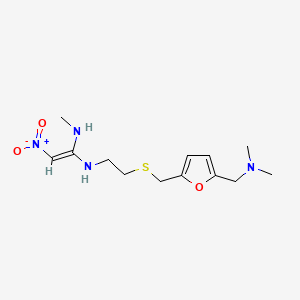
| Formula | C13H22N4O3S |
|---|---|
| Molecular weight | 314.41 g/mol |
| IUPAC name | (E)-1-N'-[2-[[5-[(dimethylamino)methyl]furan-2-yl]methylsulfanyl]ethyl]-1-N-methyl-2-nitroethene-1,1-diamine |
| CAS | 66357-35-5 |
| PubChem CID | 3001055 |
| InChIKey | VMXUWOKSQNHOCA-UHFFFAOYSA-N |
| logP | 1.46 (XLogP 0.3) |
| Polar surface area | 83.58 Ų |
| H-bond acceptors / donors | 7 / 2 |
| Drug-likeness (QED) | 0.38 |
| Lipinski violations | 0 |
SMILES
CNC(=C[N+](=O)[O-])NCCSCc1ccc(CN(C)C)o1Biology & Pharmacokinetics
Pharmacokinetics
| BBB penetrant | No (logBB -1.23) |
|---|
Enzyme interactions
| Enzyme | Role | Detail |
|---|---|---|
| CYP1A2 | Substrate | — |
| CYP2C19 | Substrate | — |
| CYP2C9 | Substrate | — |
| CYP2D6 | Substrate | — |
| CYP3A4 | Substrate | — |
Receptor binding (top 2)
| Target | Action | Affinity |
|---|---|---|
| HISTAMINE H2 (HRH2) | Binding | pKi 7.1 |
| H2 receptor (HRH2) | Antagonist | pKi 7.1 |
Transporters
ASBT (Inhibitor)BCRP (Inhibitor)BCRP (Inhibitor)BSEP (Inhibitor)BSEP (Inhibitor)MATE1 (Inhibitor)MATE2 (Inhibitor)MDR1 (Inhibitor)MRP1 (Inhibitor)MRP2 (Inhibitor)MRP3 (Inhibitor)MRP4 (Inhibitor)OATP1B1 (Inhibitor)OATP1B1 (Inhibitor)OATP1B3 (Inhibitor)OCT(unspecified) (Inhibitor)OCT1 (Inhibitor)OCT2 (Inhibitor)OCT3 (Inhibitor)OCTN2 (Inhibitor)P-gp (Inhibitor)MATE1 (Substrate)MDR1 (Substrate)OAT1 (Substrate)OAT2 (Substrate)OAT3 (Substrate)OCT1 (Substrate)OCT2 (Substrate)OCT3 (Substrate)P-gp (Substrate)Transporter(unspecified) (Substrate)
Drug–drug interactions (100+, DDInter)
| Interacting drug | Severity | Management |
|---|---|---|
| Atazanavir | major | |
| Dasatinib | major | |
| Lemborexant | major | |
| Loperamide | major | |
| Neratinib | major | |
| Pazopanib | major | |
| Rilpivirine | major | |
| Selpercatinib | major | |
| Siponimod | major | |
| Acalabrutinib | moderate | |
| Acetohexamide | moderate | |
| Aminophylline | moderate | |
| Bacampicillin | moderate | |
| Bosutinib | moderate | |
| Brigatinib | moderate | |
| Cefditoren | moderate | |
| Cefpodoxime | moderate | |
| Cefuroxime | moderate | |
| Ceritinib | moderate | |
| Chlorpropamide | moderate | |
| Dabrafenib | moderate | |
| Dacomitinib | moderate | |
| Delavirdine | moderate | |
| Dicoumarol | moderate | |
| Donepezil | moderate | |
| Eliglustat | moderate | |
| Entecavir | moderate | |
| Erlotinib | moderate | |
| Fingolimod | moderate | |
| Flibanserin | moderate | |
| Fosamprenavir | moderate | |
| Fosphenytoin | moderate | |
| Galantamine | moderate | |
| Gefitinib | moderate | |
| Glimepiride | moderate | |
| Glipizide | moderate | |
| Glyburide | moderate | |
| Itraconazole | moderate | |
| Ivabradine | moderate | |
| Ketoconazole | moderate |
Showing 40 of 100+.
Registered Products (1)
| Brand | Form / strength | Pack | Agent | Citizen (JOD) |
|---|---|---|---|---|
| Zydac | Ampoule 50 mg/2 ml | 5 amp | Land Of Medicine Drug Store | 3.230 |