Gefitinib
JFDA label: Iressa 250 mg Tab
Mechanism of Action
Inhibitor of Epidermal growth factor receptor — Epidermal growth factor receptor erbB1 inhibitor
| Target | Action | Gene / class |
|---|---|---|
| Epidermal growth factor receptor efficacy | INHIBITOR | EGFR |
Indications
Approved
- Non-small cell lung cancer
Class profile
| mechanismClass | Tyrosine kinase inhibitor (EGFR TKI) |
|---|---|
| targetMolecule | EGFR (ERBB1) |
| targetPathway | EGFR/RAS/MAPK/PI3K signaling |
| generation | 1st generation EGFR TKI |
| primaryTumors | NSCLC (EGFR-mutant: exon 19 del, L858R) |
| resistanceMechanisms | EGFR T790M gatekeeper mutation (primary resistance to 1st gen),MET amplification,PIK3CA mutation,SCLC transformation |
| source | NCCN/OncoKB/Goodman&Gilman13ed |
Contraindications
Source: Lexicomp
- Hypersensitivity to gefitinib or any component of the formulation Absolute
- There are no contraindications listed in the manufacturer’s US labeling Absolute
Adverse Reactions
Nervous system disorders (5)
Very Common fatigue · Insomnia
Common Hypoesthesia · peripheral neuropathy · peripheral sensory neuropathy
Hepatobiliary disorders (3)
Very Common increased serum ALT · Increased serum AST
Common Increased serum bilirubin, arthralgia
Renal and urinary disorders (2)
Very Common Proteinuria
Common Cystitis
Blood and lymphatic system disorders (6)
Common Anemia · hemorrhage · leukopenia · neutropenia · pulmonary hemorrhage · thrombocytopenia
Metabolism and nutrition disorders (1)
Common Dehydration
Gastrointestinal disorders (8)
Very Common anorexia · constipation · decreased appetite · Diarrhea · nausea · stomatitis · vomiting
Common Xerostomia
Skin and subcutaneous tissue disorders (9)
Very Common acne vulgaris · alopecia · Dermatological reaction · paronychia · pruritus · skin rash · xeroderma
Common acneiform eruption · Nail disease
Musculoskeletal and connective tissue disorders (1)
Very Common Weakness
Eye disorders (1)
Common Eye disease
General disorders and administration site conditions (1)
Common Fever
Respiratory, thoracic and mediastinal disorders (2)
Common Cough · interstitial pulmonary disease
Dosing
Source: Lexicomp
Warnings & Precautions
Source: Lexicomp
Dermatologic toxicity
Skin reactions occurred in nearly one-half of patients taking gefitinib. Bullous skin disorders, including toxic epidermal necrolysis, Stevens Johnson syndrome, erythema multiforme, and dermatitis bullous have been reported. Interrupt gefitinib treatment or discontinue for development of severe bullous, blistering, or exfoliating dermatologic conditions.
Gastrointestinal effects
Diarrhea occurs in approximately one-third of patients; grade 3 or 4 diarrhea has been observed. Diarrhea symptoms should be managed as clinically indicated; avoid dehydration. Withhold gefitinib for severe or persistent (up to 14 days) diarrhea. Gastrointestinal perforation has occurred (rarely); discontinue permanently if gastrointestinal perforation develops. Nausea, vomiting, decreased appetite, and stomatitis have also been reported.
Hepatotoxicity
Increases in ALT, AST, and bilirubin, including grade 3 or higher toxicity have been observed. Fatal hepatotoxicity has occurred rarely. Monitor liver functions tests periodically. Withhold gefitinib in patients with worsening liver function; discontinue for severe hepatic impairment.
Ocular toxicity
Ocular disorders, including keratitis, corneal erosion, abnormal eyelash growth, conjunctivitis, blepharitis, and dry eye have been reported; some events were grade 3. Recent corneal surgery and contact lens wearing may be risk factors for ocular toxicity. Advise patients to promptly report developing eye symptoms and promptly refer for ophthalmic evaluation if signs of keratitis (eg, acute or worsening of eye inflammation, lacrimation, blurred vision, pain, red eye, and/or light sensitivity). Interrupt gefitinib treatment or discontinue for severe or worsening ocular disorders.
Pulmonary toxicity
Interstitial lung disease (ILD) or ILD-like reactions (eg, acute respiratory distress syndrome, lung infiltration, pneumonitis, or pulmonary fibrosis) have occurred (rarely) with gefitinib; some cases were grade 3 or higher and some were fatal. Withhold gefitinib and promptly assess any patient with worsening respiratory symptoms (dyspnea, cough, and fever); discontinue permanently if ILD is confirmed. Disease-related concerns:
Hepatic impairment
Gefitinib exposure is increased in patients with mild, moderate, and severe hepatic impairment due to cirrhosis. However, in a study of patients with liver metastases, patients with metastases and moderate impairment had similar systemic exposure as patients with metastases and normal hepatic function. Monitor for adverse reactions if administering to patients with moderate or severe hepatic impairment. Concurrent drug therapy issues:
Drug-drug interactions
Potentially significant interactions may exist, requiring dose or frequency adjustment, additional monitoring, and/or selection of alternative therapy. Consult drug interactions database for more detailed information.
Drugs that affect gastric pH
Elevated gastric pH may reduce gefitinib plasma concentrations; if possible, avoid concomitant use with proton pump inhibitors. If proton pump inhibitor therapy is necessary, administer gefitinib 12 hours before or 12 hours after the proton pump inhibitor dose. May administer gefitinib 6 hours before or 6 hours after H2-receptor antagonists or antacids. Special populations:
CYP2D6 poor metabolizers
Systemic exposure of gefitinib may be increased in CYP2D6 poor metabolizers. No dosage adjustment is recommended, although patients should be monitored closely for adverse reactions. Other warnings/precautions:
Appropriate use
Establish EGFR mutation status prior to treatment. Do not use in patients with EGFR mutation-negative tumors. Studies have demonstrated a subset of patients who are more likely to respond to gefitinib treatment. This subset includes patients of Asian origin, never-smokers, women, patients with bronchoalveolar adenocarcinoma, and patients with EGFR-mutated tumors. Deletion in exon 19 and mutation in exon 21 are the two most commonly found EGFR mutations; both mutations correlate with clinical response, resulting in increased response rates in patients with the mutation (Riely, 2006). Studies have compared gefitinib in treatment naïve patients to combination chemotherapy in the subsets of patients described above, resulting in a longer progression free survival in the gefitinib arm (Mok 2009). ASCO guidelines state that the first-line use of gefitinib may be recommended in stage IV disease with activating EGFR mutations (Masters 2015). In patients with a KRAS mutation, however, EGFR-TKI therapy is not recommended.
Pregnancy & Lactation
Pregnancy
Adverse events have been observed in animal reproduction studies. Gefitinib may cause fetal harm when administered to a pregnant woman. Women of reproductive potential should use effective contraception during and for at least 2 weeks following gefitinib treatment.
Lactation
It is not known if gefitinib is present in breast milk. Due to the potential for serious adverse reactions in the breastfed infant, breastfeeding is not recommended by the manufacturer.
Monitoring
| Efficacy | Tumour response (RECIST criteria, tumour markers, imaging); progression-free survival; performance status (ECOG/Karnofsky) |
|---|---|
| Toxicity | CBC with differential (nadir timing depends on agent); LFTs; renal function; ECG (QT for relevant agents); echocardiogram for cardiotoxic agents (anthracyclines, trastuzumab); cumulative dose tracking for dose-limited toxicities |
| Clinical pearl | Treatment response is assessed after 2–3 cycles. Grade 3–4 toxicities typically require dose reduction or interruption per protocol-defined criteria. |
| Counseling | Attend all scheduled blood tests and imaging appointments. Report fever > 38°C (risk of neutropaenic sepsis — medical emergency), unusual bleeding, or new pain immediately. |
Chemistry & Properties
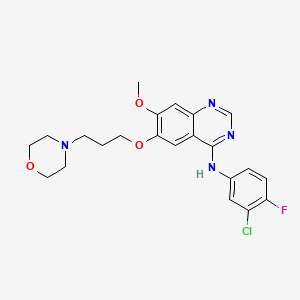
| Formula | C22H24ClFN4O3 |
|---|---|
| Molecular weight | 446.91 g/mol |
| IUPAC name | N-(3-chloro-4-fluorophenyl)-7-methoxy-6-(3-morpholin-4-ylpropoxy)quinazolin-4-amine |
| CAS | 184475-35-2 |
| PubChem CID | 123631 |
| InChIKey | XGALLCVXEZPNRQ-UHFFFAOYSA-N |
| logP | 4.28 (XLogP 4.1) |
| Polar surface area | 68.74 Ų |
| H-bond acceptors / donors | 7 / 1 |
| Drug-likeness (QED) | 0.52 |
| Lipinski violations | 0 |
SMILES
COc1cc2ncnc(Nc3ccc(F)c(Cl)c3)c2cc1OCCCN1CCOCC1Biology & Pharmacokinetics
Pharmacokinetics
| BBB penetrant | Yes (logBB -0.5) |
|---|
Enzyme interactions
| Enzyme | Role | Detail |
|---|---|---|
| CYP2C19 | Substrate | — |
| CYP2C8 | Inhibitor | — |
| CYP2D6 | Inhibitor | — |
| CYP2D6 | Substrate | — |
| CYP3A4 | Inhibitor | — |
| CYP3A4 | Substrate | — |
Receptor binding (top 21)
| Target | Action | Affinity |
|---|---|---|
| epidermal growth factor receptor (EGFR) | Inhibitor | pKd 9.0 |
| Epidermal growth factor receptor (EGFR) | Binding | pKi 8.7 |
| epidermal growth factor receptor (EGFR) | Inhibitor | pKi 8.3 |
| Cyclin G associated kinase (GAK) | Binding | pKi 8.2 |
| epidermal growth factor receptor (EGFR) | Inhibitor | pIC50 7.2 |
| MAP kinase interacting serine/threonine kinase 2 (MKNK2) | Binding | pKi 6.4 |
| Receptor-interacting serine-threonine kinase 2 (RIPK2) | Binding | pKi 6.1 |
| Serine/threonine kinase 10 (STK10) | Binding | pKi 6.1 |
| V-erb-b2 erythroblastic leukemia viral oncogene homolog 2 (ERBB2) | Binding | pKi 6.0 |
| Lymphocyte-specific protein tyrosine kinase (LCK) | Binding | pKi 6.0 |
| STE20-like kinase (yeast) (SLK) | Binding | pKi 6.0 |
| EPH receptor A6 (EPHA6) | Binding | pKi 5.9 |
| Mitogen-activated protein kinase 9 (MAPK9) | Binding | pKi 5.9 |
| 1200015E14Rik | Binding | pKi 5.9 |
| Casein kinase 1, epsilon (CSNK1E) | Binding | pKi 5.7 |
Transporters
ASBT (Inhibitor)BCRP (Inhibitor)BCRP (Inhibitor)BSEP (Inhibitor)BSEP (Inhibitor)CNT1 (Inhibitor)CNT2 (Inhibitor)CNT3 (Inhibitor)ENT1 (Inhibitor)ENT2 (Inhibitor)MATE1 (Inhibitor)MATE2 (Inhibitor)MDR1 (Inhibitor)MRP1 (Inhibitor)MRP1 (Inhibitor)MRP2 (Inhibitor)MRP3 (Inhibitor)MRP4 (Inhibitor)NTCP (Inhibitor)OAT3 (Inhibitor)OATP1A2 (Inhibitor)OATP1B1 (Inhibitor)OATP1B3 (Inhibitor)OATP2B1 (Inhibitor)OCT1 (Inhibitor)OCT2 (Inhibitor)OCT3 (Inhibitor)OCTN2 (Inhibitor)P-gp (Inhibitor)BCRP (Substrate)P-gp (Substrate)
Drug–drug interactions (100+, DDInter)
| Interacting drug | Severity | Management |
|---|---|---|
| Aminolevulinic acid | major | |
| Leflunomide | major | |
| Lomitapide | major | |
| Mipomersen | major | |
| Ozanimod | major | |
| Pexidartinib | major | |
| Teriflunomide | major | |
| Thioridazine | major | |
| Abametapir (topical) | moderate | |
| Alpelisib | moderate | |
| Aminoglutethimide | moderate | |
| Aminolevulinic acid (topical) | moderate | |
| Amiodarone | moderate | |
| Amobarbital | moderate | |
| Amprenavir | moderate | |
| Anisindione | moderate | |
| Apalutamide | moderate | |
| Aprepitant | moderate | |
| Aripiprazole | moderate | |
| Asparaginase Erwinia chrysanthemi | moderate | |
| Asparaginase Escherichia coli | moderate | |
| Atazanavir | moderate | |
| Atomoxetine | moderate | |
| Bedaquiline | moderate | |
| Berotralstat | moderate | |
| Bexarotene | moderate | |
| Bicalutamide | moderate | |
| Bictegravir | moderate | |
| Binimetinib | moderate | |
| Boceprevir | moderate | |
| Bosentan | moderate | |
| Brentuximab vedotin | moderate | |
| Brigatinib | moderate | |
| Butabarbital | moderate | |
| Butalbital | moderate | |
| Calaspargase pegol | moderate | |
| Cannabidiol | moderate | |
| Carbamazepine | moderate | |
| Cenobamate | moderate | |
| Ceritinib | moderate |
Showing 40 of 100+.
Registered Products (1)
| Brand | Form / strength | Pack | Agent | Citizen (JOD) |
|---|---|---|---|---|
| Iressa | Tablet 250 mg | 30 tab | Shawi & Rushedat Drug Store | — |