Oxytocin
JFDA label: Gynocin 5IU/0.5ml
- Appropriate use:
Mechanism of Action
Agonist of Oxytocin receptor — Oxytocin receptor agonist
| Target | Action | Gene / class |
|---|---|---|
| Oxytocin receptor efficacy | AGONIST | OXTR |
Indications
Approved
- Antepartum
- Postpartum
Contraindications
Source: Lexicomp
- Hypersensitivity to oxytocin or any component of the formulation Absolute
- contraindicated vaginal delivery (invasive cervical cancer, active genital herpes, prolapse of the cord, cord presentation, total placenta previa, or vasa previa) Absolute
- fetal distress when delivery is not imminent Absolute
- hypertonic or hyperactive uterus Absolute
- obstetrical emergencies where surgical intervention is favored Absolute
- significant cephalopelvic disproportion Absolute
- unfavorable fetal positions or presentations (such as transverse lies) Absolute
- where adequate uterine activity fails to achieve satisfactory progress Absolute
Adverse Reactions
Cardiac disorders (3)
Not Known Cardiac arrhythmia (including premature ventricular contraction) · hypertension · subarachnoid hemorrhage
Nervous system disorders (1)
Not Known Hypertonia (uterine)
Renal and urinary disorders (4)
Not Known Postpartum hemorrhage · tetanic uterine contractions · uterine rupture · uterine spasm
Blood and lymphatic system disorders (1)
Not Known Pelvic hematoma
Immune system disorders (1)
Not Known Anaphylaxis
Metabolism and nutrition disorders (1)
Not Known Water intoxication (severe water intoxication with seizure and coma is associated with a slow oxytocin infusion over 24 hours)
Gastrointestinal disorders (2)
Not Known Nausea · vomiting
Dosing
Source: Lexicomp
Warnings & Precautions
Source: Lexicomp
Antidiuretic effect
May produce intrinsic antidiuretic effect (ie, water intoxication). Severe water intoxication with convulsions, coma, and death may occur, particularly with large doses (40 to 50 milliunits/minute) or when given as a slow infusion over 24 hours and if the patient is receiving fluids by mouth.
Cardiovascular effects
Arrhythmias, hypotension, myocardial ischemia, peripheral vasodilation, and tachycardia have been reported following administration. The risk of adverse events is influenced by dose and route of administration and is increased in women with cardiovascular disease. Use with extreme caution in hemodynamically unstable patients (Dyer 2011).
Maternal deaths
Maternal deaths caused by hypertensive episodes, subarachnoid hemorrhage, or rupture of the uterus and fetal deaths have occurred with oxytocic medications when used for induction of labor or for augmentation in the first and second stages of labor.
Uterine effects
High doses or hypersensitivity to oxytocin may cause uterine hypertonicity, spasm, tetanic contraction, or rupture of the uterus. Concurrent drug therapy issues:
Drug-drug interactions
Potentially significant interactions may exist, requiring dose or frequency adjustment, additional monitoring, and/or selection of alternative therapy. Consult drug interactions database for more detailed information. Other warnings/precautions:
Appropriate use
To be used for medical rather than elective induction of labor. Oxytocin is used to initiate or improve uterine contractions in order to achieve a vaginal delivery; it should only be used when medically needed for fetal or maternal reasons. Medical indications for labor induction may include Rh problems, maternal diabetes, preeclampsia at or near term, when delivery is in the best interest of mother or fetus, or premature rupture of membranes when delivery is indicated. Use is generally not recommended in the following conditions: Fetal distress, hydramnios, partial placenta previa, prematurity, borderline cephalopelvic disproportion, or conditions where there is a predisposition for uterine rupture (eg, previous major surgery on cervix or uterus, cesarean section, overdistention of the uterus, grand multiparity, past history of uterine sepsis or traumatic delivery).
Appropriate use
Abortion: For the adjunctive management of abortion in the first trimester, curettage is generally considered primary therapy. Oxytocin infusion in second trimester abortion will often be effective; however, other therapy may be required.
Trained personnel
IV preparations should be administered by adequately trained individuals familiar with its use and able to identify complications; continuous observation is necessary for all patients.
Pregnancy & Lactation
Pregnancy
[US Boxed Warning]: To be used for medical rather than elective induction of labor. Small amounts of exogenous oxytocin are expected to reach the fetal circulation. When used as indicated, teratogenic effects would not be expected. Nonteratogenic adverse reactions are reported in the neonate as well as the mother.
Lactation
Endogenous oxytocin mediates milk ejection. Administration of exogenous oxytocin may disrupt the initiation of breastfeeding (Buckley 2015). Skin-to-skin contact between mother and baby facilitates the release of endogenous oxytocin and the establishment of the milk ejection reflex (ABM 2011).
Monitoring
| Clinical pearl | Fluid intake and output during administration, uterine activity (tonus, amplitude, and frequency of contractions), maternal blood pressure; fetal heart rate in relation to uterine contractions. |
|---|
Chemistry & Properties
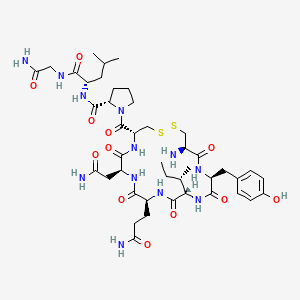
| Formula | C43H66N12O12S2 |
|---|---|
| Molecular weight | 1007.21 g/mol |
| IUPAC name | (2S)-1-[(4R,7S,10S,13S,16S,19R)-19-amino-7-(2-amino-2-oxoethyl)-10-(3-amino-3-oxopropyl)-13-[(2S)-butan-2-yl]-16-[(4-hydroxyphenyl)methyl]-6,9,12,15,18-pentaoxo-1,2-dithia-5,8,11,14,17-pentazacycloicosane-4-carbonyl]-N-[(2S)-1-[(2-amino-2-oxoethyl)amino]-4-methyl-1-oxopentan-2-yl]pyrrolidine-2-carboxamide |
| CAS | 50-56-6 |
| PubChem CID | 439302 |
| InChIKey | XNOPRXBHLZRZKH-DSZYJQQASA-N |
SMILES
CC[C@H](C)[C@@H]1NC(=O)[C@H](Cc2ccc(O)cc2)NC(=O)[C@@H](N)CSSC[C@@H](C(=O)N2CCC[C@H]2C(=O)N[C@@H](CC(C)C)C(=O)NCC(N)=O)NC(=O)[C@H](CC(N)=O)NC(=O)[C@H](CCC(N)=O)NC1=OBiology & Pharmacokinetics
Pharmacokinetics
| BBB penetrant | No |
|---|
Enzyme interactions
| Enzyme | Role | Detail |
|---|---|---|
| CYP2C19 | Substrate | — |
Receptor binding (top 4)
| Target | Action | Affinity |
|---|---|---|
| Oxytocin (OXTR) | Binding | pKi 9.3 |
| VASOPRESSIN V1A (AVPR1A) | Binding | pKi 6.9 |
| VASOPRESSIN V2 (AVPR2) | Binding | pKi 5.8 |
| VASOPRESSIN V1B (AVPR1B) | Binding | pKi 5.7 |
Transporters
BCRP (Inhibitor)BSEP (Inhibitor)BSEP (Inhibitor)MDR1 (Inhibitor)MRP1 (Inhibitor)MRP3 (Inhibitor)MRP4 (Inhibitor)OATP1B1 (Inhibitor)OATP1B3 (Inhibitor)P-gp (Inhibitor)OATP3A1 (Substrate)P-gp (Substrate)
Drug–drug interactions (100+, DDInter)
| Interacting drug | Severity | Management |
|---|---|---|
| Amiodarone | major | |
| Amisulpride | major | |
| Anagrelide | major | |
| Arsenic trioxide | major | |
| Bedaquiline | major | |
| Bepridil | major | |
| Cabozantinib | major | |
| Ceritinib | major | |
| Chloroquine | major | |
| Cisapride | major | |
| Citalopram | major | |
| Clozapine | major | |
| Crizotinib | major | |
| Dinoprostone (topical) | major | |
| Disopyramide | major | |
| Dofetilide | major | |
| Dolasetron | major | |
| Dronedarone | major | |
| Droperidol | major | |
| Efavirenz | major | |
| Escitalopram | major | |
| Fingolimod | major | |
| Gatifloxacin | major | |
| Grepafloxacin | major | |
| Halofantrine | major | |
| Haloperidol | major | |
| Hydroxychloroquine | major | |
| Ibutilide | major | |
| Iloperidone | major | |
| Ivabradine | major | |
| Ivosidenib | major | |
| Lefamulin | major | |
| Levacetylmethadol | major | |
| Lumefantrine | major | |
| Macimorelin | major | |
| Mesoridazine | major | |
| Methadone | major | |
| Mifepristone | major | |
| Moxifloxacin | major | |
| Nilotinib | major |
Showing 40 of 100+.
Registered Products (7)
| Brand | Form / strength | Pack | Agent | Citizen (JOD) |
|---|---|---|---|---|
| Gynocin 10IU/1ml | Ampoule 10 IU/1 ml | 6 amp pack varies | Hikma Pharmaceuticals Co.Ltd/Jordan | — |
| Gynocin 10IU/1ml | Ampoule 10 IU/1 ml | 10 amp pack varies | Hikma Pharmaceuticals Co.Ltd/Jordan | — |
| Gynocin 5IU/0.5ml | Ampoule 5 IU/0.5 ml | 6 amp pack varies | Hikma Pharmaceuticals Co.Ltd/Jordan | — |
| Gynocin 5IU/0.5ml | Ampoule 5 IU/0.5 ml | 10 amp pack varies | Hikma Pharmaceuticals Co.Ltd/Jordan | — |
| OFOST 10 IU/ml solution for injection and infusion | Infusion 10 IU | 10 amp | Alshefra Dru Store company | — |
| Oxytocin 10 I.U | Ampoule 10 IU/ml | 10 amp | AL BISHAWI DRUG STORE | — |
| oxytocin | Ampoule 5 IU/ml | 10 amp | AL BISHAWI DRUG STORE | — |