Silver Sulfadiazine
🧬 Cross-allergy: Sulfonamides
JFDA label: No-Burn Cream
Mechanism of Action
Inhibitor of Dihydropteroate synthase — Bacterial dihydropteroate synthase inhibitor
| Target | Action | Gene / class |
|---|---|---|
| Dihydropteroate synthase efficacy | INHIBITOR | folP |
Indications
Approved
- Burn treatment
Contraindications
Source: Lexicomp
- Hypersensitivity to silver sulfadiazine or any component of the formulation Absolute
- pregnant women approaching or at term Absolute
- premature infants or neonates ≤2 months of age. Documentation of allergenic cross-reactivity for drugs in this class is limited. However, because of similarities in chemical structure and/or pharmacologic actions, the possibility of cross-sensitivity cannot be ruled out with certainty Absolute
Adverse Reactions
Hepatobiliary disorders (1)
Not Known Hepatitis
Renal and urinary disorders (1)
Not Known Interstitial nephritis
Blood and lymphatic system disorders (4)
Not Known Agranulocytosis · aplastic anemia · hemolytic anemia · leukopenia
Immune system disorders (1)
Not Known Hypersensitivity reaction (may be related to sulfa component)
Skin and subcutaneous tissue disorders (5)
Not Known Erythema multiforme · pruritus · skin discoloration · skin photosensitivity · skin rash
Dosing
Source: Lexicomp
Warnings & Precautions
Source: Lexicomp
Sulfonamide allergy
Chemical similarities are present among sulfonamides, sulfonylureas, carbonic anhydrase inhibitors, thiazides, and loop diuretics (except ethacrynic acid). Use in patients with sulfonamide allergy is specifically contraindicated in product labeling, however, a risk of cross-reaction exists in patients with allergy to any of these compounds; avoid use when previous reaction has been severe.
Superinfection
Prolonged use may result in fungal or bacterial superinfection, including C. difficile-associated diarrhea (CDAD) and pseudomembranous colitis; CDAD has been observed >2 months postantibiotic treatment. Fungal proliferation may rarely occur in and below the eschar.
Systemic effects
Systemic absorption may be significant and adverse reactions may occur. Disease-related concerns:
G6PD deficiency
Use with caution in patients with G6PD deficiency; hemolysis may occur.
Hepatic impairment
Use with caution in patients with hepatic impairment; sulfadiazine may accumulate.
Renal impairment
Use with caution in patients with renal impairment; sulfadiazine may accumulate. Concurrent drug therapy issues:
Drug-drug interactions
Potentially significant interactions may exist, requiring dose or frequency adjustment, additional monitoring, and/or selection of alternative therapy. Consult drug interactions database for more detailed information. Dosage form specific issues:
Propylene glycol
Some dosage forms may contain propylene glycol; large amounts are potentially toxic and have been associated hyperosmolality, lactic acidosis, seizures, and respiratory depression; use caution (AAP 1997; Zar 2007). Other warnings/precautions:
Appropriate use
For topical use only. Avoid contact with eyes.
Pregnancy & Lactation
Pregnancy
Adverse events were not observed in animal reproduction studies. Because of the theoretical increased risk for hyperbilirubinemia and kernicterus, silver sulfadiazine is contraindicated for use near term, on premature infants, or on newborn infants during the first 2 months of life (refer to Sulfadiazine monograph).
Lactation
It is not known if silver sulfadiazine is found in breast milk following topical application; however, sulfonamide serum concentrations may reach therapeutic levels following application to extensive areas. Due to the potential for serious adverse reactions in the nursing infant, the manufacturer recommends a decision be made whether to discontinue nursing or to discontinue the drug, taking into account the importance of treatment to the mother. Oral sulfadiazine is contraindicated in nursing mo
Monitoring
| Clinical pearl | Serum electrolytes, urinalysis, renal function tests, CBC in patients with extensive burns on long-term treatment. Serum sulfa concentrations, if clinically indicated. |
|---|
Chemistry & Properties
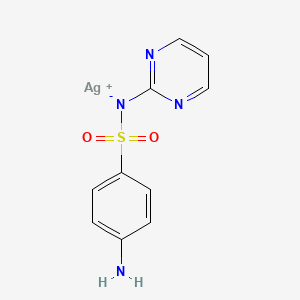
| Formula | C10H9AgN4O2S |
|---|---|
| Molecular weight | 357.14 g/mol |
| IUPAC name | silver (4-aminophenyl)sulfonyl-pyrimidin-2-ylazanide |
| CAS | 22199-08-2 |
| PubChem CID | 441244 |
| InChIKey | UEJSSZHHYBHCEL-UHFFFAOYSA-N |
| logP | 0.86 |
| Polar surface area | 97.97 Ų |
| H-bond acceptors / donors | 5 / 2 |
| Drug-likeness (QED) | 0.79 |
| Lipinski violations | 0 |
SMILES
Nc1ccc(S(=O)(=O)[N-]c2ncccn2)cc1.[Ag+]Biology & Pharmacokinetics
Pharmacokinetics predicted
| Bioavailability | 10.0% |
|---|---|
| Half-life | 1.015 h |
| Volume of distribution | 0.437 L/kg |
| Protein binding | 59.6% |
| BBB penetrant | No |
Enzyme interactions
| Enzyme | Role | Detail |
|---|---|---|
| CYP2C9 | Substrate | — |
| CYP3A4 | Substrate | — |
Transporters
BCRP (Inhibitor)BSEP (Inhibitor)BSEP (Inhibitor)MRP1 (Inhibitor)MRP2 (Inhibitor)MRP3 (Inhibitor)MRP4 (Inhibitor)OAT3 (Inhibitor)OATP1B1 (Inhibitor)OATP1B3 (Inhibitor)OATP1B3 (Inhibitor)P-gp (Inhibitor)P-gp (Substrate)
Drug–drug interactions (60, DDInter)
| Interacting drug | Severity | Management |
|---|---|---|
| Aminobenzoic acid | major | |
| Aminolevulinic acid | major | |
| Cyclosporine | major | |
| Dicoumarol | major | |
| Nitrous acid | major | |
| Warfarin | major | |
| Acetohexamide | moderate | |
| Aminolevulinic acid (topical) | moderate | |
| Asparaginase Escherichia coli | moderate | |
| Balsalazide | moderate | |
| Brentuximab vedotin | moderate | |
| Celecoxib | moderate | |
| Chlorpropamide | moderate | |
| Clofarabine | moderate | |
| Dapsone | moderate | |
| Dapsone (topical) | moderate | |
| Diclofenac | moderate | |
| Epirubicin | moderate | |
| Ethinylestradiol | moderate | |
| Folic acid | moderate | |
| Glimepiride | moderate | |
| Glipizide | moderate | |
| Glyburide | moderate | |
| Idelalisib | moderate | |
| Insulin aspart (aspart protamine) | moderate | |
| Insulin aspart (aspart) | moderate | |
| Insulin degludec | moderate | |
| Insulin detemir | moderate | |
| Insulin glargine | moderate | |
| Insulin glulisine | moderate | |
| Insulin human | moderate | |
| Insulin human (inhalation, rapid acting) | moderate | |
| Insulin human (isophane) | moderate | |
| Insulin human (regular) | moderate | |
| Insulin human (zinc extended) | moderate | |
| Insulin human (zinc) | moderate | |
| Insulin lispro | moderate | |
| Insulin lispro (protamine) | moderate | |
| Interferon beta-1a | moderate | |
| Interferon beta-1b | moderate |
Showing 40 of 60.
Registered Products (7)
| Brand | Form / strength | Pack | Agent | Citizen (JOD) |
|---|---|---|---|---|
| No-Burn Cream | Cream 1 % | 30 g tube pack varies | PHILADELPHIA PHAEMACEUTICALS.COMP/JORDAN | 1.430 |
| Silvezin Cream | Cream 1 % | 50 g tube pack varies | Sukhtian Group | 2.380 |
| No-Burn Cream | Cream 1 % | 200 g tube pack varies | PHILADELPHIA PHAEMACEUTICALS.COMP/JORDAN | 4.200 |
| Flamazine cream | Cream 1 % | 250 g tube pack varies | Petra Drug Store | 7.900 |
| Silvezin Cream | Cream 1 % | 500 g tube pack varies | Sukhtian Group | 12.840 |
| Flamazine cream | Cream 1 % | 500 g tube pack varies | Petra Drug Store | 14.740 |
| Flammacerium 1%, | Cream 1 %, 2.2 % | 500 g tube | Hikma Pharmaceuticals Co.Ltd/Jordan | 29.770 |