Polymyxin B
JFDA label: Neopred-P eye ear drops
- Appropriate use:
- Nephrotoxicity:
- Neurotoxicity:
- Concurrent therapy:
- Neuromuscular blockade:
- Use in pregnancy:
- Nephrotoxicity
- Neuromuscular blockade
Mechanism of Action
Binds to phospholipids, alters permeability, and damages the bacterial cytoplasmic membrane permitting leakage of intracellular constituents
Indications
Approved
- Infections, acute
- Pseudomonal infections
- Serious infections
Off-label
- Selective gastrointestinal tract decontamination
Contraindications
Source: Lexicomp
- Hypersensitivity to polymyxin B or any component of the formulation Absolute
Adverse Reactions
Cardiac disorders (1)
Not Known Facial flushing
Nervous system disorders (4)
Not Known dizziness · drug fever · meningitis (intrathecal administration) · Neurotoxicity (includes ataxia, blurred vision, drowsiness, irritability, numbness of extremities oral paresthesia)
Immune system disorders (1)
Not Known Anaphylactoid reaction
Metabolism and nutrition disorders (4)
Not Known Hypocalcemia · hypochloremia · hypokalemia · hyponatremia
Skin and subcutaneous tissue disorders (1)
Not Known Urticaria
Musculoskeletal and connective tissue disorders (1)
Not Known weakness
General disorders and administration site conditions (1)
Not Known Pain at injection site
Dosing
Source: Lexicomp
Warnings & Precautions
Source: Lexicomp
Local reactions
May cause severe pain at IM injection site or thrombophlebitis at IV infusion site.
Nephrotoxicity
May cause nephrotoxicity; avoid concurrent or sequential use of other nephrotoxic drugs. Usual risk factors include preexisting renal impairment, advanced age and dehydration. Polymyxin B-induced nephrotoxicity may be manifested by albuminuria, cellular casts, and azotemia; monitor BUN, serum creatinine, and urinary analysis at baseline and as clinically indicated. Discontinue therapy with decreasing urinary output and increasing BUN. Data suggest polymyxin B undergoes a selective uptake process into renal cells, which plays a primary role in nephrotoxicity potential (Abdelraouf 2014). One small study in patients receiving polymyxin B with a normal baseline renal function observed an overall prevalence rate of nephrotoxicity of 46% with a median onset of 9 days (Dubrovaskaya 2015).
Neurotoxicity
May cause neurotoxicity, which can also result in respiratory paralysis from neuromuscular blockade especially when the drug is given soon after anesthesia or muscle relaxants. Avoid concurrent or sequential use of other neurotoxic drugs. Avoid concurrent use of curariform muscle relaxants and other neurotoxic drugs (eg, ether, tubocurarine, succinylcholine, gallamine, decamethonium, sodium citrate), which may cause respiratory depression.
Superinfection
Prolonged use may result in fungal or bacterial superinfection, including C. difficile-associated diarrhea (CDAD) and pseudomembranous colitis; CDAD has been observed >2 months postantibiotic treatment. Disease-related concerns:
Renal impairment
Use with caution in patients with impaired renal function; manufacturer’s prescribing information states dosage reduction required, however, recent pharmacokinetic/pharmacodynamic and clinical studies suggest daily dose requirement is not affected by renal function (Sandri 2013a; Nelson 2015; Thamlikitkul 2016). Concurrent drug therapy issues:
Drug-drug interactions
Potentially significant interactions may exist, requiring dose or frequency adjustment, additional monitoring, and/or selection of alternative therapy. Consult drug interactions database for more detailed information Special populations:
Pregnancy
Safety in pregnant women not established. Other warnings/precautions:
IM/Intrathecal/IV administration
Intramuscular/intrathecal/intravenous administration only to hospitalized patients.
Parenteral administration
Polymyxin B sulfate is most toxic when given parenterally; avoid parenteral use whenever possible.
Pregnancy & Lactation
Pregnancy
[US Boxed Warning]: Safety in pregnant women has not been established. Animal reproduction studies are lacking. A teratogenic potential has not been identified for polymyxin b, but very limited data is available (Heinonen 1977; Kazy 2005). Based on the relative toxicity compared to other antibiotics, systemic use in pregnancy is not recommended (Knothe 1985). Due to poor tissue diffusion, topical use would be expected to have only minimal risk to the mother or fetus (Leachman 2006).
Lactation
It is not known if polymyxin b is excreted in human milk. If present in breast milk, polymyxin b is not absorbed well from a normal gastrointestinal tract. Nondose-related effects could include modification of the bowel flora.
Monitoring
| Clinical pearl | Neurologic symptoms and signs of superinfection; renal function (decreasing urine output and increasing BUN may require discontinuance of therapy) |
|---|
Chemistry & Properties
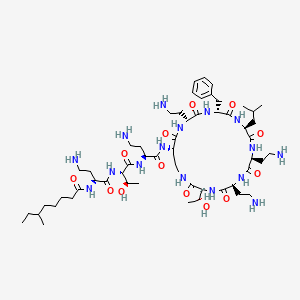
| Formula | C56H98N16O13 |
|---|---|
| Molecular weight | 1203.5 g/mol |
| IUPAC name | N-[(2S)-4-amino-1-[[(2S,3R)-1-[[(2S)-4-amino-1-oxo-1-[[(3S,6S,9S,12S,15R,18R,21S)-6,9,18-tris(2-aminoethyl)-15-benzyl-3-[(1R)-1-hydroxyethyl]-12-(2-methylpropyl)-2,5,8,11,14,17,20-heptaoxo-1,4,7,10,13,16,19-heptazacyclotricos-21-yl]amino]butan-2-yl]amino]-3-hydroxy-1-oxobutan-2-yl]amino]-1-oxobutan-2-yl]-6-methyloctanamide |
| CAS | 1404-26-8 |
| PubChem CID | 49800004 |
| InChIKey | WQVJHHACXVLGBL-BPJDFBQWSA-N |
| logP | -2.5 (XLogP -2.5) |
| Polar surface area | 491.0 Ų |
| H-bond acceptors / donors | 18 / 18 |
SMILES
CCC(C)CCCCC(=O)NC(CCN)C(=O)NC(C(C)O)C(=O)NC(CCN)C(=O)NC1CCNC(=O)C(NC(=O)C(NC(=O)C(NC(=O)C(NC(=O)C(NC(=O)C(NC1=O)CCN)CC2=CC=CC=C2)CC(C)C)CCN)CCN)C(C)OBiology & Pharmacokinetics
Pharmacokinetics predicted
| Bioavailability | 70.0% |
|---|---|
| Half-life | 1.844 h |
| Volume of distribution | 0.293 L/kg |
| Protein binding | 8.0% |
| BBB penetrant | No |
Transporters
BCRP (Inhibitor)BSEP (Inhibitor)MRP1 (Inhibitor)OATP1B1 (Inhibitor)OATP1B1 (Inhibitor)OATP1B3 (Inhibitor)P-gp (Inhibitor)P-gp (Substrate)
Drug–drug interactions (72, DDInter)
| Interacting drug | Severity | Management |
|---|---|---|
| Amikacin | major | |
| Amikacin (liposome) | major | |
| Atracurium | major | |
| Botulinum Toxin Type B | major | |
| Botulinum toxin type A | major | |
| Cidofovir | major | |
| Cisatracurium | major | |
| Deferasirox | major | |
| Diatrizoate | major | |
| Doxacurium | major | |
| Everolimus | major | |
| Gentamicin | major | |
| Human Rho(D) immune globulin | major | |
| Human botulinum neurotoxin A/B immune globulin | major | |
| Human cytomegalovirus immune globulin | major | |
| Human immunoglobulin G (intravenous and subcutaneous) | major | |
| Human immunoglobulin G (intravenous) | major | |
| Inotersen | major | |
| Iodipamide | major | |
| Iodixanol | major | |
| Iohexol | major | |
| Iopamidol | major | |
| Iopromide | major | |
| Iothalamic acid | major | |
| Ioversol | major | |
| Ioxilan | major | |
| Kanamycin | major | |
| Metocurine | major | |
| Mivacurium | major | |
| Neomycin | major | |
| Netilmicin | major | |
| Pancuronium | major | |
| Pipecuronium | major | |
| Plazomicin | major | |
| Rapacuronium | major | |
| Rocuronium | major | |
| Sirolimus | major | |
| Streptomycin | major | |
| Succinylcholine | major | |
| Tacrolimus | major |
Showing 40 of 72.
Registered Products (12)
| Brand | Form / strength | Pack | Agent | Citizen (JOD) |
|---|---|---|---|---|
| Otosporin Ear / Drops | Eye/Ear Drops 10 mg/ml, 3400 IU, 10000 IU | 5 ml | Suleiman Tannous & Sons Co. Ltd | 0.940 |
| multicin Z center oint. | Ointment 3.5 mg, 5000 IU, 400 IU | 15 g tube pack varies | MIDDLE EAST PHARMA&CHEMICAL IND/JORDAN | 0.970 |
| Detroz-P | Injection 1 mg/ml, 3500 IU/ml, 6000 IU/ml | 5 ml | Dar Al Dawa Development and Investment Co Ltd/Jordan | 1.140 |
| Cebemyxine e/o | Ophthalmic Ointment 1000000 IU, 430000 IU | 5 g tube | Petra Drug Store | 1.320 |
| TERRACORTRIL E/E OINTMENT | Ointment 10 mg, 5 mg, 10000 IU | 3.5 g tube | Sabbagh Drug Store | 1.320 |
| TERRACORTRIL E/E SUSP | Suspension 5.7 mg, 11.400 IU, 17 mg | 5 ml | Sabbagh Drug Store | 1.350 |
| multicin z center powder | Powder (as Sulphate)3.5 mg/g, (as Sulphate)5000 IU/g, (as zinc)400 IU/g | 15 g | MIDDLE EAST PHARMA&CHEMICAL IND/JORDAN | 1.560 |
| Neopred-P eye ear drops | Ophthalmic Solution 10000 IU, 5 mg, 5 mg | 10 ml | Amman Pharmaceutical Industries Co | 1.800 |
| multicin Z center oint. | Ointment 3.5 mg, 5000 IU, 400 IU | 30 g tube pack varies | MIDDLE EAST PHARMA&CHEMICAL IND/JORDAN | 1.840 |
| Maxitrol Eye Drops | Ophthalmic Solution 1 mg/ml, 6.000 IU/ml, 3.500 IU/ml | 5 ml | The Jordan Drugstore Co | 2.460 |
| Polygynax 12 Ovules | Ovule 100000 IU, 35000 IU, 35000 IU | 12 | Quality Drug Store | 4.710 |
| Multisol Aerosol 150 gm | Cream 500.000 IU, 150.000 IU, 40.000 IU | 150 gm | MIDDLE EAST PHARMA&CHEMICAL IND/JORDAN | 7.320 |