Pancuronium
JFDA label: Alpax Ampoules 2 ml
- Experienced personnel:
Mechanism of Action
Blocks neural transmission at the myoneural junction by binding with cholinergic receptor sites
Contraindications
Source: Lexicomp
- Hypersensitivity to pancuronium, bromide, or any component of the formulation Absolute
Adverse Reactions
Cardiac disorders (5)
Not Known Flushing · increased blood pressure · increased cardiac work · increased pulse · severe myasthenia (long-term use)
Nervous system disorders (1)
Not Known Paralysis (long-term use)
Gastrointestinal disorders (1)
Not Known Sialorrhea
Skin and subcutaneous tissue disorders (1)
Not Known Skin rash (transient)
Dosing
Source: Lexicomp
Warnings & Precautions
Source: Lexicomp
Neuromuscular cross-sensitivity
Cross-sensitivity with other neuromuscular-blocking agents may occur; use extreme caution in patients with previous anaphylactic reactions. Disease-related concerns:
Burn injury
Resistance may occur in burn patients (≥20% of total body surface area), usually several days after the injury, and may persist for several months after wound healing (Han, 2009).
Conditions which may antagonize neuromuscular blockade
Respiratory alkalosis, hypercalcemia, demyelinating lesions, peripheral neuropathies, denervation, and muscle trauma may result in antagonism of neuromuscular blockade (Greenberg, 2013; Miller, 2010; Murray, 2002; Naguib, 2002).
Conditions which may potentiate neuromuscular blockade
Electrolyte abnormalities (eg, severe hypocalcemia, severe hypokalemia, hypermagnesemia), neuromuscular diseases, metabolic acidosis, metabolic alkalosis, respiratory acidosis, Eaton-Lambert syndrome and myasthenia gravis may result in potentiation of neuromuscular blockade (Greenberg, 2013; Miller, 2010; Naguib, 2002).
Hepatic impairment
Elimination half-life is doubled due to reduced clearance of pancuronium and recovery is prolonged; use with caution in patients with hepatic impairment and adjust dose appropriately.
Renal impairment
Elimination half-life is doubled due to reduced clearance of pancuronium and recovery is prolonged; use with caution in patients with renal impairment and adjust dose appropriately. Special populations:
Elderly
Use with caution in the elderly, effects and duration are more variable.
Immobilized patients
Resistance may occur in patients who are immobilized. Dosage form specific issues:
Benzyl alcohol and derivatives
Some dosage forms may contain benzyl alcohol; large amounts of benzyl alcohol (≥99 mg/kg/day) have been associated with a potentially fatal toxicity (“gasping syndrome”) in neonates; the “gasping syndrome” consists of metabolic acidosis, respiratory distress, gasping respirations, CNS dysfunction (including convulsions, intracranial hemorrhage), hypotension, and cardiovascular collapse (AAP ["Inactive" 1997]; CDC, 1982); some data suggests that benzoate displaces bilirubin from protein binding sites (Ahlfors, 2001); avoid or use dosage forms containing benzyl alcohol with caution in neonates. See manufacturer’s labeling. Other warnings/precautions:
Appropriate use
Maintenance of an adequate airway and respiratory support is critical.
Experienced personnel
[U.S. Boxed Warning]: Should be administered by adequately trained individuals familiar with its use.
Pregnancy & Lactation
Pregnancy
Animal reproduction studies have not been conducted. Small amounts of pancuronium cross the placenta (Daily, 1984). May be used short-term in cesarean section; reduced doses recommended in patients also receiving magnesium sulfate due to enhanced effects.
Lactation
No information is available on the use of pancuronium during breastfeeding.
Monitoring
| Clinical pearl | Heart rate, blood pressure, assisted ventilation status; cardiac monitor, blood pressure monitor, and ventilator required |
|---|
Chemistry & Properties
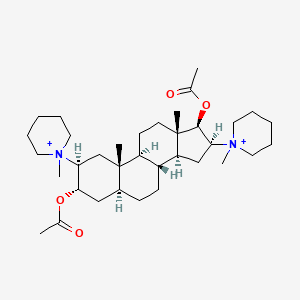
| Formula | C35H60N2O4+2 |
|---|---|
| Molecular weight | 572.88 g/mol |
| IUPAC name | [(2S,3S,5S,8R,9S,10S,13S,14S,16S,17R)-17-acetyloxy-10,13-dimethyl-2,16-bis(1-methylpiperidin-1-ium-1-yl)-2,3,4,5,6,7,8,9,11,12,14,15,16,17-tetradecahydro-1H-cyclopenta[a]phenanthren-3-yl] acetate |
| CAS | 16974-53-1 |
| PubChem CID | 441289 |
| InChIKey | GVEAYVLWDAFXET-XGHATYIMSA-N |
| logP | 6.11 (XLogP 6.6) |
| Polar surface area | 52.6 Ų |
| H-bond acceptors / donors | 4 / 0 |
| Drug-likeness (QED) | 0.30 |
| Lipinski violations | 2 |
SMILES
CC(=O)O[C@H]1C[C@@H]2CC[C@@H]3[C@H](CC[C@@]4(C)[C@H]3C[C@H]([N+]3(C)CCCCC3)[C@@H]4OC(C)=O)[C@@]2(C)C[C@@H]1[N+]1(C)CCCCC1Biology & Pharmacokinetics
Pharmacokinetics
| BBB penetrant | No |
|---|
Transporters
BCRP (Inhibitor)BSEP (Inhibitor)BSEP (Inhibitor)MRP1 (Inhibitor)MRP3 (Inhibitor)MRP4 (Inhibitor)OATP1B1 (Inhibitor)OATP1B3 (Inhibitor)OCT1 (Inhibitor)P-gp (Inhibitor)OCT1 (Substrate)P-gp (Substrate)
Drug–drug interactions (53, DDInter)
| Interacting drug | Severity | Management |
|---|---|---|
| Amikacin | major | |
| Amikacin (liposome) | major | |
| Gentamicin | major | |
| Kanamycin | major | |
| Neomycin | major | |
| Paromomycin | major | |
| Polymyxin B | major | |
| Streptomycin | major | |
| Aminophylline | moderate | |
| Amphotericin B | moderate | |
| Amphotericin B (cholesteryl sulfate) | moderate | |
| Amphotericin B (lipid complex) | moderate | |
| Amphotericin B (liposomal) | moderate | |
| Bacitracin | moderate | |
| Betamethasone | moderate | |
| Chloroquine | moderate | |
| Clindamycin | moderate | |
| Clindamycin (topical) | moderate | |
| Cyclophosphamide | moderate | |
| Cyclosporine | moderate | |
| Demeclocycline | moderate | |
| Dexamethasone | moderate | |
| Doxycycline | moderate | |
| Dyphylline | moderate | |
| Fludrocortisone | moderate | |
| Gentamicin (topical) | moderate | |
| Hydrocortisone | moderate | |
| Lidocaine | moderate | |
| Magnesium chloride | moderate | |
| Magnesium sulfate | moderate | |
| Mannitol | moderate | |
| Methylprednisolone | moderate | |
| Metoclopramide | moderate | |
| Minocycline | moderate | |
| Neomycin (topical) | moderate | |
| Oxtriphylline | moderate | |
| Oxytetracycline | moderate | |
| Oxytocin | moderate | |
| Prednisolone | moderate | |
| Prednisone | moderate |
Showing 40 of 53.
Registered Products (1)
| Brand | Form / strength | Pack | Agent | Citizen (JOD) |
|---|---|---|---|---|
| Alpax Ampoules | Ampoule 2 mg/ml | 2 ml | Hikma Pharmaceuticals Co.Ltd/Jordan | — |