Docetaxel
JFDA label: Adenex
- Increased mortality:
- Hepatic function impairment:
- Neutropenia:
- Hypersensitivity:
- Fluid retention:
- Fluid retention
- Neutropenia
- Hypersensitivity
Mechanism of Action
Inhibitor of Tubulin — Tubulin inhibitor
| Target | Action | Gene / class |
|---|---|---|
| Tubulin efficacy | INHIBITOR |
Indications
Approved
- Breast cancer
- Docefrez
- Gastric cancer
- Head and neck cancer
- NSCLC
- Non-small cell lung cancer
- Prostate cancer
- Taxotere (and various generic brands)
Off-label
- Bladder cancer, metastatic (single-agent)
- Esophageal cancer, chemoradiation
- Esophageal cancer, locally-advanced or metastatic disease
- Ewing sarcoma, osteosarcoma (recurrent or progressive)
- Ovarian cancer
- Prostate cancer, metastatic, hormone-sensitive
- Small cell lung cancer, relapsed
- Soft tissue sarcoma
- Unknown-primary, adenocarcinoma
Class profile
| mechanismClass | Plant alkaloid (semi-synthetic taxane) |
|---|---|
| targetMolecule | Beta-tubulin (stabilizes polymerization) |
| targetPathway | Mitotic spindle (G2/M arrest) |
| generation | 2nd generation taxane |
| primaryTumors | Breast,NSCLC,Prostate,Gastric,Head and neck |
| resistanceMechanisms | MDR1/P-gp efflux,Beta-III tubulin overexpression,CYP3A4 induction |
| source | NCCN/OncoKB/Goodman&Gilman13ed |
Contraindications
Source: Lexicomp
- Additional contraindications (not in the US labeling): Severe hepatic impairment Absolute
- Severe hypersensitivity to docetaxel or any component of the formulation Absolute
- breastfeeding Absolute
- neutrophil count 3 Absolute
- severe hypersensitivity to other medications containing polysorbate 80 Absolute
Adverse Reactions
Cardiac disorders (2)
Common Decreased left ventricular ejection fraction · hypotension
Nervous system disorders (2)
Very Common Central nervous system toxicity
Common Peripheral motor neuropathy
Hepatobiliary disorders (3)
Very Common Increased serum transaminases
Common increased serum alkaline phosphatase · Increased serum bilirubin
Blood and lymphatic system disorders (4)
Very Common anemia · febrile neutropenia · leukopenia · thrombocytopenia
Gastrointestinal disorders (5)
Very Common diarrhea · nausea · Stomatitis · vomiting
Common Dysgeusia
Skin and subcutaneous tissue disorders (3)
Very Common Alopecia · dermatological reaction · nail disease
Musculoskeletal and connective tissue disorders (4)
Very Common myalgia · neuromuscular reaction · Weakness
Common Arthralgia
Infections and infestations (2)
Very Common Infection
Common Severe infection
General disorders and administration site conditions (2)
Very Common Fever
Common Infusion site reactions
Respiratory, thoracic and mediastinal disorders (1)
Very Common Pulmonary reaction
Dosing
Source: Lexicomp
Warnings & Precautions
Source: Lexicomp
Bone marrow suppression
Patients with an absolute neutrophil count 3 should not receive docetaxel. Monitor blood counts frequently to monitor for neutropenia (which may be severe and result in infection). The dose-limiting toxicity is neutropenia. Platelets should recover to >100,000/mm3 prior to treatment. Patients with increased liver function tests experienced more episodes of neutropenia with a greater number of severe infections; monitor liver function tests frequently. Hematologic toxicity may require dose reduction or therapy discontinuation.
Cutaneous reactions
Cutaneous reactions, including erythema (with edema) and desquamation, have been reported; may require dose reduction.
Extravasation
Docetaxel is an irritant with vesicant-like properties; ensure proper needle or catheter placement prior to and during infusion; avoid extravasation.
Fluid retention
Severe fluid retention, characterized by pleural effusion (requiring immediate drainage), ascites with pronounced abdominal distention, peripheral edema (poorly tolerated), dyspnea at rest, cardiac tamponade, generalized edema, and weight gain, has been reported (despite the use of premedication with 3 days of dexamethasone). Fluid retention may begin as lower extremity peripheral edema and become generalized with a median weight gain of 2 kg. In patients with breast cancer, the median cumulative dose to onset of moderate or severe fluid retention was 819 mg/m2; fluid retention resolves in a median of 16 weeks after discontinuation. Patients should be premedicated with a corticosteroid (starting 1 day prior to administration) to reduce the incidence and severity of fluid retention. Closely monitor patients with existing effusions.
Hypersensitivity reactions
Severe hypersensitivity reactions, characterized by generalized rash/erythema, hypotension, bronchospasms, or rare anaphylaxis may occur (may be fatal; has occurred in patients receiving a 3-day corticosteroid premedication). Hypersensitivity reactions require immediate discontinuation of the docetaxel infusion and administration of appropriate therapy. Do not administer to patients with a history of severe hypersensitivity to docetaxel or polysorbate 80. Minor reactions including flushing or localized skin reactions may also occur. Observe for hypersensitivity, especially with the first 2 infusions. Discontinue for severe reactions; do not rechallenge if severe. Patients should be premedicated with a corticosteroid (starting 1 day prior to administration) to prevent or reduce the severity of hypersensitivity reactions.
Neurosensory symptoms
Dosage adjustment is recommended with severe neurosensory symptoms (paresthesia, dysesthesia, pain); persistent symptoms may require discontinuation. Reversal of symptoms may be delayed after discontinuation.
Ocular adverse effects
Cystoid macular edema (CME) has been reported; if vision impairment occurs, a prompt comprehensive ophthalmic exam is recommended. If CME is diagnosed, initiate appropriate CME management and discontinue docetaxel (consider non-taxane treatments). In a study of patients receiving docetaxel for the adjuvant treatment of breast cancer, a majority of patients experienced tearing, which occurred in patients with and without lacrimal duct obstruction at baseline. Onset was generally after cycle 1, but subsided in most patients within 4 months after therapy completion (Chan 2013).
Secondary malignancies
Treatment-related acute myeloid leukemia or myelodysplasia occurred in patients receiving docetaxel in combination with anthracyclines and/or cyclophosphamide.
Treatment-related mortality
Patients with abnormal liver function, those receiving higher doses, and patients with non–small cell lung cancer and a history of prior treatment with platinum derivatives who receive single-agent docetaxel at a dose of 100 mg/m2 are at higher risk for treatment-related mortality.
Weakness
Fatigue and weakness (may be severe) have been reported; symptoms may last a few days up to several weeks. In patients with progressive disease, weakness may be associated with a decrease in performance status. Disease-related concerns:
Heart failure
In a scientific statement from the American Heart Association, docetaxel has been determined to be an agent that may either cause direct myocardial toxicity or exacerbate underlying myocardial dysfunction (magnitude: moderate) (AHA [Page 2016]).
Hepatic impairment
Avoid use in patients with bilirubin exceeding upper limit of normal (ULN) or AST and/or ALT >1.5 times ULN in conjunction with alkaline phosphatase >2.5 times ULN. Patients with bilirubin elevations or abnormal transaminases (with concurrent abnormal alkaline phosphatase) are at increased risk for grade 4 neutropenia, neutropenic fever, infections, severe thrombocytopenia, severe stomatitis, severe skin toxicity, and toxic death. Patients with isolated transaminase elevations >1.5 times ULN also had a higher rate of grade 4 neutropenic fever, although no increased incidence of toxic death. Monitor bilirubin, AST or ALT, and alkaline phosphatase prior to each docetaxel cycle. The alcohol content of the docetaxel formulation should be taken into account when administering to patients with hepatic impairment. Concurrent drug therapy issues:
Drug-drug interactions
Potentially significant interactions may exist, requiring dose or frequency adjustment, additional monitoring, and/or selection of alternative therapy. Consult drug interactions database for more detailed information. Dosage form specific issues:
Alcohol content
Some docetaxel formulations contain alcohol (content varies by formulation), which may affect the central nervous system and cause symptoms of alcohol intoxication. Consider alcohol content and use with caution in patients for whom alcohol intake should be avoided or minimized. Patients should avoid driving or operating machinery immediately after the infusion. An FDA-approved non-alcohol generic formulation (20 mg/mL) is available.
Polysorbate 80
Some dosage forms may contain polysorbate 80 (also known as Tweens). Hypersensitivity reactions, usually a delayed reaction, have been reported following exposure to pharmaceutical products containing polysorbate 80 in certain individuals (Isaksson 2002; Lucente 2000; Shelley 1995). Thrombocytopenia, ascites, pulmonary deterioration, and renal and hepatic failure have been reported in premature neonates after receiving parenteral products containing polysorbate 80 (Alade 1986; CDC 1984). See manufacturer’s labeling. Other warnings/precautions:
Premedication
Premedication with oral corticosteroids is recommended to decrease the incidence and severity of fluid retention and severity of hypersensitivity reactions. The manufacturer recommends dexamethasone 16 mg/day (8 mg twice daily) orally for 3 days, starting the day before docetaxel administration; for prostate cancer, when prednisone is part of the antineoplastic regimen, dexamethasone 8 mg orally is administered at 12 hours, 3 hours, and 1 hour prior to docetaxel.
Pregnancy & Lactation
Pregnancy
Adverse events have been observed in animal reproduction studies. An ex vivo human placenta perfusion model illustrated that docetaxel crossed the placenta at term. Placental transfer was low and affected by the presence of albumin; higher albumin concentrations resulted in lower docetaxel placental transfer (Berveiller 2012). Some pharmacokinetic properties of docetaxel may be altered in pregnant women (van Hasselt 2014). Women of childbearing potential should avoid becoming pregnant during therapy. A pregnancy registry is available for all cancers diagnosed during pregnancy at Cooper Health (877-635-4499).
Lactation
It is not known if docetaxel is present in breast milk. Due to the potential for serious adverse reactions in breastfed infants, the manufacturer recommends a decision be made to discontinue breastfeeding or the drug, taking into account the importance of treatment to the mother.
Monitoring
| Efficacy | Tumour response (RECIST criteria, tumour markers, imaging); progression-free survival; performance status (ECOG/Karnofsky) |
|---|---|
| Toxicity | CBC with differential (nadir timing depends on agent); LFTs; renal function; ECG (QT for relevant agents); echocardiogram for cardiotoxic agents (anthracyclines, trastuzumab); cumulative dose tracking for dose-limited toxicities |
| Clinical pearl | Treatment response is assessed after 2–3 cycles. Grade 3–4 toxicities typically require dose reduction or interruption per protocol-defined criteria. |
| Counseling | Attend all scheduled blood tests and imaging appointments. Report fever > 38°C (risk of neutropaenic sepsis — medical emergency), unusual bleeding, or new pain immediately. |
Chemistry & Properties
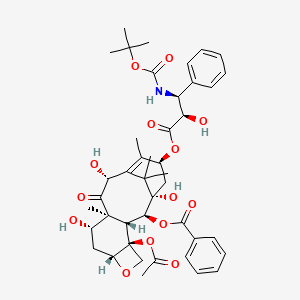
| Formula | C43H59NO17 |
|---|---|
| Molecular weight | 861.94 g/mol |
| IUPAC name | [(1S,2S,3R,4S,7R,9S,10S,12R,15S)-4-acetyloxy-1,9,12-trihydroxy-15-[(2R,3S)-2-hydroxy-3-[(2-methylpropan-2-yl)oxycarbonylamino]-3-phenylpropanoyl]oxy-10,14,17,17-tetramethyl-11-oxo-6-oxatetracyclo[11.3.1.03,10.04,7]heptadec-13-en-2-yl] benzoate |
| CAS | 114977-28-5 |
| PubChem CID | 148124 |
| InChIKey | XCDIRYDKECHIPE-QHEQPUDQSA-N |
| logP | 3.26 (XLogP 1.6) |
| Polar surface area | 224.45 Ų |
| H-bond acceptors / donors | 14 / 5 |
| Drug-likeness (QED) | 0.15 |
| Lipinski violations | 2 |
SMILES
CC(=O)O[C@@]12CO[C@@H]1C[C@H](O)[C@@]1(C)C(=O)[C@H](O)C3=C(C)[C@@H](OC(=O)[C@H](O)[C@@H](NC(=O)OC(C)(C)C)c4ccccc4)C[C@@](O)([C@@H](OC(=O)c4ccccc4)[C@H]21)C3(C)C.O.O.OBiology & Pharmacokinetics
Pharmacokinetics
| BBB penetrant | No |
|---|
Enzyme interactions
| Enzyme | Role | Detail |
|---|---|---|
| CYP2C8 | Inhibitor | — |
| CYP3A4 | Inhibitor | IC₅₀ 2.0000000000000004 µM |
| CYP3A4 | Substrate | — |
Transporters
BCRP (Inhibitor)BSEP (Inhibitor)BSEP (Inhibitor)MDR1 (Inhibitor)MRP1 (Inhibitor)MRP2 (Inhibitor)MRP3 (Inhibitor)MRP4 (Inhibitor)OATP1B1 (Inhibitor)OATP1B1 (Inhibitor)OATP1B3 (Inhibitor)OATP1B3 (Inhibitor)P-gp (Inhibitor)Transporter(unspecified) (Inhibitor)MDR1 (Substrate)MRP2 (Substrate)OAT2 (Substrate)OATP1A2 (Substrate)OATP1A5 (Substrate)OATP1B1 (Substrate)OATP1B3 (Substrate)OATP1C1 (Substrate)OATP3A1 (Substrate)OATP4A1 (Substrate)OATP5A1 (Substrate)P-gp (Substrate)
Drug–drug interactions (100+, DDInter)
| Interacting drug | Severity | Management |
|---|---|---|
| Adalimumab | major | |
| Amiodarone | major | |
| Amprenavir | major | |
| Atazanavir | major | |
| Bacillus calmette-guerin substrain tice live antigen | major | |
| Baricitinib | major | |
| Boceprevir | major | |
| Ceritinib | major | |
| Certolizumab pegol | major | |
| Cladribine | major | |
| Clarithromycin | major | |
| Clozapine | major | |
| Cobicistat | major | |
| Conivaptan | major | |
| Crizotinib | major | |
| Cyclosporine | major | |
| Deferiprone | major | |
| Delavirdine | major | |
| Diltiazem | major | |
| Dronedarone | major | |
| Erythromycin | major | |
| Etanercept | major | |
| Fingolimod | major | |
| Fosamprenavir | major | |
| Golimumab | major | |
| Idelalisib | major | |
| Indinavir | major | |
| Infliximab | major | |
| Itraconazole | major | |
| Ketoconazole | major | |
| Leflunomide | major | |
| Lonafarnib | major | |
| Measles virus vaccine live attenuated | major | |
| Mifepristone | major | |
| Mumps virus strain B level jeryl lynn live antigen | major | |
| Natalizumab | major | |
| Nefazodone | major | |
| Nelfinavir | major | |
| Ozanimod | major | |
| Posaconazole | major |
Showing 40 of 100+.
Registered Products (20)
| Brand | Form / strength | Pack | Agent | Citizen (JOD) |
|---|---|---|---|---|
| Adenex | Vial 80 mg/2 ml | 2 ml | Sun Set Drug Store | — |
| Adenex | Vial 20 mg/0.5 ml | 0.5 ml | Sun Set Drug Store | — |
| DOCETAXEL NEAPOLIS | Vial Docetaxel Anhydrous 20 mg/1 ml | 1 vial | Professional Drug Store | — |
| DOCETAXEL NEAPOLIS | Vial Docetaxel Anhydrous 80 mg/4 ml | 1 vial | Professional Drug Store | — |
| Docecan | Vial 20 mg/ml | 1 vial | Hikma Pharmaceuticals Co.Ltd/Jordan | — |
| Docecan | Vial 80 mg/4 ml | 1 vial | Hikma Pharmaceuticals Co.Ltd/Jordan | — |
| Docecan | Vial 160 mg/8 ml | 1 vial | Hikma Pharmaceuticals Co.Ltd/Jordan | — |
| Docelina | Vial 80 mg/4 ml | 1 vial | MS PHARMA/JORDAN | — |
| Docelina | Vial 20 mg/1 ml | 1 vial | MS PHARMA/JORDAN | — |
| Docetaxel | Vial 20 mg/2 ml | 1 vial | Sabbagh Drug Store | — |
| Docetaxel Accord | Vial 20 mg/ml | 1 vial | شركة مستودع ادوية جرينلاند | — |
| Docetaxel Actavis | Vial 80 mg/2 ml | 2 vial | Beta Drug Store | — |
| Docetaxel Actavis 20mg/0.5ml | Vial 20 mg/0.5 ml | 2 vial | Beta Drug Store | — |
| Docetaxel Ebewe 80mg/8ml Concentrate for Solution for Infusion | Infusion 80 mg/8 ml | 1 vial | Sabbagh Drug Store | — |
| Docetaxel Hospira | Vial 20 mg/2 ml | 1 vial | Petra Drug Store | — |
| Docetaxel Hospira | Vial 80 mg/8 ml | 1 vial | Petra Drug Store | — |
| Docetaxel Hospira | Vial 160 mg/16 ml | 1 vial | Petra Drug Store | — |
| Docetaxel accord | Vial 80 mg/4 ml | 1 vial | شركة مستودع ادوية جرينلاند | — |
| Taxotere | Vial 20 mg/1 ml | 1 vial | Ulfa Pharma Co. | — |
| Taxotere 80mg/4ml Concentrate For Solution For Infusion | Infusion 80 mg/4 ml | 1 vial | Ulfa Pharma Co. | — |