Dacarbazine
JFDA label: Dacarbazine Medac 500mg
- Experienced physician:
- Bone marrow suppression:
- Hepatic effects:
- Carcinogenic/teratogenic:
Mechanism of Action
Inhibitor of DNA — DNA inhibitor
| Target | Action | Gene / class |
|---|---|---|
| DNA efficacy | INHIBITOR |
Indications
Approved
- Hodgkin lymphoma
- Metastatic malignant melanoma
Off-label
- Medullary thyroid cancer (advanced)
- Pancreatic neuroendocrine tumors (advanced)
- Pheochromocytoma (malignant)
- Soft-tissue sarcomas (advanced)
Contraindications
Source: Lexicomp
- Additional contraindications (not in the US labeling): Prior severe myelosuppression Absolute
- Hypersensitivity to dacarbazine or any component of the formulation Absolute
Adverse Reactions
Nervous system disorders (1)
Not Known Infusion-site pain
Blood and lymphatic system disorders (3)
Not Known Bone marrow depression (onset: 5 to 7 days; nadir: 7 to 10 days; recovery: 21 to 28 days) · leukopenia · thrombocytopenia
Gastrointestinal disorders (2)
Not Known anorexia · Nausea and vomiting
Skin and subcutaneous tissue disorders (1)
Not Known Alopecia
Dosing
Source: Lexicomp
Warnings & Precautions
Source: Lexicomp
Anaphylaxis
May occur following dacarbazine administration.
Bone marrow suppression
Bone marrow suppression is the most common toxicity; leukopenia and thrombocytopenia may be severe; may result in treatment delays or discontinuation; anemia may also occur. Monitor CBC with differential. The onset for leukopenia is ~14 days (range: 10 to 30 days) and the duration is ~1 to 3 weeks. The onset for thrombocytopenia is ~18 days (range: 12 to 30 days) and the duration is ~1 to 3 weeks.
Carcinogenic/teratogenic
Studies have demonstrated this agent to be carcinogenic and/or teratogenic when used in animals.
Extravasation
Dacarbazine is an irritant; local reactions may occur (Perez Fidalgo 2012). According to the manufacturer, extravasation may result in tissue damage and severe pain.
Gastrointestinal toxicity
Dacarbazine is associated with a high emetic potential; antiemetics are recommended to prevent nausea and vomiting (Dupuis 2011; Hesketh 2017; Roila 2016).
Hepatic effects
Hepatic necrosis has been reported. Hepatotoxicity may be accompanied with hepatic vein thrombosis and hepatocellular necrosis; may be fatal. Hepatotoxicity usually occurs with combination chemotherapy, but may occur with dacarbazine alone. Disease-related concerns:
Hepatic impairment
Use with caution in patients with hepatic impairment; half-life is increased, monitor for toxicity and consider dosage reduction.
Renal impairment
Use with caution in patients with renal impairment; half-life is increased, monitor for toxicity and consider dosage reduction. Concurrent drug therapy issues:
Drug-drug interactions
Potentially significant interactions may exist, requiring dose or frequency adjustment, additional monitoring, and/or selection of alternative therapy. Consult drug interactions database for more detailed information. Other warnings/precautions:
Experienced physician
Should be administered under the supervision of an experienced cancer chemotherapy physician. Carefully evaluate the potential benefits of therapy against the risk for toxicity. Adequate laboratory facilities should be available for appropriate monitoring.
Pregnancy & Lactation
Pregnancy
[US Boxed Warning]: Studies have demonstrated this agent to be carcinogenic and/or teratogenic when used in animals; adverse effects have been observed in animal reproduction studies. Women of reproductive potential should avoid becoming pregnant during treatment. The European Society for Medical Oncology has published guidelines for diagnosis, treatment, and follow-up of cancer during pregnancy. The guidelines recommend referral to a facility with expertise in cancer during pregnancy and encourage a multidisciplinary team (obstetrician, neonatologist, oncology team). In general, if chemotherapy is indicated, it should be avoided during in the first trimester, there should be a 3-week time period between the last chemotherapy dose and anticipated delivery, and chemotherapy should not be administered beyond week 33 of gestation (Peccatori 2013). An international consensus panel has published guidelines for hematologic malignancies during pregnancy. Dacarbazine is a component of the ABVD
Lactation
It is not known if dacarbazine is excreted in breast milk. Due to the potential for serious adverse reactions in the breast-feeding infant, a decision should be made to discontinue dacarbazine or to discontinue breast-feeding, taking into account the benefits of treatment to the mother.
Monitoring
| Clinical pearl | CBC with differential, liver function |
|---|
Chemistry & Properties
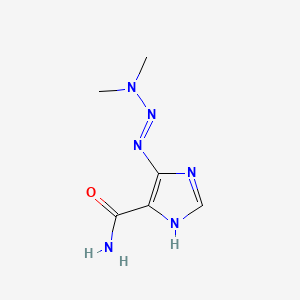
| Formula | C6H10N6O |
|---|---|
| Molecular weight | 182.19 g/mol |
| IUPAC name | 4-[(E)-dimethylaminodiazenyl]-1H-imidazole-5-carboxamide |
| CAS | 4342-03-4 |
| PubChem CID | 135398738 |
| InChIKey | FDKXTQMXEQVLRF-ZHACJKMWSA-N |
| logP | 0.07 (XLogP -0.6) |
| Polar surface area | 99.73 Ų |
| H-bond acceptors / donors | 4 / 2 |
| Drug-likeness (QED) | 0.51 |
| Lipinski violations | 0 |
SMILES
CN(C)/N=N/c1[nH]cnc1C(N)=OBiology & Pharmacokinetics
Pharmacokinetics predicted
| Bioavailability | 10.0% |
|---|---|
| Half-life | 1.373 h |
| Volume of distribution | 1.028 L/kg |
| Protein binding | 5.2% |
| BBB penetrant | No |
Enzyme interactions
| Enzyme | Role | Detail |
|---|---|---|
| CYP1A2 | Inhibitor | — |
| CYP1A2 | Substrate | — |
| CYP2C8 | Inhibitor | — |
Transporters
BCRP (Inhibitor)BSEP (Inhibitor)BSEP (Inhibitor)MRP1 (Inhibitor)MRP2 (Inhibitor)MRP3 (Inhibitor)MRP4 (Inhibitor)OATP1B1 (Inhibitor)OATP1B1 (Inhibitor)OATP1B3 (Inhibitor)OATP1B3 (Inhibitor)P-gp (Inhibitor)P-gp (Substrate)
Drug–drug interactions (100+, DDInter)
| Interacting drug | Severity | Management |
|---|---|---|
| Adalimumab | major | |
| Aldesleukin | major | |
| Bacillus calmette-guerin substrain tice live antigen | major | |
| Baricitinib | major | |
| Certolizumab pegol | major | |
| Cladribine | major | |
| Clozapine | major | |
| Deferiprone | major | |
| Etanercept | major | |
| Fingolimod | major | |
| Golimumab | major | |
| Infliximab | major | |
| Leflunomide | major | |
| Lomitapide | major | |
| Measles virus vaccine live attenuated | major | |
| Mipomersen | major | |
| Mumps virus strain B level jeryl lynn live antigen | major | |
| Nalidixic acid | major | |
| Natalizumab | major | |
| Ozanimod | major | |
| Pexidartinib | major | |
| Rotavirus vaccine | major | |
| Rubella virus vaccine | major | |
| Samarium (153Sm) lexidronam | major | |
| Siponimod | major | |
| Smallpox (Vaccinia) Vaccine, Live | major | |
| Talimogene laherparepvec | major | |
| Teriflunomide | major | |
| Thalidomide | major | |
| Tofacitinib | major | |
| Typhoid vaccine (live) | major | |
| Upadacitinib | major | |
| Varicella Zoster Vaccine (Recombinant) | major | |
| Yellow Fever Vaccine | major | |
| Alefacept | moderate | |
| Alemtuzumab | moderate | |
| Anakinra | moderate | |
| Anthrax vaccine | moderate | |
| Asparaginase Erwinia chrysanthemi | moderate | |
| Asparaginase Escherichia coli | moderate |
Showing 40 of 100+.
Registered Products (2)
| Brand | Form / strength | Pack | Agent | Citizen (JOD) |
|---|---|---|---|---|
| Dacarbazine Medac | Vial 500 mg | 1 vial | Pharma Care Drug Store | — |
| Dacarbazine Medac | Vial 200 mg | 10 vial | Pharma Care Drug Store | — |