Tirofiban
JFDA label: Ribofan
Mechanism of Action
A reversible antagonist of fibrinogen binding to the glycoprotein (GP) IIb/IIIa receptor, the major platelet surface receptor involved in platelet aggregation. When administered intravenously, it inhibits ex vivo platelet aggregation in a dose- and concentration-dependent manner. When given according to the recommended regimen, >90% inhibition is attained within 10 minutes after initiation. Platelet aggregation inhibition is reversible following cessation of the infusion.
Indications
Approved
- Unstable angina/non-ST-elevation myocardial infarction
Off-label
- To support PCI (administered at the time of PCI) for ST-elevation myocardial infarction (STEMI)
- To support PCI (administered at the time of elective PCI) for stable ischemic heart disease (high risk features)
Contraindications
Source: Lexicomp
- Additional contraindications (not in US labeling): History of thrombocytopenia following prior exposure to any other GPIIb/IIIa inhibitor Absolute
- Severe hypersensitivity reaction (ie, anaphylactic reaction) to tirofiban or any component of the formulation Absolute
- active internal bleeding or a history of bleeding diathesis, major surgical procedure, or severe physical trauma within the previous month Absolute
- acute pericarditis Absolute
- angina precipitated by obvious provoking factors (eg, arrhythmia, severe anemia, hyperthyroidism, hypotension) Absolute
- cirrhosis or clinically significant liver disease Absolute
- current use with other GP IIb/IIIa inhibitors Absolute
- history of intracranial hemorrhage or neoplasm, arteriovenous malformation, or aneurysm Absolute
- history of thrombocytopenia following prior exposure to tirofiban Absolute
- history, symptom or findings suggestive of aortic dissection Absolute
- known coagulopathy, platelet disorder or history of thrombocytopenia Absolute
- major surgical procedure or relevant trauma within the previous 6 weeks Absolute
- malignant or severe uncontrolled hypertension (>180 mmHg/110 mmHg) Absolute
- recent (within the previous 30 days) internal bleeding Absolute
- recent epidural procedure Absolute
- stroke within 30 days prior to hospitalization or any history of hemorrhagic stroke Absolute
Adverse Reactions
Cardiac disorders (4)
Common bradycardia · Coronary artery dissection · edema · vasodepressor syncope
Nervous system disorders (2)
Common Dizziness · headache
Renal and urinary disorders (1)
Common Pelvic pain
Blood and lymphatic system disorders (2)
Common Major hemorrhage · thrombocytopenia: 3
Gastrointestinal disorders (1)
Common Nausea
Skin and subcutaneous tissue disorders (1)
Common Diaphoresis
Musculoskeletal and connective tissue disorders (1)
Common Leg pain
General disorders and administration site conditions (1)
Common Fever
Other (1)
Very Common Hematologic & oncologic: Minor hemorrhage
Dosing
Source: Lexicomp
Warnings & Precautions
Source: Lexicomp
Bleeding
The most common complication is bleeding, including retroperitoneal, pulmonary, and spontaneous GI and/or GU bleeding; watch closely for bleeding, especially the arterial access site for the cardiac catheterization. Fatal bleeding has been reported. Use with extreme caution in patients with platelet counts 3, patients with hemorrhagic retinopathy, previous history of GI disease, recent thrombolytic therapy and in chronic dialysis patients. Use caution with administration of other drugs affecting hemostasis. Minimize other procedures including arterial and venous punctures, IM injections, nasogastric tubes, etc.
Thrombocytopenia
Profound thrombocytopenia has been reported with use of tirofiban. If during therapy platelet count decreases to 3, monitor platelet counts to exclude pseudothrombocytopenia. If thrombocytopenia is confirmed, discontinue tirofiban and heparin if administered concurrently. Platelet counts should recover rapidly (within 1 to 5 days) after discontinuation. Previous exposure to a glycoprotein IIb/IIIa inhibitor may increase the risk of thrombocytopenia. Use is contraindicated in patients with a history of thrombocytopenia following exposure to tirofiban. Specific management guidelines for GP IIb/IIIa induced thrombocytopenia have been published (Huxtable 2006; Llevadot 2000). Disease-related concerns:
Renal impairment
Dosage reduction of the maintenance infusion rate is necessary in patients with CrCl ≤60 mL/minute. Other warnings/precautions:
Percutaneous coronary intervention
Sheath removal: Prior to pulling the sheath, ACT should be • Surgery: Discontinue at least 2 to 4 hours prior to coronary artery bypass graft surgery (ACC/AHA [Amsterdam 2014]; ACCF/AHA [Hillis, 2011]).
Pregnancy & Lactation
Pregnancy
Adverse events have not been observed in animal reproduction studies. Information related to use in pregnancy is limited; successful use during pregnancy has been described in a case report (Boztosun, 2008).
Lactation
It is not known if tirofiban is excreted in breast milk. Due to the potential for serious adverse reactions in the nursing infant, a decision should be made whether to discontinue nursing or to discontinue the drug, taking into account the importance of treatment to the mother.
LactMed: monitor the infant.
Monitoring
| Clinical pearl | Platelet count (baseline; 6 hours after initiation and daily thereafter during therapy). Monitor platelet counts more closely in patients who have had previous exposure to glycoprotein IIb/IIa antagonists. Persistent reductions of platelet counts 3 may require interruption or discontinuation of infusion; hemoglobin and hematocrit; signs of bleeding. Standard post-PCI assessment if patient undergoes PCI (eg, monitoring vascular access site, monitoring for chest pain and signs of bleeding) |
|---|
Chemistry & Properties
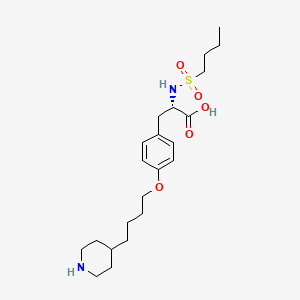
| Formula | C22H36N2O5S |
|---|---|
| Molecular weight | 440.61 g/mol |
| IUPAC name | (2S)-2-(butylsulfonylamino)-3-[4-(4-piperidin-4-ylbutoxy)phenyl]propanoic acid |
| CAS | 144494-65-5 |
| PubChem CID | 60947 |
| InChIKey | COKMIXFXJJXBQG-NRFANRHFSA-N |
| logP | 2.95 (XLogP 1.4) |
| Polar surface area | 104.73 Ų |
| H-bond acceptors / donors | 5 / 3 |
| Drug-likeness (QED) | 0.38 |
| Lipinski violations | 0 |
SMILES
CCCCS(=O)(=O)N[C@@H](Cc1ccc(OCCCCC2CCNCC2)cc1)C(=O)OBiology & Pharmacokinetics
Pharmacokinetics predicted
| Bioavailability | 70.0% |
|---|---|
| Half-life | 0.761 h |
| Volume of distribution | 1.055 L/kg |
| Protein binding | 63.3% |
| BBB penetrant | No |
Enzyme interactions
| Enzyme | Role | Detail |
|---|---|---|
| CYP2C19 | Substrate | — |
| CYP3A4 | Substrate | — |
Receptor binding (top 1)
| Target | Action | Affinity |
|---|---|---|
| integrin αIIbβ3 (ITGA2B|ITGB3) | Inhibitor | pIC50 9.4 |
Transporters
BCRP (Inhibitor)BSEP (Inhibitor)MRP1 (Inhibitor)OATP1B1 (Inhibitor)OATP1B3 (Inhibitor)P-gp (Inhibitor)P-gp (Substrate)
Drug–drug interactions (100+, DDInter)
| Interacting drug | Severity | Management |
|---|---|---|
| Abciximab | major | |
| Acalabrutinib | major | |
| Alteplase | major | |
| Anagrelide | major | |
| Anisindione | major | |
| Anistreplase | major | |
| Apixaban | major | |
| Ardeparin | major | |
| Argatroban | major | |
| Avapritinib | major | |
| Betrixaban | major | |
| Cabozantinib | major | |
| Cangrelor | major | |
| Caplacizumab | major | |
| Clopidogrel | major | |
| Dalteparin | major | |
| Danaparoid | major | |
| Dasatinib | major | |
| Deferasirox | major | |
| Defibrotide | major | |
| Desirudin | major | |
| Dicoumarol | major | |
| Dipyridamole | major | |
| Drotrecogin alfa | major | |
| Edoxaban | major | |
| Enoxaparin | major | |
| Eptifibatide | major | |
| Fondaparinux | major | |
| Heparin | major | |
| Ibritumomab tiuxetan | major | |
| Ibrutinib | major | |
| Inotersen | major | |
| Lepirudin | major | |
| Omacetaxine mepesuccinate | major | |
| Panobinostat | major | |
| Ponatinib | major | |
| Prasugrel | major | |
| Ramucirumab | major | |
| Regorafenib | major | |
| Reteplase | major |
Showing 40 of 100+.
Registered Products (4)
| Brand | Form / strength | Pack | Agent | Citizen (JOD) |
|---|---|---|---|---|
| Aggrastat Concentrate For Infusion | Infusion 0.25 mg/ml | 1 vial | Adatco Drug Store | — |
| Fibrostat | Vial 281.0 mcg/1 ml | 1 vial | / HIKMA PHARMACEUTICALS.IND/JORDAN / General / / HIKMA PHARMACEUTICALS.IND/JORDAN / General / General / / HIKMA PHARMACE | — |
| Ribofan | Vial 0.25 mg/ml | 1 vial | MS PHARMA/JORDAN | — |
| Tirofiban Altan 0.05 mg/mL solution for infusion | Infusion 12.5 mg/250 ml | 1 BAG/1 BOX | Reda Jardaneh Drug Store | — |