Atomoxetine
JFDA label: Strattera Hard Capsule
- Suicidal ideation in children and adolescents:
Mechanism of Action
Selectively inhibits the reuptake of norepinephrine (Ki 4.5 nM) with little to no activity at the other neuronal reuptake pumps or receptor sites.
Indications
Approved
- Attention-deficit/hyperactivity disorder
Contraindications
Source: Lexicomp
- Additional contraindications (not in U.S. labeling): Symptomatic cardiovascular diseases, moderate-to-severe hypertension Absolute
- Hypersensitivity to atomoxetine or any component of the formulation Absolute
- advanced arteriosclerosis Absolute
- current or past history of pheochromocytoma Absolute
- narrow-angle glaucoma Absolute
- severe cardiac or vascular disorders in which the condition would be expected to deteriorate with clinically important increases in blood pressure (eg, 15 to 20 mm Hg) or heart rate (eg, 20 beats/minute ) Absolute
- uncontrolled hyperthyroidism Absolute
- use with or within 14 days of MAO inhibitors Absolute
Adverse Reactions
Cardiac disorders (9)
Common cold extremities · flushing · Increased diastolic blood pressure · orthostatic hypotension · palpitations · prolonged Q-T interval on ECG · syncope · systolic hypertension · tachycardia
Nervous system disorders (18)
Very Common drowsiness · Headache · insomnia
Common abnormal dreams · agitation · anxiety · chills · depression · disturbed sleep · dizziness · emotional lability · Fatigue · hostility · irritability · jitteriness · paresthesia · restlessness · sensation of cold
Renal and urinary disorders (10)
Very Common Erectile dysfunction
Common dysmenorrhea · dysuria · Ejaculatory disorder · orgasm abnormal · pollakiuria · prostatitis · testicular pain · urinary frequency · urinary retention
Metabolism and nutrition disorders (5)
Common decreased libido · hot flash · increased thirst · menstrual disease · Weight loss
Gastrointestinal disorders (10)
Very Common abdominal pain · constipation · decreased appetite · nausea · vomiting · Xerostomia
Common anorexia · dysgeusia · Dyspepsia · flatulence
Skin and subcutaneous tissue disorders (5)
Very Common Hyperhidrosis
Common Excoriation · pruritus · skin rash · urticaria
Musculoskeletal and connective tissue disorders (3)
Common muscle spasm · Tremor · weakness
Eye disorders (3)
Common Blurred vision · conjunctivitis · mydriasis
General disorders and administration site conditions (1)
Common Therapeutic response unexpected
Respiratory, thoracic and mediastinal disorders (1)
Common Pharyngolaryngeal pain
Dosing
Source: Lexicomp
Warnings & Precautions
Source: Lexicomp
Aggressive behavior
New or worsening symptoms of hostility or aggressive behaviors have been associated with atomoxetine, particularly with the initiation of therapy.
Allergic reactions
Anaphylactic reactions, angioneurotic edema, urticaria, and rash may occur (rare).
Altered cardiac conduction
In clinical trials, at therapeutic doses, atomoxetine consistently did not prolong the QT/QTc interval; however, one placebo-controlled study in healthy CYP2D6 poor metabolizers demonstrated a statistically significant increase in QTc with increasing atomoxetine concentrations (Loghin 2012; Martinez-Raga 2013). Case reports suggest that atomoxetine overdose may increase the QT interval; however, this occurred when atomoxetine was combined with other agents known to have QT prolongation potential or inhibit CYP2D6 (Barker 2004; Sawant 2004). Atomoxetine, at high concentrations ex vivo, has demonstrated hERG channel block (Scherer 2009).
Cardiovascular events
Atomoxetine has been associated with serious cardiovascular events including sudden death in patients with preexisting structural cardiac abnormalities or other serious heart problems (sudden death in children and adolescents; sudden death, stroke, and MI in adults). Atomoxetine should be avoided in patients with known serious structural cardiac abnormalities, cardiomyopathy, serious heart rhythm abnormalities, or other serious cardiac problems that could increase the risk of sudden death that these conditions alone carry. Patients should be carefully evaluated for cardiac disease prior to initiation of therapy. Perform a prompt cardiac evaluation in patients who develop symptoms of exertional chest pain, unexplained syncope, or other symptoms suggestive of cardiac disease during treatment.
Hepatotoxicity
Use may be associated with rare but severe hepatotoxicity, including hepatic failure; discontinue and do not restart if signs or symptoms of hepatotoxic reaction (eg, jaundice, pruritus, flu-like symptoms, dark urine, right upper quadrant tenderness) or laboratory evidence of liver injury are noted. The majority of reported cases occurred within 120 days of initiation of therapy.
Orthostasis
Orthostasis and subsequent syncope may occur. Use with caution in patients predisposed to hypotension, or with conditions associated with abrupt heart rate or blood pressure changes.
Priapism
Prolonged and painful erections (priapism), sometimes requiring surgical intervention, have been reported (rarely) with methylphenidate and atomoxetine use in pediatric and adult patients. Priapism has been reported to develop after some time on the drug, often subsequent to an increase in dose but also during a period of drug withdrawal (drug holidays or discontinuation). Patients with certain hematological dyscrasias (eg, sickle cell disease), malignancies, perineal trauma, or concomitant use of alcohol, illicit drugs, or other medications associated with priapism may be at increased risk. Patients who develop abnormally sustained or frequent and painful erections should discontinue therapy and seek immediate medical attention. An emergent urological consultation should be obtained in severe cases. Priapism has been associated with different dosage forms and products; it is not known if rechallenge with a different formulation will risk recurrence. Avoidance of stimulants and atomoxetine may be preferred in patients with severe cases that were slow to resolve and/or required detumescence (Eiland, 2014).
Psychiatric effects
Treatment-emergent psychotic or manic symptoms (eg, hallucinations, delusional thinking, mania) may occur in children and adolescents without a prior history of psychotic illness or mania. Consider discontinuation of treatment if symptoms occur. Disease-related concerns:
ADHD and comorbidities
Randomized, controlled trials have demonstrated that atomoxetine does not worsen anxiety in patients with existing anxiety disorders or tics related to Tourette’s disorder.
Bipolar disorder
Use caution in patients with comorbid bipolar disorder; therapy may induce mixed/manic episodes. Atomoxetine is not approved for major depressive disorder; patients presenting with depressive symptoms should be screened for bipolar disorder.
Hepatic impairment
Use with caution in patients with hepatic impairment; dosage adjustments necessary in moderate and severe hepatic insufficiency.
Hypertension
Use with caution in patients with hypertension and other cardiovascular or cerebrovascular conditions that might be exacerbated by increases in blood pressure or heart rate. CYP2D6 poor metabolizers may experience greater increases in blood pressure and heart rate effects.
Urinary retention
Use with caution in patients with a history of urinary retention or bladder outlet obstruction; may cause urinary retention/hesitancy. Special populations:
CYP2D6 poor metabolizers
Dosage adjustments are recommended in CYP2D6 poor metabolizers; these patients have increased exposure to atomoxetine.
Pediatric
[US. Boxed Warning]: Use with caution in pediatric patients; may be an increased risk of suicidal ideation. Closely monitor for clinical worsening, suicidality, or unusual changes in behavior; especially during the initial few months of a course of drug therapy, or at times of dose changes, either increases or decreases. The family or caregiver should be instructed to closely observe the patient and communicate condition with healthcare provider. Growth should be monitored during treatment. Height and weight gain may be reduced during the first 9 to 12 months of treatment, but should recover by 3 years of therapy. Other warnings/precautions:
ADHD treatment
Appropriate use: Recommended to be used as part of a comprehensive treatment program for attention deficit disorders.
Pregnancy & Lactation
Pregnancy
Adverse events have been observed in animal reproduction studies. Information related to atomoxetine use in pregnancy is limited; appropriate contraception is recommended for sexually active women of childbearing potential (Heiligenstein, 2003).
Lactation
It is not known if atomoxetine is excreted in breast milk. The manufacturer recommends that caution be exercised when administering atomoxetine to nursing women.
LactMed: monitor the infant.
Monitoring
| Clinical pearl | Patient growth (weight/height gain in children); attention, hyperactivity, anxiety, worsening of aggressive behavior or hostility; blood pressure and pulse (baseline and following dose increases and periodically during treatment) Family members and caregivers need to monitor patient daily for emergence of irritability, agitation, unusual changes in behavior, and suicide ideation. Pediatric patients should be monitored closely for suicidality, clinical worsening, or unusual changes in behavior, especially during the initial for months of therapy or at times of dose changes. Appearance of symptoms needs to be immediately reported to healthcare provider. Thoroughly evaluate for cardiovascular risk. Monitor heart rate, blood pressure, and consider obtaining ECG prior to initiation (Martinez-Raga, 2013; Vetter, 2008). Periodically reevaluate the long-term usefulness of the drug for the individual patient. |
|---|
Chemistry & Properties
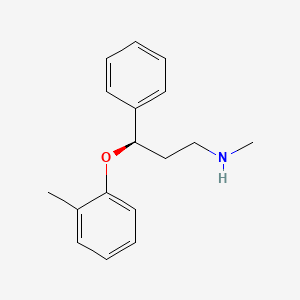
| Formula | C17H21NO |
|---|---|
| Molecular weight | 255.36 g/mol |
| IUPAC name | (3R)-N-methyl-3-(2-methylphenoxy)-3-phenylpropan-1-amine |
| CAS | 83015-26-3 |
| PubChem CID | 54841 |
| InChIKey | VHGCDTVCOLNTBX-QGZVFWFLSA-N |
| logP | 3.72 (XLogP 3.7) |
| Polar surface area | 21.26 Ų |
| H-bond acceptors / donors | 2 / 1 |
| Drug-likeness (QED) | 0.85 |
| Lipinski violations | 0 |
SMILES
CNCC[C@@H](Oc1ccccc1C)c1ccccc1Biology & Pharmacokinetics
Pharmacokinetics
| BBB penetrant | Yes |
|---|
Enzyme interactions
| Enzyme | Role | Detail |
|---|---|---|
| CYP1A2 | Inhibitor | — |
| CYP1A2 | Substrate | — |
| CYP2B6 | Substrate | — |
| CYP2C19 | Substrate | — |
| CYP2C9 | Substrate | — |
| CYP2D6 | Inhibitor | IC₅₀ 2.0000000000000004 µM |
| CYP2D6 | Substrate | — |
| CYP3A4 | Inhibitor | — |
| CYP3A4 | Substrate | — |
Receptor binding (top 23)
| Target | Action | Affinity |
|---|---|---|
| NET (SLC6A2) | Inhibitor | pKd 8.7 |
| Norepinephrine transporter | Binding | pKi 8.4 |
| SERT (SLC6A4) | Inhibitor | pKd 8.1 |
| 5-HT Transporter (SLC6A4) | Binding | pKi 7.4 |
| 5-HT2 | Binding | pKi 6.0 |
| adrenergic Alpha2A (ADRA2A) | Binding | pKi 6.0 |
| DOPAMINE D2 (DRD2) | Binding | pKi 6.0 |
| Cholinergic, muscarinic M1 (CHRM1) | Binding | pKi 6.0 |
| Cholinergic, muscarinic M2 (CHRM2) | Binding | pKi 6.0 |
| 5-HT1A (HTR1A) | Binding | pKi 6.0 |
| 5-HT1B (HTR1B) | Binding | pKi 6.0 |
| 5-HT1D (HTR1D) | Binding | pKi 6.0 |
| 5-HT2A (HTR2A) | Binding | pKi 6.0 |
| 5-HT2C (HTR2C) | Binding | pKi 6.0 |
| 5-HT6 (HTR6) | Binding | pKi 6.0 |
Transporters
BCRP (Inhibitor)BSEP (Inhibitor)BSEP (Inhibitor)MRP1 (Inhibitor)MRP2 (Inhibitor)MRP3 (Inhibitor)MRP4 (Inhibitor)OATP1B1 (Inhibitor)OATP1B1 (Inhibitor)OATP1B3 (Inhibitor)OATP1B3 (Inhibitor)OATP2B1 (Inhibitor)OCT2 (Inhibitor)P-gp (Inhibitor)MDR1 (Substrate)P-gp (Substrate)
Drug–drug interactions (100+, DDInter)
| Interacting drug | Severity | Management |
|---|---|---|
| Anagrelide | major | |
| Arsenic trioxide | major | |
| Cabozantinib | major | |
| Ceritinib | major | |
| Chloroquine | major | |
| Cinacalcet | major | |
| Cisapride | major | |
| Cocaine (nasal) | major | |
| Cocaine (topical) | major | |
| Crizotinib | major | |
| Dacomitinib | major | |
| Dolasetron | major | |
| Fingolimod | major | |
| Halofantrine | major | |
| Hydroxychloroquine | major | |
| Ivosidenib | major | |
| Leflunomide | major | |
| Macimorelin | major | |
| Methylene blue | major | |
| Nilotinib | major | |
| Osimertinib | major | |
| Ozanimod | major | |
| Panobinostat | major | |
| Papaverine | major | |
| Pasireotide | major | |
| Procarbazine | major | |
| Ribociclib | major | |
| Siponimod | major | |
| Teriflunomide | major | |
| Toremifene | major | |
| Vandetanib | major | |
| Vemurafenib | major | |
| Abarelix | moderate | |
| Abiraterone | moderate | |
| Alimemazine | moderate | |
| Apalutamide | moderate | |
| Asparaginase Escherichia coli | moderate | |
| Astemizole | moderate | |
| Bicalutamide | moderate | |
| Bisacodyl | moderate |
Showing 40 of 100+.
Registered Products (14)
| Brand | Form / strength | Pack | Agent | Citizen (JOD) |
|---|---|---|---|---|
| Axepta | Capsule 10 mg | 30 cap | UNITED PHARM.MFG.CO.LTD(UPM)/JORDAN | 18.410 |
| Strattera Hard Capsule | Capsule 10 mg | 28 cap | THE ARAB DRUG STORE P.S.C | 19.090 |
| Axepta | Tablet 18 mg | 30 tab | UNITED PHARM.MFG.CO.LTD(UPM)/JORDAN | 21.650 |
| Axepta | Tablet 25 mg | 30 tab | UNITED PHARM.MFG.CO.LTD(UPM)/JORDAN | 21.650 |
| Axepta | Tablet 40 mg | 30 tab | UNITED PHARM.MFG.CO.LTD(UPM)/JORDAN | 21.650 |
| Strattera Hard Capsules | Capsule 18 mg | 28 cap | THE ARAB DRUG STORE P.S.C | 22.450 |
| Strattera Hard Capsules | Capsule 25 mg | 28 cap | THE ARAB DRUG STORE P.S.C | 22.450 |
| Strattera Hard Capsules | Capsule 40 mg | 28 cap | THE ARAB DRUG STORE P.S.C | 22.450 |
| Axepta | Tablet 60 mg | 30 tab | UNITED PHARM.MFG.CO.LTD(UPM)/JORDAN | 32.480 |
| Strattera Hard Capsules | Capsule 60 mg | 28 cap | THE ARAB DRUG STORE P.S.C | 33.680 |
| Amotex 25 | Tablet 25 mg | 28 tab | THE JORDANIAN PHARMACEUTICAL MANUFACTURING COMPANY/JORDAN | 59.080 |
| Axepta | Capsule 80.0 mg | 30 cap | UNITED PHARM.MFG.CO.LTD(UPM)/JORDAN | 59.330 |
| Amotex 40 | Tablet 40 mg | 32 tab | THE JORDANIAN PHARMACEUTICAL MANUFACTURING COMPANY/JORDAN | 67.520 |
| Amotex 60 | Tablet 60 mg | 32 tab | THE JORDANIAN PHARMACEUTICAL MANUFACTURING COMPANY/JORDAN | 67.520 |