Brivaracetam
JFDA label: Provecta
Mechanism of Action
Modulator of Synaptic vesicle glycoprotein 2A — Synaptic vesicle glycoprotein 2A modulator
| Target | Action | Gene / class |
|---|---|---|
| Synaptic vesicle glycoprotein 2A efficacy | MODULATOR | SV2A |
Indications
Approved
- Partial-onset seizures
Contraindications
Source: Lexicomp
- Hypersensitivity to brivaracetam or any component of the formulation Absolute
Adverse Reactions
Nervous system disorders (17)
Not Known abnormal gait · ataxia · dizziness · drowsiness · equilibrium disturbance · euphoria · Fatigue · hypersomnia · infusion-site pain · intoxicated feeling · irritability · lethargy · malaise · psychiatric disturbance · sedation · suicidal ideation · vertigo
Blood and lymphatic system disorders (1)
Not Known Decreased white blood cell count
Immune system disorders (1)
Not Known Hypersensitivity reaction
Gastrointestinal disorders (3)
Not Known constipation · dysgeusia · Nausea and vomiting
Musculoskeletal and connective tissue disorders (1)
Not Known Weakness
Eye disorders (1)
Not Known Nystagmus
Dosing
Source: Lexicomp
Warnings & Precautions
Source: Lexicomp
CNS depression
May cause CNS depression (impaired coordination, ataxia, abnormal gait, fatigue, dizziness, and somnolence), which may impair physical or mental abilities. Risk is greatest early in treatment, but may occur at any time. Patients must be cautioned about performing tasks that require mental alertness (eg, operating machinery, driving).
Hematologic effects
May cause hematologic abnormalities; significant decreased white blood cell count (9/L) and decreased neutrophil count (9/L) have been reported.
Hypersensitivity
Bronchospasm and angioedema have been reported. Discontinue therapy if a hypersensitivity reaction develops. Multiorgan hypersensitivity syndrome (also known as Drug Rash Eosinophilia and Systemic Symptoms or DRESS), is a serious condition sometimes induced by antiepileptic drugs. DRESS initially presents with fever and rash, then with other organ system involvement that may include eosinophilia, lymphadenopathy, hepatitis, nephritis, and/or myocarditis. If any of these hypersensitivity reactions are suspected and an alternative cause cannot be established, discontinue brivaracetam.
Psychiatric symptoms
Psychosis, paranoia, hallucinations, and behavioral symptoms (including abnormal behavior, adjustment disorder, affect liability, aggression, agitation, altered mood, anger, anxiety, apathy, belligerence, depression, irritability, mood swings, nervousness, psychomotor hyperactivity, restlessness, and tearfulness) may occur; clinical trials reported events in 13% of patients receiving brivaracetam compared with 8% receiving placebo.
Suicidal ideation
Pooled analysis of trials involving various antiepileptics (regardless of indication) showed an increased risk of suicidal thoughts/behavior (incidence rate: 0.43% treated patients compared with 0.24% of patients receiving placebo); risk observed as early as 1 week after initiation and continued through duration of trials (most trials ≤24 weeks). Monitor all patients for notable changes in behavior that might indicate suicidal thoughts or depression; notify the health care provider immediately if symptoms occur. Disease-related concerns:
Hepatic impairment
Use caution in patients with hepatic impairment; dosage adjustment recommended.
Renal impairment
Use caution in patients with renal impairment; not recommended in patients with end-stage renal disease (ESRD) undergoing dialysis. Concurrent drug therapy issues:
Drug-drug interactions
Potentially significant interactions may exist, requiring dose or frequency adjustment, additional monitoring, and/or selection of alternative therapy. Consult drug interactions database for more detailed information. Special populations:
CYP2C19 poor metabolizers
Poor metabolizers of CYP2C19 may require dose reduction. Other warnings/precautions:
Withdrawal
Anticonvulsants should not be discontinued abruptly because of the possibility of increasing seizure frequency; therapy should be withdrawn gradually to minimize the potential of increased seizure frequency, unless safety concerns require a more rapid withdrawal.
Pregnancy & Lactation
Pregnancy
Adverse events have been observed in animal reproduction studies. Females exposed to brivaracetam during pregnancy are encouraged to enroll themselves into the North American Antiepileptic Drug (NAAED) Pregnancy Registry by calling 1-888-233-2334. Additional information is available at http://www.aedpregnancyregistry.org.
Lactation
It is not known if brivaracetam is present in breast milk. According to the manufacturer, the decision to breastfeed during therapy should consider the risk of infant exposure, the benefits of breastfeeding to the infant, and benefits of treatment to the mother.
LactMed: monitor the infant.
Monitoring
| Clinical pearl | CBC with differential, liver and renal function, and symptoms of depression and suicidality (as clinically indicated) |
|---|
Chemistry & Properties
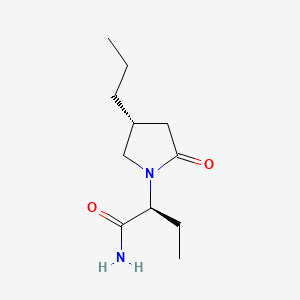
| Formula | C11H20N2O2 |
|---|---|
| Molecular weight | 212.29 g/mol |
| IUPAC name | (2S)-2-[(4R)-2-oxo-4-propylpyrrolidin-1-yl]butanamide |
| CAS | 357336-20-0 |
| PubChem CID | 9837243 |
| InChIKey | MSYKRHVOOPPJKU-BDAKNGLRSA-N |
| logP | 0.9 (XLogP 1.0) |
| Polar surface area | 63.4 Ų |
| H-bond acceptors / donors | 2 / 1 |
| Drug-likeness (QED) | 0.74 |
| Lipinski violations | 0 |
SMILES
CCC[C@@H]1CC(=O)N([C@@H](CC)C(N)=O)C1Biology & Pharmacokinetics
Pharmacokinetics predicted
| Bioavailability | 10.0% |
|---|---|
| Half-life | 0.857 h |
| Volume of distribution | 0.557 L/kg |
| Protein binding | 21.0% |
| BBB penetrant | Yes |
Enzyme interactions
| Enzyme | Role | Detail |
|---|---|---|
| CYP2C19 | Substrate | — |
| CYP3A4 | Substrate | — |
Transporters
BCRP (Inhibitor)BCRP (Inhibitor)BSEP (Inhibitor)BSEP (Inhibitor)MATE1 (Inhibitor)MATE2 (Inhibitor)MDR1 (Inhibitor)MRP1 (Inhibitor)MRP2 (Inhibitor)OAT1 (Inhibitor)OAT3 (Inhibitor)OATP1B1 (Inhibitor)OATP1B1 (Inhibitor)OATP1B3 (Inhibitor)OATP1B3 (Inhibitor)OCT1 (Inhibitor)OCT2 (Inhibitor)P-gp (Inhibitor)MDR1 (Substrate)MRP1 (Substrate)MRP2 (Substrate)OATP1B1 (Substrate)OATP1B3 (Substrate)P-gp (Substrate)
Drug–drug interactions (68, DDInter)
| Interacting drug | Severity | Management |
|---|---|---|
| Alimemazine | moderate | |
| Azatadine | moderate | |
| Azelastine (nasal) | moderate | |
| Brimonidine (ophthalmic) | moderate | |
| Brimonidine (topical) | moderate | |
| Brompheniramine | moderate | |
| Carbinoxamine | moderate | |
| Cetirizine | moderate | |
| Chlorcyclizine | moderate | |
| Chloroquine | moderate | |
| Chlorphenesin | moderate | |
| Chlorpheniramine | moderate | |
| Clemastine | moderate | |
| Clofedanol | moderate | |
| Clopidogrel | moderate | |
| Codeine | moderate | |
| Cyclizine | moderate | |
| Cyproheptadine | moderate | |
| Dexbrompheniramine | moderate | |
| Dextromethorphan | moderate | |
| Difenoxin | moderate | |
| Diphenhydramine | moderate | |
| Diphenoxylate | moderate | |
| Doxepin | moderate | |
| Doxepin (topical) | moderate | |
| Doxylamine | moderate | |
| Dronabinol | moderate | |
| Ethanol | moderate | |
| Hydrocodone | moderate | |
| Hydroxychloroquine | moderate | |
| Levocetirizine | moderate | |
| Meclizine | moderate | |
| Mefloquine | moderate | |
| Mepyramine | moderate | |
| Methdilazine | moderate | |
| Metoclopramide | moderate | |
| Morphine | moderate | |
| Morphine (liposomal) | moderate | |
| Nabilone | moderate | |
| Olopatadine (nasal) | moderate |
Showing 40 of 68.
Registered Products (6)
| Brand | Form / strength | Pack | Agent | Citizen (JOD) |
|---|---|---|---|---|
| Provecta | Tablet 10 mg | 14 tab | Hikma Pharmaceuticals Co.Ltd/Jordan | 16.540 |
| Provecta | Solution 10 mg/1 ml | 150 ml | Hikma Pharmaceuticals Co.Ltd/Jordan | 40.980 |
| Provecta | Tablet 100 mg | 60 tab | Hikma Pharmaceuticals Co.Ltd/Jordan | 78.020 |
| Provecta | Tablet 75 mg | 60 tab | Hikma Pharmaceuticals Co.Ltd/Jordan | 78.020 |
| Provecta | Tablet 25 mg | 60 tab | Hikma Pharmaceuticals Co.Ltd/Jordan | 78.020 |
| Provecta | Tablet 50 mg | 60 tab | Hikma Pharmaceuticals Co.Ltd/Jordan | 78.020 |