Cabergoline
JFDA label: DOSTINEX Tab
Mechanism of Action
Agonist of D(2) dopamine receptor — Dopamine D2 receptor agonist
| Target | Action | Gene / class |
|---|---|---|
| D(2) dopamine receptor efficacy | AGONIST | DRD2 |
Indications
Approved
- Canadian labeling
- Hyperprolactinemic disorders
Off-label
- Cushing syndrome
- Restless legs syndrome
Contraindications
Source: Lexicomp
- Known hypersensitivity to cabergoline, ergot derivatives, or any component of the formulation Absolute
- history of cardiac valvular disorders (indicated by valvulopathy of any valve, thickening of valve leaflet, valve restriction, or mixed valve restriction stenosis) Absolute
- history of pulmonary, pericardial, or retroperitoneal fibrotic disorders Absolute
- uncontrolled hypertension Absolute
Adverse Reactions
Cardiac disorders (5)
Common hypotension · Orthostatic hypotension · palpitations · peripheral edema · syncope
Nervous system disorders (13)
Very Common dizziness · Headache
Common anxiety · depression · drowsiness · Fatigue · insomnia · lack of concentration · malaise · nervousness · pain · paresthesia · vertigo
Renal and urinary disorders (2)
Common dysmenorrhea · Mastalgia
Metabolism and nutrition disorders (2)
Common dependent edema · Hot flash
Gastrointestinal disorders (10)
Very Common Nausea
Common abdominal pain · anorexia · Constipation · diarrhea · dyspepsia · flatulence · toothache · vomiting · xerostomia
Skin and subcutaneous tissue disorders (2)
Common Acne vulgaris · pruritus
Musculoskeletal and connective tissue disorders (2)
Common arthralgia · Weakness
Eye disorders (2)
Common Periorbital edema · visual disturbance
Respiratory, thoracic and mediastinal disorders (3)
Common Flu-like symptoms · rhinitis · throat irritation
Dosing
Source: Lexicomp
Warnings & Precautions
Source: Lexicomp
Cardiac valvulopathy
Cardiac valvulopathy has been reported with use. Cardiovascular evaluation (eg. chest x-ray, CT scan, echocardiogram) is necessary prior to initiating treatment; do not start therapy if valvular disease is detected. During treatment, the lowest effective dose should be utilized (incidence may be higher for daily doses >2 mg). Discontinue if an echocardiogram reveals new valvular regurgitation, valvular restriction, or valve leaflet thickening.
Cardiovascular effects
Initial doses >1 mg may cause orthostatic hypotension; may be symptomatic. Use with caution in patients with cardiovascular disease; hypertension, stroke, and seizure have been reported with other dopamine agonists. Concurrent use with antihypertensives may increase risk.
CNS depression
May cause somnolence, which may impair physical or mental abilities; patients must be cautioned about performing tasks that require mental alertness (eg, operating machinery or driving).
Pleural/retroperitoneal fibrosis
Cases of pleural, pericardial, and retroperitoneal fibrosis have been reported. Do not use in patients with a history of cardiac or extracardiac fibrotic disorders. Following diagnosis of fibrosis, discontinuation of cabergoline may result in improvement of condition.
Psychiatric disorders
Aggression, psychotic behavior, and impulse control disorders such as pathological gambling, increased libido, hypersexuality, compulsive spending or buying, and binge-eating have been reported with use; generally reversible with dose reduction or discontinuation of treatment. Disease-related concerns:
Hepatic impairment
Use with caution and carefully monitor patients with hepatic impairment; extensive hepatic metabolism.
Peptic ulcer disease
Use with caution in patients with peptic ulcer disease (PUD) or GI bleeding.
Raynaud syndrome
Use with caution in patients with Raynaud syndrome. Concurrent drug therapy issues:
Drug-drug interactions
Potentially significant interactions may exist, requiring dose or frequency adjustment, additional monitoring, and/or selection of alternative therapy. Consult drug interactions database for more detailed information.
Pregnancy & Lactation
Pregnancy
Adverse events have not been observed in most animal reproduction studies. Treatment of hyperprolactinemia may restore fertility in previously infertile women. Although available evidence suggests cabergoline use early in pregnancy does not cause harm to the fetus, it is recommended that therapy be discontinued once pregnancy is discovered. If treatment during pregnancy is required, other agents are preferred. Monitoring of prolactin levels should be suspended during pregnancy (Melmed 2011). Not recommended for use in women with pregnancy-induced hypertension (eg, preeclampsia, eclampsia, postpartum hypertension) unless benefit outweighs potential risk. Canadian labeling (not in US labeling): Exclude pregnancy prior to use; prevent pregnancy for ≥1 month following discontinuation of treatment.
Lactation
It is not known if cabergoline is excreted in breast milk. Cabergoline interferes with lactation and should not be given to women postpartum who are breast-feeding or who are planning to breast-feed. In the U.S. labeling, cabergoline is not indicated for the inhibition or suppression of physiologic lactation. Due to the potential for serious adverse reactions in the nursing infant, the manufacturer recommends a decision be made whether to discontinue nursing or to discontinue the drug, taking in
Monitoring
| Clinical pearl | Blood pressure (both sitting/supine and standing); serum prolactin level (monthly until normalized); echocardiogram (at baseline and every 6 to 12 months or as needed during therapy); erythrocyte sedimentation rate, chest x-ray, and serum creatinine (at baseline and during therapy as needed); signs and symptoms of pleuropulmonary disease, renal insufficiency, ureteral/abdominal vascular obstruction, and cardiac failure |
|---|
Chemistry & Properties
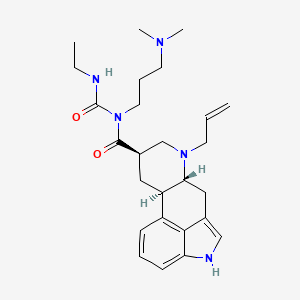
| Formula | C26H37N5O2 |
|---|---|
| Molecular weight | 451.62 g/mol |
| IUPAC name | (6aR,9R,10aR)-N-[3-(dimethylamino)propyl]-N-(ethylcarbamoyl)-7-prop-2-enyl-6,6a,8,9,10,10a-hexahydro-4H-indolo[4,3-fg]quinoline-9-carboxamide |
| CAS | 81409-90-7 |
| PubChem CID | 54746 |
| InChIKey | KORNTPPJEAJQIU-KJXAQDMKSA-N |
| logP | 3.19 (XLogP 3.4) |
| Polar surface area | 71.68 Ų |
| H-bond acceptors / donors | 4 / 2 |
| Drug-likeness (QED) | 0.60 |
| Lipinski violations | 0 |
SMILES
C=CCN1C[C@H](C(=O)N(CCCN(C)C)C(=O)NCC)C[C@@H]2c3cccc4[nH]cc(c34)C[C@H]21Biology & Pharmacokinetics
Pharmacokinetics
| BBB penetrant | Yes |
|---|
Enzyme interactions
| Enzyme | Role | Detail |
|---|---|---|
| CYP1A2 | Substrate | — |
| CYP2C19 | Substrate | — |
| CYP2D6 | Inhibitor | — |
| CYP2D6 | Substrate | — |
| CYP3A4 | Substrate | — |
Receptor binding (top 14)
| Target | Action | Affinity |
|---|---|---|
| D3 receptor (DRD3) | Agonist | pKi 9.1 |
| 5-HT2B receptor (HTR2B) | Agonist | pKi 8.9 |
| 5-HT2A receptor (HTR2A) | Agonist | pKi 8.2 |
| 5-HT1D receptor (HTR1D) | Agonist | pKi 8.1 |
| α2A-adrenoceptor (ADRA2A) | Antagonist | pKi 7.9 |
| 5-HT1A receptor (HTR1A) | Agonist | pKi 7.7 |
| α2C-adrenoceptor (ADRA2C) | Antagonist | pKi 7.7 |
| D5 receptor (DRD5) | Agonist | pKi 7.7 |
| D4 receptor (DRD4) | Agonist | pKi 7.3 |
| α2B-adrenoceptor (ADRA2B) | Antagonist | pKi 7.1 |
| D1 receptor (DRD1) | Agonist | pKi 6.7 |
| α1A-adrenoceptor (ADRA1A) | Antagonist | pKi 6.5 |
| 5-HT1B receptor (HTR1B) | Agonist | pKi 6.3 |
| 5-HT2C receptor (HTR2C) | Agonist | pKi 6.2 |
Transporters
BCRP (Inhibitor)BSEP (Inhibitor)BSEP (Inhibitor)MRP1 (Inhibitor)MRP2 (Inhibitor)MRP3 (Inhibitor)MRP4 (Inhibitor)OATP1B1 (Inhibitor)OATP1B3 (Inhibitor)P-gp (Inhibitor)P-gp (Substrate)
Drug–drug interactions (14, DDInter)
| Interacting drug | Severity | Management |
|---|---|---|
| Clarithromycin | major | |
| Erythromycin | major | |
| Lorcaserin | major | |
| Alimemazine | moderate | |
| Amyl Nitrite | moderate | |
| Diazoxide | moderate | |
| Ethanol | moderate | |
| Ioflupane I-123 | moderate | |
| Methdilazine | moderate | |
| Metoclopramide | moderate | |
| Minoxidil | moderate | |
| Phentolamine | moderate | |
| Promethazine | moderate | |
| Thiethylperazine | moderate |
Registered Products (12)
| Brand | Form / strength | Pack | Agent | Citizen (JOD) |
|---|---|---|---|---|
| Nolact | Tablet 0.51 mg | 2 tab pack varies | / UNITED PHARM.MFG.CO.LTD(UPM)/JORDAN / General | 5.130 |
| Caberline | Tablet 0.54 mg | 2 tab | Masrouji drug store | 5.650 |
| DOSTINEX Tab | Tablet 0.5 mg | 2 tab pack varies | Khoury Drug Store | 6.130 |
| Bergo | Tablet 0.5 mg | 2 tab pack varies | JORDAN RIVER PHARMA.IND(JORIVER)/JORDAN | 6.460 |
| Prolin | Tablet 0.5 mg | 2 tab pack varies | Pharma International Company/ Jordan | 7.260 |
| Lovista Tab | Tablet 0.5 mg | 2 tab pack varies | Dar Al Dawa Development and Investment Co Ltd/Jordan | 7.540 |
| Nolact | Tablet 0.51 mg | 8 tab pack varies | / UNITED PHARM.MFG.CO.LTD(UPM)/JORDAN / General | 19.160 |
| Bergo | Tablet 0.5 mg | 8 tab pack varies | JORDAN RIVER PHARMA.IND(JORIVER)/JORDAN | 19.220 |
| stoplact | Tablet 0.5 mg | 8 tab | SAVVY PHARMA/JORDAN | 19.220 |
| DOSTINEX Tab | Tablet 0.5 mg | 8 tab pack varies | Khoury Drug Store | 21.500 |
| Prolin | Tablet 0.5 mg | 8 tab pack varies | Pharma International Company/ Jordan | 21.620 |
| Lovista Tab | Tablet 0.5 mg | 8 tab pack varies | Dar Al Dawa Development and Investment Co Ltd/Jordan | 22.420 |