Minoxidil
Active form: Minoxidil Sulfate.
JFDA label: HAIRGROW 2 % SOLUTION
- cardiotoxicity — ChEMBL drug_warning (Black Box Warning) | United States
- Minoxidil tablets contain the powerful antihypertensive agent, minoxidil, which may produce serious adverse effects. It can cause pericardial effusion, occasionally progressing to tamponade, and angin
Mechanism of Action
Opener of Sulfonylurea receptor 2, Kir6.2 — Sulfonylurea receptor 2, Kir6.2 opener
| Target | Action | Gene / class |
|---|---|---|
| Sulfonylurea receptor 2, Kir6.2 efficacy | OPENER |
Indications
Approved
- Alopecia — androgenetic alopecia
- Hypertension — hypertension
Off-label
- Ovarian Neoplasms
Contraindications
Source: openFDA
- Minoxidil tablets are contraindicated in pheochromocytoma, because it may stimulate secretion of catecholamines from the tumor through its antihypertensive action. Minoxidil is contraindicated in those patients with a history of hypersensitivity to any of the components of the preparation. Absolute
Adverse Reactions
Cardiac disorders (5)
Not Known Angina pectoris · Cardiac disorder · Cardiac tamponade · Pericarditis · Tachycardia
Vascular disorders (1)
Not Known Hypotension
Renal and urinary disorders (1)
Not Known Blood creatinine increased
Blood and lymphatic system disorders (2)
Not Known Leukopenia · Thrombocytopenia
Metabolism and nutrition disorders (1)
Not Known Fluid retention
Gastrointestinal disorders (3)
Not Known Gastrointestinal disorder · Nausea · Vomiting
Skin and subcutaneous tissue disorders (7)
Not Known Dermatitis · Dermatitis bullous · Erythema multiforme · Rash · Skin disorder · Stevens-Johnson syndrome · Toxic epidermal necrolysis
Reproductive system and breast disorders (2)
Not Known Breast disorder · Breast tenderness
Investigations (5)
Not Known Blood alkaline phosphatase increased · Electrocardiogram abnormal · Electrocardiogram ST segment · Hair growth abnormal · Weight increased
General disorders and administration site conditions (8)
Not Known Hair colour changes · Hypertrichosis · Malnutrition · Mediastinal disorder · Oedema · Oedema peripheral · Pericardial effusion · Virilism
Respiratory, thoracic and mediastinal disorders (1)
Not Known Pleural effusion
Dosing
Source: openFDA
Warnings & Precautions
Source: openFDA
Boxed Warning
Minoxidil tablets contain the powerful antihypertensive agent, minoxidil, which may produce serious adverse effects. It can cause pericardial effusion, occasionally progressing to tamponade, and angina pectoris may be exacerbated. Minoxidil should be reserved for hypertensive patients who do not respond adequately to maximum therapeutic doses of a diuretic and two other antihypertensive agents. In experimental animals, minoxidil caused several kinds of myocardial lesions as well as other adverse cardiac effects (see Cardiac Lesions in Animals ). Minoxidil must be administered under close supervision, usually concomitantly with therapeutic doses of a beta-adrenergic blocking agent to prevent tachycardia and increased myocardial workload. It must also usually be given with a diuretic, frequently one acting in the ascending limb of the loop of Henle, to prevent serious fluid accumulation. Patients with malignant hypertension and those already receiving guanethidine (see WARNINGS ) should be hospitalized when minoxidil is first administered so that they can be monitored to avoid too rapid, or large orthostatic, decreases in blood pressure.
Warnings & Precautions
Salt and Water Retention: Congestive Heart Failure – concomitant use of an adequate diuretic is required – Minoxidil tablets must usually be administered concomitantly with a diuretic adequate to prevent fluid retention and possible congestive heart failure; a high ceiling (loop) diuretic is almost always required. Body weight should be monitored closely. If minoxidil is used without a diuretic, retention of several hundred milli-equivalents of salt and corresponding volumes of water can occur within a few days, leading to increased plasma and interstitial fluid volume and local or generalized edema. Diuretic treatment alone, or in combination with restricted salt intake, will usually minimize fluid retention, although reversible edema did develop in approximately 10% of nondialysis patients so treated. Ascites has also been reported. Diuretic effectiveness was limited mostly by disease-related impaired renal function. The condition of patients with pre-existing congestive heart failure occasionally deteriorated in association with fluid retention although because of the fall in blood pressure (reduction of afterload), more than twice as many improved than worsened. Rarely, refractory fluid retention may require discontinuation of minoxidil. Provided that the patient is under close medical supervision, it may be possible to resolve refractory salt retention by discontinuing minoxidil for 1 or 2 days and then resuming treatment in conjunction with vigorous diuretic therapy. Concomitant Treatment to Prevent Tachycardia is Usually Required – Minoxidil increases the heart rate. Angina may worsen or appear for the first time during minoxidil treatment, probably because of the increased oxygen demands associated with increased heart rate and cardiac output. The increase in rate and the occurrence of angina generally can be prevented by the concomitant administration of a beta-adrenergic blocking drug or other sympathetic nervous system suppressant. The ability of beta-adrenergic blocking agents to minimize papillary muscle lesions in animals is further reason to utilize such an agent concomitantly. Round-the-clock effectiveness of the sympathetic suppressant should be ensured. Pericarditis, Pericardial Effusion and Tamponade – There have been reports of pericarditis occurring in association with the use of minoxidil. The relationship of this association to renal status is uncertain. Pericardial effusion, occasionally with tamponade, has been observed in about 3%
Pregnancy & Lactation
Pregnancy
Lactation
Maternal topical minoxidil is acceptable once breastfeeding is established. Avoid contact between the infant and skin treated with minoxidil because it can be absorbed by the infant and cause adverse effects such as excessive hair growth.
Chemistry & Properties
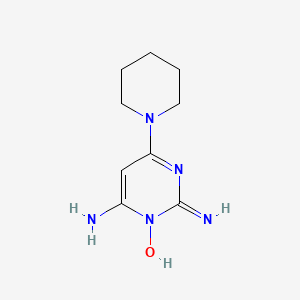
| Formula | C9H15N5O |
|---|---|
| Molecular weight | 209.25 g/mol |
| IUPAC name | 3-hydroxy-2-imino-6-piperidin-1-ylpyrimidin-4-amine |
| CAS | 38304-91-5 |
| PubChem CID | 4201 |
| InChIKey | ZFMITUMMTDLWHR-UHFFFAOYSA-N |
| logP | -0.13 (XLogP 1.2) |
| Polar surface area | 95.11 Ų |
| H-bond acceptors / donors | 5 / 2 |
| Drug-likeness (QED) | 0.50 |
| Lipinski violations | 0 |
SMILES
Nc1cc(N2CCCCC2)nc(N)[n+]1[O-]Biology & Pharmacokinetics
Pharmacokinetics predicted
| Bioavailability | 10.0% |
|---|---|
| Half-life | 1.263 h |
| Volume of distribution | 3.757 L/kg |
| Protein binding | 23.5% |
| BBB penetrant | No |
Transporters
BCRP (Inhibitor)BSEP (Inhibitor)BSEP (Inhibitor)MRP1 (Inhibitor)MRP2 (Inhibitor)MRP3 (Inhibitor)MRP4 (Inhibitor)OATP1B1 (Inhibitor)OATP1B1 (Inhibitor)OATP1B3 (Inhibitor)OATP1B3 (Inhibitor)P-gp (Inhibitor)MDR1 (Substrate)P-gp (Substrate)
Drug–drug interactions (100+, DDInter)
| Interacting drug | Severity | Management |
|---|---|---|
| Guanadrel | major | |
| Guanethidine | major | |
| Tizanidine | major | |
| Aldesleukin | moderate | |
| Alfentanil | moderate | |
| Alimemazine | moderate | |
| Alprazolam | moderate | |
| Amifostine | moderate | |
| Amisulpride | moderate | |
| Amitriptyline | moderate | |
| Amoxapine | moderate | |
| Apomorphine | moderate | |
| Apraclonidine | moderate | |
| Aripiprazole | moderate | |
| Asenapine | moderate | |
| Avanafil | moderate | |
| Baclofen | moderate | |
| Benzhydrocodone | moderate | |
| Betamethasone | moderate | |
| Brexpiprazole | moderate | |
| Brimonidine (ophthalmic) | moderate | |
| Brimonidine (topical) | moderate | |
| Budesonide | moderate | |
| Buprenorphine | moderate | |
| Bupropion | moderate | |
| Buspirone | moderate | |
| Butabarbital | moderate | |
| Butorphanol | moderate | |
| Cabergoline | moderate | |
| Canagliflozin | moderate | |
| Cariprazine | moderate | |
| Carisoprodol | moderate | |
| Chloral hydrate | moderate | |
| Chlordiazepoxide | moderate | |
| Chlorpromazine | moderate | |
| Clobazam | moderate | |
| Clomipramine | moderate | |
| Clonazepam | moderate | |
| Clorazepic acid | moderate | |
| Clozapine | moderate |
Showing 40 of 100+.
Registered Products (16)
| Brand | Form / strength | Pack | Agent | Citizen (JOD) |
|---|---|---|---|---|
| Hairgain 2% Topical Solution | Solution 2 % | 30 ml pack varies | JORDAN RIVER PHARMA.IND(JORIVER)/JORDAN | 5.250 |
| Hairgain 5% Topical Solution | Solution 5 % | 30 ml pack varies | JORDAN RIVER PHARMA.IND(JORIVER)/JORDAN | 6.830 |
| Alopexy | Solution 5 % | 60 ml | Abu Sheikha Drug Store | 8.180 |
| HAIRGROW | Solution 20 mg/ml | 50 ml | Dar Al Dawa Development and Investment Co Ltd/Jordan | 9.990 |
| Hairgain 2% Topical Solution | Solution 2 % | 60 ml pack varies | JORDAN RIVER PHARMA.IND(JORIVER)/JORDAN | 10.000 |
| Bald X | Solution 2 % | 50 ml | JERASH PHARMACEUTICALS LTD.CO/JORDAN | 10.400 |
| Bald X | Solution 5 % | 50 ml | JERASH PHARMACEUTICALS LTD.CO/JORDAN | 12.480 |
| Hairgain 5% Topical Solution | Solution 5 % | 60 ml pack varies | JORDAN RIVER PHARMA.IND(JORIVER)/JORDAN | 13.000 |
| HAIRGROW | Solution 50 mg/ml | 50 ml | Dar Al Dawa Development and Investment Co Ltd/Jordan | 13.200 |
| Hairmore Topical Spray | Spray 2 g/100 ml | 60 ml | Amman Pharmaceutical Indusries | 14.180 |
| Avogain | Solution 5 % | 50 ml | Sabbagh Drug Store | 15.240 |
| Regaine 2% Topical sol. | Solution 2 % | 60 ml | Al-Amad Drug Store | 15.760 |
| Hairmore Topical Spray | Spray 5 g/100 ml | 60 ml | Amman Pharmaceutical Indusries | 18.110 |
| Regaine 5% Topical Solution | Solution 5 % | 60 ml | Al-Amad Drug Store | 19.700 |
| Regaine For Men 5% Foam | Foam 5 % | 1 Can X 60 gm pack varies | Al-Amad Drug Store | 28.600 |
| Regaine For Men 5% Foam | Foam 5 % | 3 Can X 60 gm pack varies | Al-Amad Drug Store | 64.410 |