Tizanidine
JFDA label: SIRDALUD Tab
Mechanism of Action
An alpha2-adrenergic agonist agent which decreases spasticity by increasing presynaptic inhibition; effects are greatest on polysynaptic pathways; overall effect is to reduce facilitation of spinal motor neurons.
Indications
Approved
- Muscle spasticity
Off-label
- Acute low back pain
- Spasticity associated with cerebral palsy
Contraindications
Source: Lexicomp
- Concomitant therapy with ciprofloxacin or fluvoxamine (potent CYP1A2 inhibitors) Absolute
Adverse Reactions
Cardiac disorders (2)
Very Common Hypotension
Common Bradycardia
Nervous system disorders (10)
Very Common dizziness · Drowsiness
Common anxiety · delusions · depression · myasthenia · Nervousness · paresthesia · speech disturbance · visual hallucination
Hepatobiliary disorders (1)
Common Increased liver enzymes
Renal and urinary disorders (2)
Common urinary frequency · Urinary tract infection
Gastrointestinal disorders (6)
Very Common Xerostomia
Common abdominal pain · Constipation · diarrhea · dyspepsia · vomiting
Skin and subcutaneous tissue disorders (3)
Common Dermal ulcer · diaphoresis · skin rash
Musculoskeletal and connective tissue disorders (3)
Very Common Weakness
Common back pain · Dyskinesia
Eye disorders (1)
Common Blurred vision
Infections and infestations (1)
Common Infection
General disorders and administration site conditions (1)
Common Fever
Respiratory, thoracic and mediastinal disorders (3)
Common Flu-like symptoms · pharyngitis · rhinitis
Dosing
Source: Lexicomp
Warnings & Precautions
Source: Lexicomp
Hepatic effects
Potential for hepatotoxicity; monitor aminotransferases prior to and during use or if hepatic injury is suspected.
Hypersensitivity reactions
Hypersensitivity reactions, including anaphylaxis, angioedema, respiratory compromise, and urticaria have been reported with use. Patients with signs and symptoms of allergic reactions should discontinue therapy.
Hypotension
Significant hypotension and syncope may occur; use with caution in patients at risk for severe hypotensive effects (eg, patients taking concurrent medications which may predispose to hypotension). Minimize effects by titrating dose and monitoring for signs and symptoms of hypotension prior to dose increase.
Sedation
Sedation may occur; use with caution in patients at risk for sedative effects (eg, patients taking concurrent CNS depressants); patients must be cautioned about performing tasks which require mental alertness (eg, operating machinery or driving).
Visual hallucinations
Use has been associated with visual hallucinations or delusions; use caution in patients with psychiatric disorders. Consider discontinuation of therapy if hallucinations occur. Disease-related concerns:
Hepatic impairment
Use not recommended in patients with hepatic impairment; potential for effects likely due to extensive hepatic metabolism of tizanidine.
Renal impairment
Use with caution in patients with renal impairment. Clearance decreased significantly in patients with severe impairment (CrCl Concurrent drug therapy issues:
Drug-drug interactions
Potentially significant interactions may exist, requiring dose or frequency adjustment, additional monitoring, and/or selection of alternative therapy. Consult drug interactions database for more detailed information.
Sedatives
Effects with other sedative drugs or ethanol may be potentiated. Special populations:
Elderly
Use with caution; clearance decreased fourfold in the elderly; may increase risk of adverse effects and/or duration of effects. Elderly with severe renal impairment (CrCl 50% compared to healthy elderly subjects. Other warnings/precautions:
Abrupt withdrawal
Withdrawal resulting in rebound hypertension, tachycardia, and hypertonia may occur upon discontinuation; doses should be decreased slowly, particularly in patients taking concomitant opioids or receiving high doses (20-28 mg daily) for prolonged periods (≥9 weeks).
Food
Food alters absorption profile relative to administration under fasting conditions. In addition, bioequivalence between capsules and tablets is altered by food; capsules and tablets are bioequivalent under fasting conditions, but not under nonfasting conditions.
Pregnancy & Lactation
Pregnancy
Adverse events were observed in some animal reproduction studies.
Lactation
Excretion in breast milk is unknown, but expected due to lipid solubility.
LactMed: monitor the infant.
Monitoring
| Clinical pearl | Monitor liver function (aminotransferases) at baseline and 1 month after maximum dose achieved or if hepatic injury suspected; blood pressure; renal function |
|---|
Chemistry & Properties
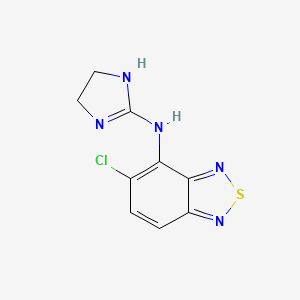
| Formula | C9H8ClN5S |
|---|---|
| Molecular weight | 253.72 g/mol |
| IUPAC name | 5-chloro-N-(4,5-dihydro-1H-imidazol-2-yl)-2,1,3-benzothiadiazol-4-amine |
| CAS | 51322-75-9 |
| PubChem CID | 5487 |
| InChIKey | XFYDIVBRZNQMJC-UHFFFAOYSA-N |
| logP | 1.72 (XLogP 1.1) |
| Polar surface area | 62.2 Ų |
| H-bond acceptors / donors | 6 / 2 |
| Drug-likeness (QED) | 0.81 |
| Lipinski violations | 0 |
SMILES
Clc1ccc2nsnc2c1NC1=NCCN1Biology & Pharmacokinetics
Pharmacokinetics
| BBB penetrant | Yes |
|---|
Enzyme interactions
| Enzyme | Role | Detail |
|---|---|---|
| CYP1A2 | Substrate | — |
| CYP2C19 | Substrate | — |
| CYP2D6 | Inhibitor | — |
| CYP2D6 | Substrate | — |
| CYP3A4 | Substrate | — |
Receptor binding (top 7)
| Target | Action | Affinity |
|---|---|---|
| α2B-adrenoceptor (ADRA2B) | Agonist | pIC50 7.8 |
| α2A-adrenoceptor (ADRA2A) | Agonist | pIC50 7.6 |
| Nischarin (NISCH) | Binding | pKi 7.5 |
| α2B-adrenoceptor (ADRA2B) | Agonist | pEC50 7.0 |
| α2A-adrenoceptor (ADRA2A) | Agonist | pKi 6.0 |
| α2A-adrenoceptor (ADRA2A) | Agonist | pEC50 5.8 |
| α2B-adrenoceptor (ADRA2B) | Agonist | pKi 5.8 |
Transporters
BCRP (Inhibitor)BSEP (Inhibitor)BSEP (Inhibitor)MRP1 (Inhibitor)MRP2 (Inhibitor)MRP3 (Inhibitor)MRP4 (Inhibitor)OATP1B1 (Inhibitor)OATP1B3 (Inhibitor)P-gp (Inhibitor)P-gp (Substrate)
Drug–drug interactions (100+, DDInter)
| Interacting drug | Severity | Management |
|---|---|---|
| Acyclovir | major | |
| Aldesleukin | major | |
| Amyl Nitrite | major | |
| Anagrelide | major | |
| Arsenic trioxide | major | |
| Cabozantinib | major | |
| Caffeine | major | |
| Ceritinib | major | |
| Chloroquine | major | |
| Cimetidine | major | |
| Cisapride | major | |
| Codeine | major | |
| Crizotinib | major | |
| Deferasirox | major | |
| Diazoxide | major | |
| Dolasetron | major | |
| Epoprostenol | major | |
| Ethinylestradiol | major | |
| Famotidine | major | |
| Fingolimod | major | |
| Halofantrine | major | |
| Hydrocodone | major | |
| Hydroxychloroquine | major | |
| Iloprost | major | |
| Interferon alfa-2b | major | |
| Ivosidenib | major | |
| Leflunomide | major | |
| Lumefantrine | major | |
| Macimorelin | major | |
| Methoxsalen | major | |
| Minoxidil | major | |
| Morphine | major | |
| Morphine (liposomal) | major | |
| Niclosamide | major | |
| Nilotinib | major | |
| Obeticholic acid | major | |
| Osilodrostat | major | |
| Ozanimod | major | |
| Panobinostat | major | |
| Papaverine | major |
Showing 40 of 100+.
Registered Products (4)
| Brand | Form / strength | Pack | Agent | Citizen (JOD) |
|---|---|---|---|---|
| Relezin | Tablet 2 mg | 30 tab | UNITED PHARM.MFG.CO.LTD(UPM)/JORDAN | 1.750 |
| SIRDALUD Tab | Tablet 2 mg | 30 tab | Nabulsi Drug Store | 2.130 |
| Relezin | Tablet 4 mg | 30 tab | UNITED PHARM.MFG.CO.LTD(UPM)/JORDAN | 4.350 |
| SIRDALUD Tab | Tablet 4 mg | 30 tab | Nabulsi Drug Store | 7.300 |