Methoxsalen
JFDA label: UltraMeladinine Paint
- carcinogenicity — ChEMBL drug_warning (Black Box Warning) | United States
- Methoxsalen with ultraviolet (UV) radiation should be used only by physicians who have special competence in the diagnosis and treatment of psoriasis and who have special training and experience in ph
Mechanism of Action
Inhibitor of DNA — DNA inhibitor
| Target | Action | Gene / class |
|---|---|---|
| DNA efficacy | INHIBITOR |
Indications
Approved
- Lymphoma, T-Cell — T-cell non-Hodgkin lymphoma
- Psoriasis — psoriasis
Off-label
- Arthritis, Rheumatoid
- Bronchiolitis Obliterans Syndrome
- Crohn Disease
- Epidermolysis Bullosa Acquisita
- Graft vs Host Disease
- Lymphoma
- Mycosis Fungoides
- Pancreatic Neoplasms
- Scleroderma, Diffuse
- Sezary Syndrome
Contraindications
Source: openFDA
- IV. CONTRAINDICATIONS A. Patients exhibiting idiosyncratic reactions to psoralen compounds. B. Patients possessing a specific history of light sensitive disease states should not initiate methoxsalen therapy except under special circumstances. Diseases associated with photosensitivity include lupus erythematosus, porphyria cutanea tarda, erythropoietic protoporphyria, variegate porphyria, xeroderma pigmentosum, and albinism. C. Patients with melanoma or with a history of melanoma. D. Patients with invasive squamous cell carcinomas. E. Patients with aphakia, because of the significantly increased risk of retinal damage due to the absence of lenses. Absolute
Adverse Reactions
Immune system disorders (1)
Rare Hypersensitivity
Gastrointestinal disorders (1)
Rare Nausea
Skin and subcutaneous tissue disorders (2)
Rare Dermatitis · Rash
Investigations (1)
Rare Body temperature increased
General disorders and administration site conditions (1)
Rare Dysgeusia
Dosing
Source: openFDA
Warnings & Precautions
Source: openFDA
Boxed Warning
Methoxsalen with ultraviolet (UV) radiation should be used only by physicians who have special competence in the diagnosis and treatment of psoriasis and who have special training and experience in photochemotherapy. The use of Psoralen and ultraviolet radiation therapy should be under constant supervision of such a physician. For the treatment of patients with psoriasis, photochemotherapy should be restricted to patients with severe, recalcitrant, disabling psoriasis which is not adequately responsive to other forms of therapy, and only when the diagnosis is certain. Because of the possibilities of ocular damage, aging of the skin, and skin cancer (including melanoma), the patient should be fully informed by the physician of the risks inherent in this therapy.
Warnings & Precautions
V. WARNINGS - GENERAL A. SKIN BURNING: Serious burns from either UVA or sunlight (even through window glass) can result if the recommended dosage of the drug and/or exposure schedules are exceeded. B. CARCINOGENICITY: ANIMAL STUDIES: Topical or intraperitoneal methoxsalen has been reported to be a potent photocarcinogen in albino mice and hairless mice (Hakim et al., 1960 10 ). However, methoxsalen given by the oral route to Swiss albino mice suggests this agent exerts a protective effect against ultraviolet carcinogenesis; mice given 8-methoxypsoralen in their diet showed 38% ear tumors 180 days after the start of ultraviolet therapy compared to 62% for controls (O'Neal et al., 1957 11 ). HUMAN STUDIES: A 5.7 year prospective study of 1380 psoriasis patients treated with oral methoxsalen and ultraviolet A photochemotherapy (PUVA) demonstrated that the risk of cutaneous squamous-cell carcinoma developing at least 22 months following the first PUVA exposure was approximately 12.8 times higher in the high dose patients than in the low dose patients (Stern et al., 1979 12 , Stern et al., 1980 13 , and Stern et al., 1984 14 ). The substantial dose-dependent increase was observed in patients with neither a prior history of skin cancer nor significant exposure to cutaneous carcinogens. Reduction in PUVA dosage significantly reduces the risk. No substantial dose-related increase was noted for basal cell carcinoma according to Stern et al., 1984 14 . Increases appear greatest in patients who have pre-PUVA exposure to 1) prolonged tar and UVB treatment, 2) ionizing radiation, or 3) arsenic. Roenigk et al., 1980 15 , studied 690 patients for up to 4 years and found no increase in the risk of non-melanoma skin cancer, although patients in this cohort had significantly less exposure to PUVA than in the Stern et al. study. Recent analysis of new data in the Stern et al cohort (Stern et al., 1997 16 ) has shown that these patients have an elevated relative risk of contracting melanoma. The relative risk for melanoma in these patients was 2.3 (95% confidence interval 1.1 to 4.1). The risk is particularly higher in those patients who have received more than 250 PUVA treatments and in those whose treatment has spanned greater than 15 years earlier. Some patients developing melanoma did so even after having ceased PUVA therapy over 5 years earlier. These observations indicate the need for monitoring of PUVA patients for skin tumors throughout their lives. In a study in Indi
Pregnancy & Lactation
Pregnancy
Lactation
Use of topical methoxsalen is not contraindicated during breastfeeding, but avoid direct contact of the treated skin with the skin of the infant.
Chemistry & Properties
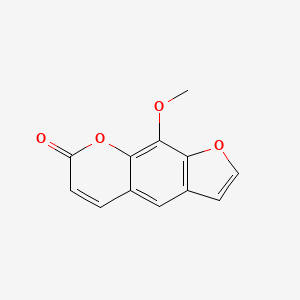
| Formula | C12H8O4 |
|---|---|
| Molecular weight | 216.19 g/mol |
| IUPAC name | 9-methoxyfuro[3,2-g]chromen-7-one |
| CAS | 298-81-7 |
| PubChem CID | 4114 |
| InChIKey | QXKHYNVANLEOEG-UHFFFAOYSA-N |
| logP | 2.55 (XLogP 1.9) |
| Polar surface area | 52.58 Ų |
| H-bond acceptors / donors | 4 / 0 |
| Drug-likeness (QED) | 0.59 |
| Lipinski violations | 0 |
SMILES
COc1c2occc2cc2ccc(=O)oc12Biology & Pharmacokinetics
Pharmacokinetics
| BBB penetrant | No |
|---|
Enzyme interactions
| Enzyme | Role | Detail |
|---|---|---|
| CYP1A2 | Inhibitor | IC₅₀ 0.040000000000000015 µM |
| CYP2B6 | Inhibitor | — |
| CYP2C19 | Inhibitor | — |
| CYP2C8 | Inhibitor | — |
| CYP2D6 | Inhibitor | — |
| CYP3A4 | Inhibitor | Ki 7.416198487095665 µM |
| CYP3A4 | Substrate | — |
Transporters
BCRP (Inhibitor)BSEP (Inhibitor)MRP1 (Inhibitor)OATP1B1 (Inhibitor)OATP1B1 (Inhibitor)OATP1B3 (Inhibitor)OATP1B3 (Inhibitor)OATP2B1 (Inhibitor)P-gp (Inhibitor)P-gp (Substrate)
Drug–drug interactions (100+, DDInter)
| Interacting drug | Severity | Management |
|---|---|---|
| Aminolevulinic acid | major | |
| Rasagiline | major | |
| Tizanidine | major | |
| Acetazolamide | moderate | |
| Acetohexamide | moderate | |
| Acitretin | moderate | |
| Adapalene (topical) | moderate | |
| Afatinib | moderate | |
| Alectinib | moderate | |
| Alimemazine | moderate | |
| Alitretinoin (topical) | moderate | |
| Alosetron | moderate | |
| Aminolevulinic acid (topical) | moderate | |
| Amiodarone | moderate | |
| Avapritinib | moderate | |
| Bendroflumethiazide | moderate | |
| Benzthiazide | moderate | |
| Bexarotene | moderate | |
| Bexarotene (topical) | moderate | |
| Bicalutamide | moderate | |
| Bumetanide | moderate | |
| Celecoxib | moderate | |
| Cetuximab | moderate | |
| Chlorothiazide | moderate | |
| Chlorpromazine | moderate | |
| Chlorpropamide | moderate | |
| Chlorthalidone | moderate | |
| Cinoxacin | moderate | |
| Ciprofloxacin | moderate | |
| Coal tar (topical) | moderate | |
| Cobimetinib | moderate | |
| Dabrafenib | moderate | |
| Dapsone | moderate | |
| Demeclocycline | moderate | |
| Doxycycline | moderate | |
| Doxycycline (topical) | moderate | |
| Enoxacin | moderate | |
| Eravacycline | moderate | |
| Erlotinib | moderate | |
| Etacrynic acid | moderate |
Showing 40 of 100+.
Registered Products (2)
| Brand | Form / strength | Pack | Agent | Citizen (JOD) |
|---|---|---|---|---|
| UltraMeladinine Paint | Solution 0.03 g/15 ml | 15 ml | Petra Drug Store | 1.930 |
| Neo-Meladenine | Tablet 15 mg | 50 tab | Petra Drug Store | 3.110 |