Chlorambucil
JFDA label: Leukeran Tablets
- Bone marrow suppression:
- Fertility effects:
Mechanism of Action
Inhibitor of DNA — DNA inhibitor
| Target | Action | Gene / class |
|---|---|---|
| DNA efficacy | INHIBITOR |
Indications
Approved
- Chronic lymphocytic leukemia
- Lymphomas
Off-label
- Nephrotic syndrome, steroid sensitive (pediatrics)
- Waldenström macroglobulinemia
Class profile
| mechanismClass | Alkylating agent (nitrogen mustard) |
|---|---|
| targetMolecule | DNA (cross-linking) |
| targetPathway | DNA damage response |
| generation | Classic |
| primaryTumors | CLL,Lymphoma,Ovarian |
| resistanceMechanisms | Reduced drug uptake,Enhanced DNA repair,p53 mutations,BCL-2 overexpression |
| source | NCCN/OncoKB/Goodman&Gilman13ed |
Contraindications
Source: Lexicomp
- Additional contraindications (not in US labeling): Use within 4 weeks of a full course of radiation or chemotherapy Absolute
- Hypersensitivity to chlorambucil or any component of the formulation Absolute
- hypersensitivity to other alkylating agents (may have cross-hypersensitivity) Absolute
- prior (demonstrated) resistance to chlorambucil Absolute
Adverse Reactions
Nervous system disorders (2)
Not Known Drug fever · peripheral neuropathy
Hepatobiliary disorders (2)
Not Known Hepatotoxicity · jaundice
Renal and urinary disorders (3)
Not Known Azoospermia · cystitis (sterile) · infertility
Blood and lymphatic system disorders (10)
Not Known Anemia · bone marrow depression · bone marrow failure (irreversible) · leukemia (secondary) · leukopenia · lymphocytopenia · malignant neoplasm (secondary) · neutropenia (onset: 3 weeks; recovery: 10 days after last dose) · pancytopenia · thrombocytopenia
Immune system disorders (2)
Not Known Angioedema · hypersensitivity reaction
Metabolism and nutrition disorders (1)
Not Known Amenorrhea
Gastrointestinal disorders (4)
Not Known Diarrhea (infrequent) · nausea (infrequent) · oral mucosa ulcer (infrequent) · vomiting (infrequent)
Skin and subcutaneous tissue disorders (3)
Not Known Allergic skin reaction · skin rash · urticaria
General disorders and administration site conditions (1)
Not Known Fever
Respiratory, thoracic and mediastinal disorders (2)
Not Known Interstitial pneumonitis · pulmonary fibrosis
Other (13)
Not Known Agitation · ataxia · confusion · erythema multiforme · flaccid paralysis · hallucination · muscle twitching · myoclonus · seizure (focal/generalized) · SIADH (syndrome of inappropriate antidiuretic hormone secretion) · Stevens-Johnson syndrome · toxic epidermal necrolysis · tremor
Dosing
Source: Lexicomp
Warnings & Precautions
Source: Lexicomp
Bone marrow suppression
[U.S. Boxed Warning]: May cause severe bone marrow suppression; neutropenia may be severe. Reduce initial dosage if patient has received myelosuppressive or radiation therapy within the previous 4 weeks, or has a depressed baseline leukocyte or platelet count. Irreversible bone marrow damage may occur with total doses approaching 6.5 mg/kg. Progressive lymphopenia may develop (recovery is generally rapid after discontinuation).
Fertility effects
[U.S. Boxed Warning]: Affects human fertility; probably mutagenic and teratogenic as well; chromosomal damage has been documented. Reversible and irreversible sterility (when administered to prepubertal and pubertal males), azoospermia (in adult males) and amenorrhea (in females) have been observed.
Secondary malignancy
[U.S. Boxed Warning]: Carcinogenic; acute myelocytic leukemia and secondary malignancies may be associated with chronic therapy. Duration of treatment and higher cumulative doses are associated with a higher risk for development of leukemia.
Seizures
Have been observed with use; patients with a history of nephrotic syndrome and high pulse doses are at higher risk of seizures. Use with caution in patients with a history of seizure disorder or head trauma.
Skin reactions
Rare instances of severe skin reactions (eg, erythema multiforme, Stevens-Johnson syndrome, toxic epidermal necrolysis) have been reported; discontinue promptly if skin reaction occurs. Disease-related concerns:
Hepatic impairment
Chlorambucil is primarily metabolized in the liver. Dosage reductions should be considered in patients with hepatic impairment. Concurrent drug therapy issues:
Drug-drug interactions
Potentially significant interactions may exist, requiring dose or frequency adjustment, additional monitoring, and/or selection of alternative therapy. Consult drug interactions database for more detailed information. Other warnings/precautions:
Vaccines
Avoid administration of live vaccines to immunocompromised patients.
Pregnancy & Lactation
Pregnancy
Animal reproduction studies have demonstrated teratogenicity. Chlorambucil crosses the human placenta. Following exposure during the first trimester, case reports have noted adverse renal effects (unilateral agenesis). Women of childbearing potential should avoid becoming pregnant while receiving treatment. [U.S. Boxed Warning]: Affects human fertility; probably mutagenic and teratogenic as well; chromosomal damage has been documented. Reversible and irreversible sterility (when administered to prepubertal and pubertal males), azoospermia (in adult males) and amenorrhea (in females) have been observed. Fibrosis, vasculitis and depletion of primordial follicles have been noted on autopsy of the ovaries.
Lactation
It is not known if chlorambucil is excreted in breast milk. Due to the potential for serious adverse reactions in the nursing infant, the decision to discontinue chlorambucil or to discontinue breast-feeding should take into account the benefits of treatment to the mother.
Monitoring
| Efficacy | Tumour response (RECIST criteria, tumour markers, imaging); progression-free survival; performance status (ECOG/Karnofsky) |
|---|---|
| Toxicity | CBC with differential (nadir timing depends on agent); LFTs; renal function; ECG (QT for relevant agents); echocardiogram for cardiotoxic agents (anthracyclines, trastuzumab); cumulative dose tracking for dose-limited toxicities |
| Clinical pearl | Treatment response is assessed after 2–3 cycles. Grade 3–4 toxicities typically require dose reduction or interruption per protocol-defined criteria. |
| Counseling | Attend all scheduled blood tests and imaging appointments. Report fever > 38°C (risk of neutropaenic sepsis — medical emergency), unusual bleeding, or new pain immediately. |
Chemistry & Properties
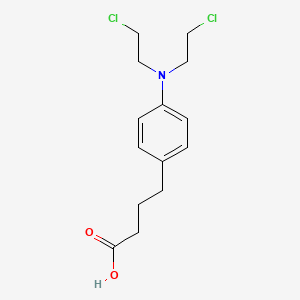
| Formula | C14H19Cl2NO2 |
|---|---|
| Molecular weight | 304.22 g/mol |
| IUPAC name | 4-[4-[bis(2-chloroethyl)amino]phenyl]butanoic acid |
| CAS | 305-03-3 |
| PubChem CID | 2708 |
| InChIKey | JCKYGMPEJWAADB-UHFFFAOYSA-N |
| logP | 3.38 (XLogP 1.7) |
| Polar surface area | 40.54 Ų |
| H-bond acceptors / donors | 2 / 1 |
| Drug-likeness (QED) | 0.71 |
| Lipinski violations | 0 |
SMILES
O=C(O)CCCc1ccc(N(CCCl)CCCl)cc1Biology & Pharmacokinetics
Pharmacokinetics
| BBB penetrant | No (logBB -1.7) |
|---|
Enzyme interactions
| Enzyme | Role | Detail |
|---|---|---|
| CYP1A2 | Substrate | — |
| CYP2C9 | Substrate | — |
| CYP2D6 | Inhibitor | IC₅₀ 65.09999999999997 µM |
Transporters
BCRP (Inhibitor)BSEP (Inhibitor)BSEP (Inhibitor)MATE1 (Inhibitor)MRP1 (Inhibitor)MRP2 (Inhibitor)MRP3 (Inhibitor)MRP4 (Inhibitor)OAT3 (Inhibitor)OATP1B1 (Inhibitor)OATP1B3 (Inhibitor)OATP1B3 (Inhibitor)P-gp (Inhibitor)OATP1A2 (Substrate)P-gp (Substrate)
Drug–drug interactions (100+, DDInter)
| Interacting drug | Severity | Management |
|---|---|---|
| Adalimumab | major | |
| Bacillus calmette-guerin substrain tice live antigen | major | |
| Baricitinib | major | |
| Certolizumab pegol | major | |
| Cladribine | major | |
| Clozapine | major | |
| Deferiprone | major | |
| Etanercept | major | |
| Fingolimod | major | |
| Golimumab | major | |
| Infliximab | major | |
| Leflunomide | major | |
| Measles virus vaccine live attenuated | major | |
| Mumps virus strain B level jeryl lynn live antigen | major | |
| Nalidixic acid | major | |
| Natalizumab | major | |
| Ozanimod | major | |
| Rotavirus vaccine | major | |
| Rubella virus vaccine | major | |
| Samarium (153Sm) lexidronam | major | |
| Siponimod | major | |
| Smallpox (Vaccinia) Vaccine, Live | major | |
| Talimogene laherparepvec | major | |
| Teriflunomide | major | |
| Thalidomide | major | |
| Thiotepa | major | |
| Tofacitinib | major | |
| Typhoid vaccine (live) | major | |
| Upadacitinib | major | |
| Varicella Zoster Vaccine (Recombinant) | major | |
| Yellow Fever Vaccine | major | |
| Aldesleukin | moderate | |
| Alefacept | moderate | |
| Alemtuzumab | moderate | |
| Amphotericin B | moderate | |
| Amphotericin B (cholesteryl sulfate) | moderate | |
| Amphotericin B (lipid complex) | moderate | |
| Amphotericin B (liposomal) | moderate | |
| Anakinra | moderate | |
| Anthrax vaccine | moderate |
Showing 40 of 100+.
Registered Products (1)
| Brand | Form / strength | Pack | Agent | Citizen (JOD) |
|---|---|---|---|---|
| Leukeran Tablets | Tablet 2 mg | 25 tab | Suleiman Tannous & Sons Co. Ltd | 18.460 |