Cinacalcet
JFDA label: Cencipral
Mechanism of Action
Increases the sensitivity of the calcium-sensing receptor on the parathyroid gland thereby, concomitantly lowering parathyroid hormone (PTH), serum calcium, and serum phosphorus levels, preventing progressive bone disease and adverse events associated with mineral metabolism disorders.
Indications
Approved
- Hyperparathyroidism, primary
- Hyperparathyroidism, secondary
- Parathyroid carcinoma
Contraindications
Source: Lexicomp
- Additional contraindications (not in US labeling): Hypersensitivity to any component of the formulation Absolute
- Serum calcium less than the lower limit of normal range Absolute
Adverse Reactions
Cardiac disorders (2)
Very Common Hypotension
Common Hypertension
Nervous system disorders (7)
Very Common depression · fatigue · headache · Paresthesia
Common Dizziness · noncardiac chest pain · seizure
Blood and lymphatic system disorders (1)
Very Common Anemia
Immune system disorders (1)
Common Hypersensitivity reaction
Metabolism and nutrition disorders (2)
Very Common Hypocalcemia, vomiting, diarrhea, anorexia, constipation, abdominal pain
Common Hyperkalemia
Gastrointestinal disorders (3)
Common decreased appetite · dyspepsia · Upper abdominal pain
Musculoskeletal and connective tissue disorders (7)
Very Common arthralgia · back pain · Bone fracture · limb pain · muscle spasm · myalgia · weakness
Infections and infestations (1)
Common Localized infection
Respiratory, thoracic and mediastinal disorders (3)
Very Common cough · Dyspnea · upper respiratory tract infection
Other (1)
Not Known Hematologic & oncologic: Upper gastrointestinal hemorrhage
Dosing
Source: Lexicomp
Warnings & Precautions
Source: Lexicomp
Adynamic bone disease
May develop if intact parathyroid hormone (iPTH) levels are suppressed • Cardiovascular effects: QT prolongation and ventricular arrhythmia secondary to hypocalcemia may occur. Patients with congenital long QT syndrome, history of QT interval prolongation, family history of long QT syndrome or sudden cardiac death, and other conditions that predispose to QT interval prolongation and ventricular arrhythmia may be at increased risk. Closely monitor corrected serum calcium and QT interval. Cases of idiosyncratic hypotension, worsening of heart failure, and/or arrhythmia have been reported in patients with impaired cardiovascular function; may correlate with decreased serum calcium.
GI effects
GI bleeding, mostly upper GI bleeding, have been reported (exact cause unknown); patients with risk factors for upper GI bleeding (eg, gastritis, esophagitis, ulcers, severe vomiting) may be at increased risk. Monitor for worsening of common GI adverse reactions of nausea and vomiting and for signs and symptoms of GI bleeding and ulcerations during therapy.
Hypocalcemia
Life-threatening and fatal events associated with hypocalcemia have occurred. Monitor serum calcium and for symptoms of hypocalcemia (eg, muscle spasms, myalgia, paresthesia, seizure, tetany). Use with caution in patients receiving concomitant therapies known to lower serum calcium concentrations. May require treatment interruption, dose reduction, or initiation (or dose increases) of calcium-based phosphate binder and/or vitamin D to raise serum calcium depending on calcium levels or symptoms of hypocalcemia. Do not initiate therapy if the corrected serum calcium is less than the lower limit of normal; corrected serum calcium must be at or above the lower limit of normal prior to initiation, dose increase, or reinitiation. Disease-related concerns:
Hepatic impairment
Use with caution in patients with moderate-to-severe hepatic impairment (Child-Pugh classes B and C); cinacalcet exposure and half-life are increased; monitor serum calcium, serum phosphorus and iPTH closely.
Seizure disorder
Use with caution in patients with a history of seizure disorder; seizure threshold is lowered by significant serum calcium reductions. Monitor calcium levels closely. Concurrent drug therapy issues:
Drug-drug interactions
Potentially significant interactions may exist, requiring dose or frequency adjustment, additional monitoring, and/or selection of alternative therapy. Consult drug interactions database for more detailed information. Other warnings/precautions:
Appropriate use
Not indicated for chronic kidney disease (CKD) patients not receiving dialysis. In the US, the long-term safety and efficacy of cinacalcet has not been evaluated in CKD patients with hyperparathyroidism not requiring dialysis. Although possibly related to lower baseline calcium levels, clinical studies have shown an increased incidence of hypocalcemia (
Pregnancy & Lactation
Pregnancy
Information related to the use of cinacalcet in pregnant women is limited (Edling 2014; Horius 2009; Nadarasa 2014; Rey 2016; Vera 2016).
Lactation
It is not known if cinacalcet is present in breast milk. According to the manufacturer, the decision to continue or discontinue breastfeeding during therapy should take into account the risk of infant exposure, the benefits of breastfeeding to the infant, and benefits of treatment to the mother.
Monitoring
| Clinical pearl | Monitor for signs/symptoms of hypocalcemia. Monitor serum calcium and iPTH concentrations closely in patients on concurrent CYP3A4 inhibitors or with seizure disorders; monitor serum calcium, iPTH, and serum phosphorous concentrations closely in patients with hepatic moderate to severe hepatic impairment. Hyperparathyroidism, secondary: Serum calcium and phosphorus levels prior to initiation and within a week of initiation and frequently during dose titration; iPTH should be measured 1 to 4 weeks after initiation or dosage adjustment (wait at least 12 hours after dose before drawing iPTH levels). After the maintenance dose is established, obtain serum calcium levels monthly. Parathyroid carcinoma and hyperparathyroidism, primary: Serum calcium levels prior to initiation and within a week of initiation or dosage adjustment; once maintenance dose is established, obtain serum calcium every 2 months. |
|---|
Chemistry & Properties
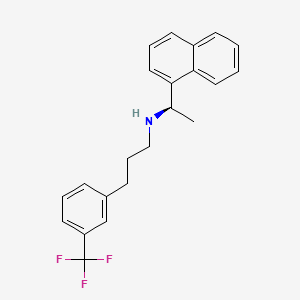
| Formula | C22H22F3N |
|---|---|
| Molecular weight | 357.42 g/mol |
| IUPAC name | N-[(1R)-1-naphthalen-1-ylethyl]-3-[3-(trifluoromethyl)phenyl]propan-1-amine |
| CAS | 226256-56-0 |
| PubChem CID | 156419 |
| InChIKey | VDHAWDNDOKGFTD-MRXNPFEDSA-N |
| logP | 6.14 (XLogP 6.1) |
| Polar surface area | 12.03 Ų |
| H-bond acceptors / donors | 1 / 1 |
| Drug-likeness (QED) | 0.52 |
| Lipinski violations | 1 |
SMILES
C[C@@H](NCCCc1cccc(C(F)(F)F)c1)c1cccc2ccccc12Biology & Pharmacokinetics
Pharmacokinetics predicted
| Bioavailability | 70.0% |
|---|---|
| Half-life | 0.276 h |
| Volume of distribution | 15.202 L/kg |
| Protein binding | 96.1% |
| BBB penetrant | No |
Enzyme interactions
| Enzyme | Role | Detail |
|---|---|---|
| CYP1A2 | Inhibitor | — |
| CYP1A2 | Substrate | — |
| CYP2B6 | Inhibitor | — |
| CYP2C19 | Inhibitor | — |
| CYP2C19 | Substrate | — |
| CYP2C8 | Inhibitor | — |
| CYP2D6 | Inhibitor | IC₅₀ 0.049999999999999996 µM |
| CYP2D6 | Substrate | — |
| CYP3A4 | Substrate | — |
Receptor binding (top 1)
| Target | Action | Affinity |
|---|---|---|
| CaS receptor (CASR) | Allosteric modulator | pEC50 7.3 |
Transporters
BCRP (Inhibitor)BSEP (Inhibitor)MRP1 (Inhibitor)OATP1B1 (Inhibitor)OATP1B3 (Inhibitor)P-gp (Inhibitor)MDR1 (Substrate)P-gp (Substrate)
Drug–drug interactions (100+, DDInter)
| Interacting drug | Severity | Management |
|---|---|---|
| Atomoxetine | major | |
| Brexpiprazole | major | |
| Deutetrabenazine | major | |
| Eliglustat | major | |
| Etelcalcetide | major | |
| Iloperidone | major | |
| Oliceridine | major | |
| Pimozide | major | |
| Pitolisant | major | |
| Tamoxifen | major | |
| Tetrabenazine | major | |
| Thioridazine | major | |
| Valbenazine | major | |
| Vortioxetine | major | |
| Abametapir (topical) | moderate | |
| Alimemazine | moderate | |
| Amitriptyline | moderate | |
| Amoxapine | moderate | |
| Amphetamine | moderate | |
| Amprenavir | moderate | |
| Aripiprazole | moderate | |
| Atazanavir | moderate | |
| Boceprevir | moderate | |
| Bortezomib | moderate | |
| Brigatinib | moderate | |
| Burosumab | moderate | |
| Carvedilol | moderate | |
| Ceritinib | moderate | |
| Cevimeline | moderate | |
| Chlorpromazine | moderate | |
| Clarithromycin | moderate | |
| Clomipramine | moderate | |
| Clozapine | moderate | |
| Cobicistat | moderate | |
| Codeine | moderate | |
| Conivaptan | moderate | |
| Darifenacin | moderate | |
| Dasatinib | moderate | |
| Deferasirox | moderate | |
| Delavirdine | moderate |
Showing 40 of 100+.
Registered Products (5)
| Brand | Form / strength | Pack | Agent | Citizen (JOD) |
|---|---|---|---|---|
| Cencipral | Tablet (as Hydrochloride) 30 mg | 28 tab | JAWEDA INT. DRUD STORE | 99.360 |
| Mimpara F.C Tab | Film-Coated Tablet 30 mg | 28 tab | Adatco Drug Store | 126.690 |
| Cencipral | Tablet ( as Hydrochloride ) 60 mg | 28 tab | JAWEDA INT. DRUD STORE | — |
| Cencipral | Tablet (as Hydrochloride) 90 mg | 28 tab | JAWEDA INT. DRUD STORE | — |
| Mimpara F.C Tab | Film-Coated Tablet 60 mg | 28 tab | Adatco Drug Store | — |