Clindamycin
JFDA label: Dalacin Vaginal Cream
- gastrointestinal toxicity — ChEMBL drug_warning (Black Box Warning) | United States
- infectious disease — ChEMBL drug_warning (Black Box Warning) | United States
- misuse — ChEMBL drug_warning (Black Box Warning) | United States
- Clostridioides difficile- associated diarrhea (CDAD) has been reported with use of nearly all antibacterial agents, including CLEOCIN PHOSPHATE and may range in severity from mild diarrhea to fatal co
Mechanism of Action
Mechanism of Action Clindamycin inhibits bacterial protein synthesis by binding to the 23S RNA of the 50S subunit of the ribosome. Clindamycin is bacteriostatic.
Indications
Approved
- Acne Vulgaris — acne
- Bacterial Infections — bacterial disease
- Endometritis — Endometritis
- Infections — infection
- Intraabdominal Infections — infection
- Osteomyelitis — osteomyelitis
Off-label
- Breast Neoplasms
- Candidiasis, Vulvovaginal
- Carcinoma, Non-Small-Cell Lung
- Chorioretinitis
- Hernia
- Hernia, Ventral
- Kidney Calculi
- Malaria
- Nasal Obstruction
- Pain
- Periapical Periodontitis
- Pneumonia, Pneumocystis
- Prediabetic State
- Severe Acute Respiratory Syndrome
- Skin Diseases
- Staphylococcal Infections
- Vaginosis, Bacterial
Antimicrobial Spectrum
Expected / intrinsic spectrum (EUCAST breakpoints & labels) — not local resistance. Source: EUCAST v16 · curated · openfda-label.
Bacteria
| Organism | Activity | MIC |
|---|---|---|
| Anaerobes | Susceptible | 45.0 mg/L |
| Bacillus spp. | Susceptible | 1.0 mg/L |
| Bacteroides fragilis group | Susceptible | 4.0 mg/L |
| Clostridium clostridioforme | Active | — |
| Clostridium perfringens | Active | — |
| Corynebacterium spp. | Susceptible | 0.5 mg/L |
| Enterococcus faecalis | Active | — |
| Fusobacterium necrophorum | Active | — |
| Fusobacterium nucleatum | Active | — |
| Peptostreptococcus anaerobius | Active | — |
| Prevotella bivia | Active | — |
| Prevotella intermedia | Active | — |
| Prevotella melaninogenica | Active | — |
| Staphylococcus aureus | Susceptible | 0.25 mg/L |
| Staphylococcus epidermidis | Active | — |
| Staphylococcus spp. | Susceptible | 0.25 mg/L |
| Streptococcus A/B/C/G | Susceptible | 0.5 mg/L |
| Streptococcus agalactiae | Active | — |
| Streptococcus anginosus | Active | — |
| Streptococcus mitis | Active | — |
| Streptococcus oralis | Active | — |
| Streptococcus pneumoniae | Susceptible | 0.5 mg/L |
| Streptococcus pneumoniae | Susceptible | 0.5 mg/L |
| Streptococcus pyogenes | Susceptible | 0.5 mg/L |
| Viridans group streptococci | Susceptible | 0.5 mg/L |
| Staphylococcus aureus | Resistant | 0.5 mg/L |
Class profile
| gramStatus | Gram+ |
|---|---|
| spectrumBreadth | Moderate |
| atypicalCoverage | No |
| isBactericidal | 0 |
| moaCategory | Protein synthesis inhibitor (50S ribosomal, 23S rRNA) |
| pdIndex | Time-dependent |
| postAntibioticEffect | Short |
| mrsaCoverage | 0 |
| resistanceMechanisms | Target site methylation (erm genes),Efflux pumps |
Contraindications
Source: openFDA
- This drug is contraindicated in individuals with a history of hypersensitivity to preparations containing clindamycin or lincomycin. Absolute
Dosing
Source: openFDA
Warnings & Precautions
Source: openFDA
Boxed Warning
Clostridioides difficile- associated diarrhea (CDAD) has been reported with use of nearly all antibacterial agents, including CLEOCIN PHOSPHATE and may range in severity from mild diarrhea to fatal colitis. Treatment with antibacterial agents alters the normal flora of the colon leading to overgrowth of C. difficile . Because CLEOCIN PHOSPHATE therapy has been associated with severe colitis which may end fatally, it should be reserved for serious infections where less toxic antimicrobial agents are inappropriate, as described in the INDICATIONS AND USAGE section. It should not be used in patients with nonbacterial infections such as most upper respiratory tract infections. C. difficile produces toxins A and B which contribute to the development of CDAD. Hypertoxin producing strains of C. difficile cause increased morbidity and mortality, as these infections can be refractory to antimicrobial therapy and may require colectomy. CDAD must be considered in all patients who present with diarrhea following antibacterial drug use. Careful medical history is necessary since CDAD has been reported to occur over two months after the administration of antibacterial agents. If CDAD is suspected or confirmed, ongoing antibacterial drug use not directed against C. difficile may need to be discontinued. Appropriate fluid and electrolyte management, protein supplementation, antibacterial drug treatment of C. difficile , and surgical evaluation should be instituted as clinically indicated.
Warnings & Precautions
See BOXED WARNING . Clostridioides difficile -Associated Diarrhea Clostridioides difficile -associated diarrhea (CDAD) has been reported with use of nearly all antibacterial agents, including CLEOCIN PHOSPHATE, and may range in severity from mild diarrhea to fatal colitis. Treatment with antibacterial agents alters the normal flora of the colon leading to overgrowth of C. difficile . C. difficile produces toxins A and B which contribute to the development of CDAD. Hypertoxin producing strains of C. difficile cause increased morbidity and mortality, as these infections can be refractory to antimicrobial therapy and may require colectomy. CDAD must be considered in all patients who present with diarrhea following antibacterial drug use. Careful medical history is necessary since CDAD has been reported to occur over two months after the administration of antibacterial agents. If CDAD is suspected or confirmed, ongoing antibacterial drug use not directed against C. difficile may need to be discontinued. Appropriate fluid and electrolyte management, protein supplementation, antibacterial drug treatment of C. difficile , and surgical evaluation should be instituted as clinically indicated. Anaphylactic and Severe Hypersensitivity Reactions Anaphylactic shock and anaphylactic reactions have been reported ( see ADVERSE REACTIONS ) . Severe hypersensitivity reactions, including acute myocardial ischemia with or without myocardial infarction, and severe skin reactions such as toxic epidermal necrolysis (TEN), drug reaction with eosinophilia and systemic symptoms (DRESS), Stevens-Johnson syndrome (SJS), some with fatal outcome, have been reported ( see ADVERSE REACTIONS ) . In case of such an anaphylactic or severe hypersensitivity reaction, discontinue treatment permanently and institute appropriate therapy. A careful inquiry should be made concerning previous sensitivities to drugs and other allergens. Benzyl Alcohol Toxicity in Neonates ("Gasping Syndrome") This product contains benzyl alcohol as a preservative. The administration of intravenous solutions containing the preservative benzyl alcohol has been associated with the "gasping syndrome", and death in neonates. Symptoms include a striking onset of gasping respiration, hypotension, bradycardia, and cardiovascular collapse. Although the normal therapeutic dose of this product delivers amounts of benzyl alcohol that are substantially lower than those reported in association with the "gasping syndrome", the min
Pregnancy & Lactation
Pregnancy
Lactation
If a nursing mother requires oral or intravenous clindamycin, it is not a reason to discontinue breastfeeding, but an alternate drug may be preferred.
LactMed: monitor the infant.
Monitoring
| Efficacy | Culture and susceptibility testing; clinical resolution (temperature, WBC, CRP, procalcitonin) |
|---|---|
| Toxicity | Renal function (dose adjustment in renal impairment); hepatic function for hepatically cleared agents; signs of C. difficile infection (diarrhoea) |
| Clinical pearl | Culture results guide de-escalation to narrower-spectrum therapy. Review antibiotic appropriateness at 48–72 h (antimicrobial stewardship). |
| Counseling | Complete the full course. Report persistent diarrhoea, rash, or lack of improvement after 48–72 h. |
Chemistry & Properties
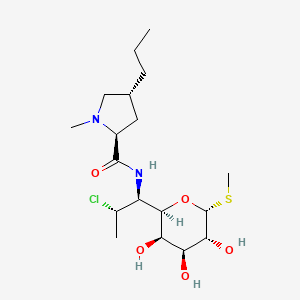
| Formula | C18H33ClN2O5S |
|---|---|
| Molecular weight | 424.99 g/mol |
| IUPAC name | (2S,4R)-N-[(1S,2S)-2-chloro-1-[(2R,3R,4S,5R,6R)-3,4,5-trihydroxy-6-methylsulfanyloxan-2-yl]propyl]-1-methyl-4-propylpyrrolidine-2-carboxamide |
| CAS | 18323-44-9 |
| PubChem CID | 446598 |
| InChIKey | KDLRVYVGXIQJDK-AWPVFWJPSA-N |
| logP | 0.39 (XLogP 2.2) |
| Polar surface area | 102.26 Ų |
| H-bond acceptors / donors | 7 / 4 |
| Drug-likeness (QED) | 0.44 |
| Lipinski violations | 0 |
SMILES
CCC[C@@H]1C[C@@H](C(=O)N[C@@H]([C@H]2O[C@H](SC)[C@H](O)[C@@H](O)[C@H]2O)[C@H](C)Cl)N(C)C1Biology & Pharmacokinetics
Pharmacokinetics
| BBB penetrant | No |
|---|
Enzyme interactions
| Enzyme | Role | Detail |
|---|---|---|
| CYP2C19 | Substrate | — |
| CYP3A4 | Substrate | — |
Transporters
BCRP (Inhibitor)BSEP (Inhibitor)MRP1 (Inhibitor)OATP1B1 (Inhibitor)OATP1B1 (Inhibitor)OATP1B3 (Inhibitor)OCT1 (Inhibitor)P-gp (Inhibitor)P-gp (Substrate)
Drug–drug interactions (72, DDInter)
| Interacting drug | Severity | Management |
|---|---|---|
| Typhoid vaccine (live) | major | |
| Vibrio cholerae CVD 103-HgR strain live antigen (live) | major | |
| Abametapir (topical) | moderate | |
| Amprenavir | moderate | |
| Apalutamide | moderate | |
| Atazanavir | moderate | |
| Atracurium | moderate | |
| Attapulgite | moderate | |
| Balsalazide | moderate | |
| Bifidobacterium longum infantis | moderate | |
| Boceprevir | moderate | |
| Carbamazepine | moderate | |
| Ceritinib | moderate | |
| Cisatracurium | moderate | |
| Clarithromycin | moderate | |
| Cobicistat | moderate | |
| Conivaptan | moderate | |
| Cyclosporine | moderate | |
| Delavirdine | moderate | |
| Doxacurium | moderate | |
| Enzalutamide | moderate | |
| Erythromycin | moderate | |
| Estradiol | moderate | |
| Ethinylestradiol | moderate | |
| Fosamprenavir | moderate | |
| Fosphenytoin | moderate | |
| Gentamicin | moderate | |
| Givosiran | moderate | |
| Idelalisib | moderate | |
| Indinavir | moderate | |
| Indium In-111 oxyquinoline | moderate | |
| Itraconazole | moderate | |
| Kaolin | moderate | |
| Ketoconazole | moderate | |
| Lactobacillus acidophilus | moderate | |
| Lonafarnib | moderate | |
| Lumacaftor | moderate | |
| Mestranol | moderate | |
| Metocurine | moderate | |
| Mitotane | moderate |
Showing 40 of 72.
Registered Products (29)
| Brand | Form / strength | Pack | Agent | Citizen (JOD) |
|---|---|---|---|---|
| Clidacin BA Free | Ampoule 600 mg/4 ml | 1 amp | Manar Drug Store | 1.740 |
| Clinaram-150mg capsule | Capsule 150 mg | 16 cap pack varies | AL-RAM PHARMA.INDUS.CO.LTD/JORDAN | 2.430 |
| Clindacin Capsules | Capsule 150 mg | 16 cap pack varies | UNITED PHARM.MFG.CO.LTD(UPM)/JORDAN | 2.430 |
| Clinimycin Caps | Capsule 150 mg | 16 cap pack varies | Hayat Pharmaceutical Industries CO.PLC/JORDAN | 2.430 |
| Clinimycin Caps | Capsule 150 mg | 400 cap pack varies | Hayat Pharmaceutical Industries CO.PLC/JORDAN | 2.430 |
| Lanacin cap | Capsule 150 mg | 16 cap pack varies | Pharma International Company/ Jordan | 2.430 |
| DALACIN C CAPSULES | Capsule 150 mg | 16 cap | Khoury Drug Store | 2.560 |
| DALACIN C INJ 300MG | Injection 300 mg/2 ml | 2 ml | Khoury Drug Store | 2.920 |
| Clinceen 300mg/2ml Concetrate for solu for inj | Injection 150 mg/ml | 1 vial | MS PHARMA/JORDAN | 3.080 |
| Clinaderm Solution | Solution 1 % | 30 ml | PHILADELPHIA PHAEMACEUTICALS.COMP/JORDAN | 3.240 |
| Fouch Vaginal Cream | Cream 2 % | 40gm + 7 applicators | AL-BARON DRUG STORE | 3.270 |
| Clindacin Gel | Gel 10 mg/g | 30 g tube | UNITED PHARM.MFG.CO.LTD(UPM)/JORDAN | 3.480 |
| Clindacin | Capsule 300 mg | 16 cap | UNITED PHARM.MFG.CO.LTD(UPM)/JORDAN | 3.940 |
| Clinimycin | Tablet as Hcl 300 mg | 16 tab | Hayat Pharmaceutical Industries CO.PLC/JORDAN | 3.940 |
| DALACIN C CAPSULES | Capsule 300 mg | 16 cap | Khoury Drug Store | 4.150 |
| Clinimycin T solution | Solution 10 mg/ml | 50 ml | Hayat Pharmaceutical Industries CO.PLC/JORDAN | 4.380 |
| Dalacin-T Topical solution | Solution 1 % | 30 ml | Khoury Drug Store | 4.610 |
| Clinimycin T gel | Gel 1 % | 45 g tube | Hayat Pharmaceutical Industries CO.PLC/JORDAN | 4.790 |
| Clinceen | Vial 150 mg/ml | 1 vial | MS PHARMA/JORDAN | 4.950 |
| DALACIN C INJ 600MG 4ML/A | Injection 600 mg/4 ml | 4 ml | Khoury Drug Store | 4.950 |
| Lindacin Topical Solution | Solution (as Phosphate) 10 mg/ml | 50 ml | Amman Pharmaceutical Industries Co | 5.000 |
| Dalacin T lotion | Lotion 1 % | 30 ml | Khoury Drug Store | 5.540 |
| Acticare 1.2%,0.025% | Cream 0.025 %, 1.2 % | 30 gm pack varies | Hayat Pharmaceutical Industries CO.PLC/JORDAN | 6.170 |
| Dalacin Vaginal Cream | Cream 2 % | 40gm+7appl | Khoury Drug Store | 7.640 |
| Acticare 1.2%,0.025% | Cream 0.025 %, 1.2 % | 45 gm pack varies | Hayat Pharmaceutical Industries CO.PLC/JORDAN | 9.260 |
| Clinaram-150mg capsule | Capsule 150 mg | 400 cap pack varies | AL-RAM PHARMA.INDUS.CO.LTD/JORDAN | 51.640 |
| Lanacin cap | Capsule 150 mg | 400 cap pack varies | Pharma International Company/ Jordan | 51.640 |
| Clindacin Capsules | Capsule 150 mg | 800 cap pack varies | UNITED PHARM.MFG.CO.LTD(UPM)/JORDAN | 103.280 |
| Clinaram-150mg capsule | Capsule 150 mg | 1000 cap pack varies | AL-RAM PHARMA.INDUS.CO.LTD/JORDAN | 129.090 |