Cloxacillin
🧬 Cross-allergy: Penicillins
JFDA label: Cloxadar 250 Caps
Mechanism of Action
Inhibits bacterial cell wall synthesis by binding to one or more of the penicillin-binding proteins (PBPs) which in turn inhibit the final transpeptidation step of peptidoglycan synthesis in bacterial cell walls, thus inhibiting cell wall biosynthesis. Bacteria eventually lyse due to ongoing activity of cell wall autolytic enzymes (autolysins and murein hydrolases) while cell wall assembly is arrested.
Indications
Approved
- Bacterial infections
Class profile
| gramStatus | Gram+ |
|---|---|
| spectrumBreadth | Narrow |
| atypicalCoverage | No |
| isBactericidal | 1 |
| moaCategory | Cell wall synthesis inhibitor (beta-lactam, penicillinase-stable) |
| pdIndex | Time-dependent |
| postAntibioticEffect | None |
| mrsaCoverage | 0 |
| resistanceMechanisms | PBP2a mutation (mecA gene),Hyperproduction of PBP2a |
Contraindications
Source: Lexicomp
- Hypersensitivity to cloxacillin, other penicillins, cephalosporins, or any component of the formulation Absolute
Adverse Reactions
Cardiac disorders (2)
Not Known Hypotension · thrombophlebitis
Nervous system disorders (5)
Not Known Confusion · lethargy · myoclonus · seizure (high doses and/or renal failure) · twitching
Hepatobiliary disorders (4)
Not Known hepatotoxicity · Increased serum alkaline phosphatase · increased serum ALT · increased serum AST
Renal and urinary disorders (5)
Not Known Hematuria · Interstitial nephritis · proteinuria · renal insufficiency · renal tubular disease
Blood and lymphatic system disorders (10)
Not Known Agranulocytosis · anemia · bone marrow depression · eosinophilia · granulocytopenia · hemolytic anemia · immune thrombocytopenia · leukopenia · neutropenia · thrombocytopenia
Immune system disorders (4)
Not Known Anaphylaxis · angioedema · hypersensitivity reaction (immediate and delayed) · Serum sickness-like reaction
Gastrointestinal disorders (12)
Not Known Abdominal pain · diarrhea · epigastric distress · flatulence · hairy tongue · loose stools · melanoglossia · nausea · oral candidiasis · pseudomembranous colitis · stomatitis · vomiting
Skin and subcutaneous tissue disorders (3)
Not Known Pruritus · skin rash · urticaria
Musculoskeletal and connective tissue disorders (1)
Not Known Laryngospasm
General disorders and administration site conditions (1)
Not Known Fever
Respiratory, thoracic and mediastinal disorders (4)
Not Known Bronchospasm · laryngeal edema · sneezing · wheezing
Dosing
Source: Lexicomp
Warnings & Precautions
Source: Lexicomp
Anaphylactoid/hypersensitivity reactions
Serious and occasionally severe or fatal hypersensitivity (anaphylactoid) reactions have been reported in patients on penicillin therapy, especially with a history of beta-lactam hypersensitivity, history of sensitivity to multiple allergens, or previous IgE-mediated reactions (eg, anaphylaxis, angioedema, urticaria). Use with caution in asthmatic patients.
CNS effects
Although not reported with cloxacillin, the transport of penicillins across the blood-brain barrier may be enhanced by inflamed meninges or during cardiopulmonary bypass. An increased risk of myoclonia, seizures, or reduced consciousness may be observed in these patients (particularly those with renal failure).
Hematologic effects
Penicillin use has been associated with hematologic disorders (eg, agranulocytosis, neutropenia, thrombocytopenia) believed to be a hypersensitivity phenomena. Reactions are most often reversible upon discontinuing therapy.
Superinfection
Prolonged use may result in fungal or bacterial superinfection, including C. difficile-associated diarrhea (CDAD) and pseudomembranous colitis; CDAD has been observed >2 months postantibiotic treatment. Disease-related concerns:
Renal impairment
Use with caution in patients with renal impairment; rate of elimination is reduced.
Seizure disorders
Use with caution in patients with a history of seizure disorder; high serum levels, particularly in the presence of renal impairment, may increase risk for seizures. Concurrent drug therapy issues:
Drug-drug interactions
Potentially significant interactions may exist, requiring dose or frequency adjustment, additional monitoring, and/or selection of alternative therapy. Consult drug interactions database for more detailed information. Special populations:
Neonates
May have decreased renal clearance of cloxacillin; frequent evaluation of serum levels and of clinical status for adverse effects as well as frequent dosage adjustments may be necessary in this patient population.
Pregnancy & Lactation
Pregnancy
Cloxacillin crosses the placenta and distributes into fetal tissue
Lactation
Cloxacillin is excreted into breast milk
Monitoring
| Efficacy | Culture and susceptibility testing; clinical resolution (temperature, WBC, CRP, procalcitonin) |
|---|---|
| Toxicity | Renal function (dose adjustment in renal impairment); hepatic function for hepatically cleared agents; signs of C. difficile infection (diarrhoea) |
| Clinical pearl | Culture results guide de-escalation to narrower-spectrum therapy. Review antibiotic appropriateness at 48–72 h (antimicrobial stewardship). |
| Counseling | Complete the full course. Report persistent diarrhoea, rash, or lack of improvement after 48–72 h. |
Chemistry & Properties
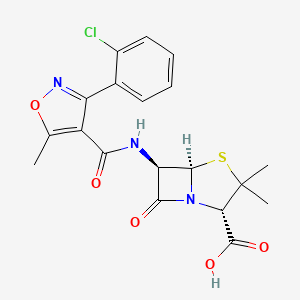
| Formula | C19H18ClN3O5S |
|---|---|
| Molecular weight | 435.89 g/mol |
| IUPAC name | (2S,5R,6R)-6-[[3-(2-chlorophenyl)-5-methyl-1,2-oxazole-4-carbonyl]amino]-3,3-dimethyl-7-oxo-4-thia-1-azabicyclo[3.2.0]heptane-2-carboxylic acid |
| CAS | 61-72-3 |
| PubChem CID | 6098 |
| InChIKey | LQOLIRLGBULYKD-JKIFEVAISA-N |
| logP | 2.55 (XLogP 2.4) |
| Polar surface area | 112.74 Ų |
| H-bond acceptors / donors | 6 / 2 |
| Drug-likeness (QED) | 0.71 |
| Lipinski violations | 0 |
SMILES
Cc1onc(-c2ccccc2Cl)c1C(=O)N[C@@H]1C(=O)N2[C@@H]1SC(C)(C)[C@@H]2C(=O)OBiology & Pharmacokinetics
Pharmacokinetics predicted
| Bioavailability | 70.0% |
|---|---|
| Half-life | 1.212 h |
| Volume of distribution | 0.123 L/kg |
| Protein binding | 95.1% |
| BBB penetrant | Yes |
Enzyme interactions
| Enzyme | Role | Detail |
|---|---|---|
| CYP2C19 | Substrate | — |
Transporters
BCRP (Inhibitor)BSEP (Inhibitor)BSEP (Inhibitor)MRP1 (Inhibitor)OAT3 (Inhibitor)OATP1B1 (Inhibitor)OATP1B1 (Inhibitor)OATP1B3 (Inhibitor)OATP1B3 (Inhibitor)P-gp (Inhibitor)PEPT1 (Inhibitor)PEPT2 (Inhibitor)OAT3 (Substrate)P-gp (Substrate)
Drug–drug interactions (17, DDInter)
| Interacting drug | Severity | Management |
|---|---|---|
| Methotrexate | major | |
| Balsalazide | moderate | |
| Chloramphenicol | moderate | |
| Demeclocycline | moderate | |
| Doxycycline | moderate | |
| Ethinylestradiol | moderate | |
| Iodide I-123 | moderate | |
| Iodide I-131 | moderate | |
| Minocycline | moderate | |
| Mycophenolic acid | moderate | |
| Pemetrexed | moderate | |
| Picosulfuric acid | moderate | |
| Proguanil | moderate | |
| Tetracycline | moderate | |
| Warfarin | moderate | |
| Clarithromycin | minor | |
| Erythromycin | minor |
Registered Products (10)
| Brand | Form / strength | Pack | Agent | Citizen (JOD) |
|---|---|---|---|---|
| Cloxadar 250 Caps | Capsule 250 mg | 16 cap pack varies | Dar Al Dawa Development and Investment Co Ltd/Jordan | 1.600 |
| PENCLODAR 500 CAPS. | Capsule 250 mg, 250 mg | 16 cap pack varies | Dar Al Dawa Development and Investment Co Ltd/Jordan | 2.340 |
| Ultracloxam | Tablet 250 mg, 250 mg | 2x8's | The Arab Pharmaceutical Manufactruing Co. | 2.600 |
| PENCLODAR 500 CAPS. | Capsule 250 mg, 250 mg | 20 cap pack varies | Dar Al Dawa Development and Investment Co Ltd/Jordan | 2.810 |
| MONOCLOX VIAL | Vial 250 mg | 10 vial | Khoury Drug Store | 6.740 |
| MONOCLOX VIAL | Vial 500 mg | 10 | Al Hilal Drug Store | 10.310 |
| Ultraxin Vials | Vial 250 mg | 500 | The Arab Pharmaceutical Manufactruing Co. | 38.220 |
| Cloxadar 250 Caps | Capsule 250 mg | 500 cap pack varies | Dar Al Dawa Development and Investment Co Ltd/Jordan | 40.000 |
| PENCLODAR 500 CAPS. | Capsule 250 mg, 250 mg | 500 cap pack varies | Dar Al Dawa Development and Investment Co Ltd/Jordan | 57.610 |
| Cloxa | Vial 500 mg | 1 vial | ٠ستÙدع أدÙÙØ© اÙÙÙÙÙÙÙ | — |