Dienogest
JFDA label: Visanne
Mechanism of Action
— Unknown
Indications
Approved
- Endometriosis
Contraindications
Source: Lexicomp
- Hypersensitivity to dienogest or any component of the formulation Absolute
- active venous thromboembolic disorder Absolute
- breast-feeding Absolute
- current or history of migraine with focal aura Absolute
- diabetes mellitus with vascular involvement Absolute
- history of or current arterial and cardiovascular disease (eg, MI, ischemic heart disease, cerebrovascular accident) Absolute
- history of or current hepatic neoplasia (benign or malignant) Absolute
- history of or current severe hepatic disease where liver function tests remain abnormal Absolute
- known or suspected pregnancy Absolute
- known or suspected sex-hormone-dependent malignancy Absolute
- ocular lesions due to ophthalmic vascular disease, such as partial or complete vision loss or defect in visual fields Absolute
- undiagnosed abnormal vaginal bleeding Absolute
Adverse Reactions
Nervous system disorders (6)
Common depression · disturbed sleep · Headache · irritability · migraine · nervousness
Renal and urinary disorders (1)
Common Vaginal hemorrhage
Metabolism and nutrition disorders (4)
Common Breast changes · decreased libido · ovarian cyst · weight gain
Gastrointestinal disorders (2)
Common abdominal pain · Nausea
Skin and subcutaneous tissue disorders (2)
Common Acne vulgaris · alopecia
Musculoskeletal and connective tissue disorders (1)
Common Weakness
Dosing
Source: Lexicomp
Warnings & Precautions
Source: Lexicomp
Bleeding
Use is associated with irregular menstrual bleeding (eg, amenorrhea, infrequent or frequent bleeding, prolonged bleeding) and may be aggravated in some women (eg, those with fibroids). Bleeding patterns generally show a reduced intensity over time. If bleeding irregularities continue with prolonged use, appropriate diagnostic measures should be taken to rule out endometrial pathology (eg, endometrial sampling, pelvic ultrasound). Consider discontinuation of therapy with prolonged heavy bleeding. Pretreatment menstrual bleeding patterns return within 2 months of therapy discontinuation.
Bone mineral density loss [Canadian Boxed Warning]
Dienogest has been associated with plateauing and loss of bone mineral density (BMD) which may not be completely reversible; BMD loss may be greater with prolonged use of dienogest and the effects may be of greater concern during adolescence and periods of bone accretion. It is not known if use of dienogest during adolescence will decrease peak bone mass and increase the risk of osteoporosis. A mean decrease in BMD in the lumbar spine of 1.2% has been observed in patients 12 to Risks/benefits of therapy in adolescents should be evaluated prior to initiating therapy and regularly during therapy. BMD monitoring should be considered in adolescent females as clinically appropriate. In a small study of adult patients, a reduction in mean bone mineral density was not observed 6 months after initiating therapy though long term data are not available. Risk assessment should also be performed in women of any age at increased risk of osteoporosis; adequate calcium and vitamin D intake should be encouraged in females of all ages.
Breast cancer
Breast cancer is a hormonal sensitive tumor and the prognosis for women with a current or recent history of breast cancer may be worse with combination hormonal contraceptive use (Curtis 2016). Data are insufficient to determine if progestin only preparations also increase this risk. Routine breast examinations are recommended during therapy. Use is contraindicated with known or suspected sex-hormone-dependent malignancy.
Carbohydrate intolerance
May impair glucose tolerance; use caution in women with diabetes or a history of gestational diabetes mellitus.
Chloasma
May occur occasionally; women with a history of chloasma should avoid sun or ultraviolet radiation exposure during therapy.
Cholestatic jaundice
Patients with a prior history of cholestatic jaundice during pregnancy or due to the use of sex steroids should discontinue use of dienogest if cholestatic jaundice reoccurs during therapy.
Hepatic tumors
Rare cases of benign and malignant hepatic tumors have been reported with use.
Ovarian cysts
Persistent ovarian cysts which are often asymptomatic may occur during therapy.
Pruritus
Patients with a prior history of pruritus during pregnancy or due to use of sex steroids should discontinue dienogest therapy if pruritus reoccurs during therapy.
Venous thromboembolism (VTE)
Progestin-only therapy has been associated with a slight but non-significant increase risk of VTE in some studies; discontinue therapy promptly with suspicion or symptoms of a thrombotic event. Discontinue use in patients with prolonged immobilization and at least 4 weeks prior to elective surgery; may resume therapy 2 weeks after complete remobilization. The risk of thromboembolism may be increased immediately postpartum. Disease-related concerns:
Cardiovascular disease
Use with caution in patients with multiple risk factors for cardiovascular disease (eg, older age, hypertension, hypercholesterolemia, morbid obesity, diabetes, women who smoke); use of progestin only preparations may increase the risk of cardiovascular disease (Curtis 2016). Use is contraindicated in women with a history of or current arterial and cardiovascular disease. Discontinue if clinically significant hypertension develops during therapy.
Depression
Use with caution in patients with depression; discontinue use with onset of clinically relevant depression or with aggravation of pre-existing depression.
Hepatic disease
Use is contraindicated in patients with a history of or current severe hepatic disease. Special populations:
Elderly
Not indicated for use in the geriatric population.
Pediatric
Not for use prior to menarche.
Smokers
The risk of cardiovascular side effects and the risk of bone mineral density decline is increased in women who smoke cigarettes. Women should be advised not to smoke. Other warnings/precautions:
Appropriate use
Not intended for use as a contraceptive.
Pregnancy & Lactation
Pregnancy
Use is contraindicated during pregnancy and pregnancy should be ruled out prior to initiating therapy. Based on limited data, inadvertent exposure in pregnancy has not shown adverse effects to the fetus. Use of hormonal contraceptives is not recommended during dienogest therapy. Nonhormonal contraceptives should be employed during treatment. Ovulation is often inhibited during therapy although normal menstruation usually returns within 2 months of therapy discontinuation.
Lactation
Use is contraindicated in nursing women. It is not known whether dienogest is excreted into human breast milk. The risk of thromboembolism may be increased immediately postpartum.
Monitoring
| Clinical pearl | Pregnancy test prior to initiating therapy; routine physical examination that includes blood pressure and Papanicolaou smear, breast exam, mammogram; adequate diagnostic measures, including endometrial sampling, if indicated, should be performed to rule out malignancy in all cases of undiagnosed abnormal vaginal bleeding; bone mineral density (prior to therapy in patients at risk for osteoporosis and as clinically indicated in adolescent females); signs and symptoms of thromboembolic disorders, vision changes |
|---|
Chemistry & Properties
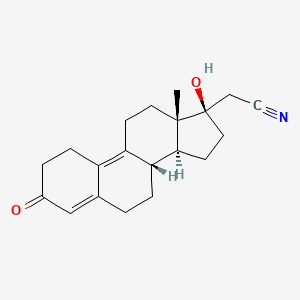
| Formula | C20H25NO2 |
|---|---|
| Molecular weight | 311.42 g/mol |
| IUPAC name | 2-[(8S,13S,14S,17R)-17-hydroxy-13-methyl-3-oxo-1,2,6,7,8,11,12,14,15,16-decahydrocyclopenta[a]phenanthren-17-yl]acetonitrile |
| CAS | 65928-58-7 |
| PubChem CID | 68861 |
| InChIKey | AZFLJNIPTRTECV-FUMNGEBKSA-N |
| logP | 3.84 (XLogP 1.8) |
| Polar surface area | 61.09 Ų |
| H-bond acceptors / donors | 3 / 1 |
| Drug-likeness (QED) | 0.80 |
| Lipinski violations | 0 |
SMILES
C[C@]12CCC3=C4CCC(=O)C=C4CC[C@H]3[C@@H]1CC[C@@]2(O)CC#NBiology & Pharmacokinetics
Pharmacokinetics predicted
| Bioavailability | 10.0% |
|---|---|
| Half-life | 1.791 h |
| Volume of distribution | 0.711 L/kg |
| Protein binding | 88.6% |
| BBB penetrant | No |
Enzyme interactions
| Enzyme | Role | Detail |
|---|---|---|
| CYP2C19 | Substrate | — |
| CYP3A4 | Substrate | — |
Transporters
BCRP (Inhibitor)BSEP (Inhibitor)MRP1 (Inhibitor)OATP1B1 (Inhibitor)OATP1B3 (Inhibitor)P-gp (Inhibitor)P-gp (Substrate)
Drug–drug interactions (37, DDInter)
| Interacting drug | Severity | Management |
|---|---|---|
| Bexarotene | major | |
| Brigatinib | major | |
| Dabrafenib | major | |
| Encorafenib | major | |
| Griseofulvin | major | |
| Mycophenolic acid | major | |
| Sugammadex | major | |
| Adalimumab | moderate | |
| Alefacept | moderate | |
| Anakinra | moderate | |
| Asparaginase Escherichia coli | moderate | |
| Canakinumab | moderate | |
| Certolizumab pegol | moderate | |
| Cladribine | moderate | |
| Emapalumab | moderate | |
| Enasidenib | moderate | |
| Entrectinib | moderate | |
| Etanercept | moderate | |
| Golimumab | moderate | |
| Guselkumab | moderate | |
| Infliximab | moderate | |
| Ixekizumab | moderate | |
| Linaclotide | moderate | |
| Metreleptin | moderate | |
| Miltefosine | moderate | |
| Neratinib | moderate | |
| Olaparib | moderate | |
| Pegaspargase | moderate | |
| Prucalopride | moderate | |
| Rilonacept | moderate | |
| Sarilumab | moderate | |
| Secukinumab | moderate | |
| Siltuximab | moderate | |
| Teriflunomide | moderate | |
| Tocilizumab | moderate | |
| Ustekinumab | moderate | |
| Ethanol | minor |
Registered Products (3)
| Brand | Form / strength | Pack | Agent | Citizen (JOD) |
|---|---|---|---|---|
| Enoret | Tablet 2 mg | 28 tab | / UNITED PHARM.MFG.CO.LTD(UPM)/JORDAN / General | 27.870 |
| Dienogest Dar Al Dawa | Tablet 2 mg | 28 tab | Dar Al Dawa Development and Investment Co Ltd/Jordan | 35.000 |
| Visanne | Tablet 2 mg | 28 tab | The Jordan Drugstore Co | 39.820 |