Dobutamine
JFDA label: Dobuject Inf. Concentrate
Mechanism of Action
Dobutamine, a racemic mixture, stimulates myocardial beta1-adrenergic receptors primarily by the (+) enantiomer and some alpha1 receptor agonism by the (-) enantiomer, resulting in increased contractility and heart rate, and stimulates both beta2- and alpha1-receptors in the vasculature. Although beta2 and alpha1 adrenergic receptors are also activated, the effects of beta2 receptor activation may equally offset or be slightly greater than the effects of alpha1 stimulation, resulting in some vasodilation in addition to the inotropic and chronotropic actions (Leier 1988; Majerus 1989; Ruffolo 1987). Lowers central venous pressure and wedge pressure, but has little effect on pulmonary vascular resistance (Leier 1977; Leier 1978).
Indications
Approved
- Cardiac decompensation
- Cardiogenic shock
- Inotropic support in advanced heart failure
Off-label
- Advanced life support
- Myocardial dysfunction related to sepsis (positive inotropic agent)
- Stress echocardiography (diagnostic agent)
Contraindications
Source: Lexicomp
- Hypersensitivity to dobutamine or sulfites (some contain sodium metabisulfate), or any component of the formulation Absolute
- hypertrophic cardiomyopathy with outflow tract obstruction (formerly known as idiopathic hypertrophic subaortic stenosis [IHSS]) Note: When utilized for stress testing, additional contraindications according to the American Society of Nuclear Cardiology (ASNC) include patients with recent (200/110 mm Hg), aortic dissection or large aortic aneurysm, and patients on beta blockers where heart rate and inotropic responses to dobutamine will be attenuated (ASNC [Henzlova 2009]) Absolute
Adverse Reactions
Cardiac disorders (9)
Not Known angina pectoris · chest pain · hypotension · increased blood pressure · increased heart rate · localized phlebitis · palpitations · ventricular ectopy (increased) · Ventricular premature contractions
Nervous system disorders (2)
Not Known Headache · paresthesia
Blood and lymphatic system disorders (1)
Not Known Thrombocytopenia (isolated cases)
Metabolism and nutrition disorders (1)
Not Known Decreased serum potassium (slight)
Gastrointestinal disorders (1)
Not Known Nausea
Skin and subcutaneous tissue disorders (1)
Not Known Skin necrosis (isolated cases)
Musculoskeletal and connective tissue disorders (1)
Not Known Leg cramps (mild)
General disorders and administration site conditions (3)
Not Known Fever · Local inflammation · local pain (from infiltration)
Respiratory, thoracic and mediastinal disorders (1)
Not Known Dyspnea
Dosing
Source: Lexicomp
Warnings & Precautions
Source: Lexicomp
Arrhythmias
Ventricular arrhythmias, including nonsustained ventricular tachycardia and supraventricular arrhythmias, have been reported (Tisdale1995). Observe closely for arrhythmias in patients with acute heart failure; sudden cardiac death has been observed (O’Connor 1999; Pickworth 1992; Young 2000). Ensure that ventricular rate is controlled in atrial fibrillation/flutter before initiating; may increase ventricular response rate. In heart transplant candidates, institute appropriate measures to protect patient against risks of sudden cardiac death (Young 2000).
Blood pressure effects
An increase in blood pressure is more common due to augmented cardiac output, but occasionally a patient may become hypotensive.
Heart failure complications
An increased risk of hospitalization and death has been observed with prolonged use in New York Heart Association Class III/IV heart failure patients (O’Connor 1999).
Tachycardia
May cause dose-related increases in heart rate.
Ventricular ectopy
May exacerbate ventricular ectopy (dose-related). Disease-related concerns:
Aortic stenosis
Ineffective therapeutically in the presence of mechanical obstruction such as severe aortic stenosis.
Electrolyte imbalance
Correct electrolyte disturbances, especially hypokalemia or hypomagnesemia, prior to use and throughout therapy to minimize the risk of arrhythmias (ACC/AHA/ESC [Zipes 2006]; Tisdale 1995).
Hypovolemia
If needed, correct hypovolemia first to optimize hemodynamics.
Active myocardial ischemia/myocardial infarction (post)
Use with caution in patients with active myocardial ischemia or recent myocardial infarction; can increase myocardial oxygen demand. Concurrent drug therapy issues:
Monoamine oxidase inhibitors (MAO-I)
Use with extreme caution in patients taking MAO inhibitors; prolong hypertension may result from concurrent use. Dosage form specific issues:
Sodium sulfite
Product may contain sodium sulfite. Special populations:
Elderly
Use with caution in the elderly; start at lower end of the dosage range. Other warnings/precautions:
Long-term therapy
According to the ACCF/AHA 2013 heart failure guidelines, long-term use of intravenous inotropic therapy without a specific indication or for reasons other than palliation is potentially harmful (ACCF/AHA [Yancy 2013]).
Pregnancy & Lactation
Pregnancy
Adverse events have not been observed in animal reproduction studies. Dobutamine should not be used as a diagnostic agent during stress testing in pregnant women (Regitz-Zagrosek 2011). Medications used for the treatment of cardiac arrest in pregnancy are the same as in the non-pregnant woman. Appropriate medications should not be withheld due to concerns of fetal teratogenicity. Dobutamine use during the post-resuscitation phase may be considered; however, the effects of inotropic support on the fetus should also be considered. Doses and indications should follow current Advanced Cardiovascular Life Support (ACLS) guidelines (Jeejeebhoy [AHA] 2015).
Lactation
It is not known if dobutamine is present in breast milk. The manufacturer recommends that caution be exercised when administering dobutamine to breastfeeding women.
Monitoring
| Clinical pearl | Blood pressure, ECG, heart rate, CVP, RAP, MAP; serum glucose, renal function; urine output; if pulmonary artery catheter is in place, monitor CI, PCWP, and SVR; ScvO2 or SvO2 Consult individual institutional policies and procedures. |
|---|
Chemistry & Properties
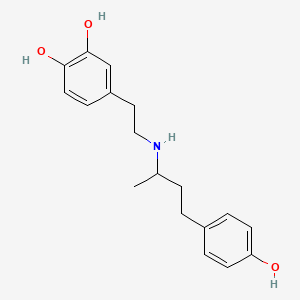
| Formula | C18H23NO3 |
|---|---|
| Molecular weight | 301.39 g/mol |
| IUPAC name | 4-[2-[4-(4-hydroxyphenyl)butan-2-ylamino]ethyl]benzene-1,2-diol |
| CAS | 34368-04-2 |
| PubChem CID | 36811 |
| InChIKey | JRWZLRBJNMZMFE-UHFFFAOYSA-N |
| logP | 2.96 (XLogP 3.4) |
| Polar surface area | 72.72 Ų |
| H-bond acceptors / donors | 4 / 4 |
| Drug-likeness (QED) | 0.59 |
| Lipinski violations | 0 |
SMILES
CC(CCc1ccc(O)cc1)NCCc1ccc(O)c(O)c1Biology & Pharmacokinetics
Pharmacokinetics predicted
| Bioavailability | 70.0% |
|---|---|
| Half-life | 1.607 h |
| Volume of distribution | 1.581 L/kg |
| Protein binding | 48.4% |
| BBB penetrant | No |
Enzyme interactions
| Enzyme | Role | Detail |
|---|---|---|
| CYP1A2 | Substrate | — |
| CYP2C8 | Inhibitor | — |
| CYP2C9 | Substrate | — |
| CYP2D6 | Substrate | — |
Receptor binding (top 1)
| Target | Action | Affinity |
|---|---|---|
| β1-adrenoceptor (ADRB1) | Agonist | pEC50 6.8 |
Transporters
BCRP (Inhibitor)BSEP (Inhibitor)BSEP (Inhibitor)MRP1 (Inhibitor)OATP1B1 (Inhibitor)OATP1B1 (Inhibitor)OATP1B3 (Inhibitor)OCT1 (Inhibitor)P-gp (Inhibitor)P-gp (Substrate)
Drug–drug interactions (73, DDInter)
| Interacting drug | Severity | Management |
|---|---|---|
| Cocaine (nasal) | major | |
| Cocaine (topical) | major | |
| Doxepin | major | |
| Acarbose | moderate | |
| Acetohexamide | moderate | |
| Albiglutide | moderate | |
| Alogliptin | moderate | |
| Canagliflozin | moderate | |
| Chlorpropamide | moderate | |
| Cimetidine | moderate | |
| Dapagliflozin | moderate | |
| Desmopressin | moderate | |
| Diatrizoate | moderate | |
| Diethylpropion | moderate | |
| Doxapram | moderate | |
| Dulaglutide | moderate | |
| Empagliflozin | moderate | |
| Ertugliflozin | moderate | |
| Exenatide | moderate | |
| Formoterol | moderate | |
| Glimepiride | moderate | |
| Glipizide | moderate | |
| Glyburide | moderate | |
| Indacaterol | moderate | |
| Insulin aspart (aspart protamine) | moderate | |
| Insulin aspart (aspart) | moderate | |
| Insulin degludec | moderate | |
| Insulin detemir | moderate | |
| Insulin glargine | moderate | |
| Insulin glulisine | moderate | |
| Insulin human | moderate | |
| Insulin human (inhalation, rapid acting) | moderate | |
| Insulin human (isophane) | moderate | |
| Insulin human (regular) | moderate | |
| Insulin human (zinc extended) | moderate | |
| Insulin human (zinc) | moderate | |
| Insulin lispro | moderate | |
| Insulin lispro (protamine) | moderate | |
| Isoprenaline | moderate | |
| Levothyroxine | moderate |
Showing 40 of 73.
Registered Products (5)
| Brand | Form / strength | Pack | Agent | Citizen (JOD) |
|---|---|---|---|---|
| DOBUTREX VIAL | Vial 250 mg | 1 vial | THE ARAB DRUG STORE P.S.C | — |
| Dobuject Inf. Concentrate | Concentrate 250 mg/5 ml | 5 ml | The Jordan Drugstore Co | — |
| Dobutamine | Vial 250 mg | 20 ml | Petra Drug Store | — |
| Dobutamine Hikma | Vial ( as Hcl) 12.5 mg/ml | 1 vial | Hikma Pharmaceuticals Co.Ltd/Jordan | — |
| MEKARD 250 mg/20 ml Concentrated Solution For I.V. Infusion | Infusion Dobutamine 250 mg/20 ml | 10 amp | JAWEDA INT. DRUD STORE | — |