Flecainide
JFDA label: Tambocor Inj
- Mortality:
- Ventricular proarrhythmic effects in patients with atrial fibrillation/flutter:
Mechanism of Action
Class Ic antiarrhythmic; slows conduction in cardiac tissue by altering transport of ions across cell membranes; causes slight prolongation of refractory periods; decreases the rate of rise of the action potential without affecting its duration; increases electrical stimulation threshold of ventricle, His-Purkinje system; possesses local anesthetic and moderate negative inotropic effects
Indications
Approved
- Ventricular arrhythmias (prevention)
Off-label
- Atrial fibrillation or flutter (pharmacologic cardioversion)
Contraindications
Source: Lexicomp
- Hypersensitivity to flecainide or any component of the formulation Absolute
- cardiogenic shock Absolute
- concurrent use of ritonavir According to the American College of Cardiology/American Heart Association/European Society of Cardiology, the use of flecainide is considered contraindicated in patients with structural heart disease (ACC/AHA/ESC [Blomstrom-Lundqvist 2003]) Absolute
- pre-existing second- or third-degree AV block or with right bundle branch block when associated with a left hemiblock (bifascicular block) (except in patients with a functioning artificial pacemaker) Absolute
Adverse Reactions
Cardiac disorders (7)
Common chest pain · edema · Palpitation · proarrhythmic · sinus node dysfunction · syncope · tachycardia
Nervous system disorders (14)
Very Common Dizziness
Common anxiety · ataxia · depression · fatigue · Headache · hypoesthesia · insomnia · malaise · nervousness additional symptoms occurring at a frequency between 1% and 3%: fever · paresis · somnolence · tinnitus · vertigo
Gastrointestinal disorders (5)
Common abdominal pain · anorexia · constipation · diarrhea · Nausea
Skin and subcutaneous tissue disorders (1)
Common Rash
Musculoskeletal and connective tissue disorders (3)
Common paresthesia · Tremor · weakness
Other (5)
Very Common Visual disturbances
Common blurred vision · Diplopia
Not Known corneal deposits · Tardive dyskinesia
Respiratory, thoracic and mediastinal disorders (1)
Very Common Dyspnea
Dosing
Source: Lexicomp
Warnings & Precautions
Source: Lexicomp
Proarrhythmic effects
Proarrhythmic effects (including increased premature ventricular contractions, ventricular tachycardia, ventricular fibrillation, and death) have been reported in patients with atrial fibrillation/fibrillation who received flecainide; use is not recommended for patients with chronic atrial fibrillation. Flecainide can cause new or worsened supraventricular or ventricular arrhythmias in all patients; effect is dose-related. Patients with sustained ventricular tachycardia and serious underlying heart disease are at an increased risk; initiation of therapy should occur in a hospital setting. Disease-related concerns:
Atrial fibrillation (chronic)
Use is not recommended in patients with chronic atrial fibrillation due to an increased risk of life-threatening ventricular arrhythmias.
Atrial flutter
Appropriate use: [US Boxed Warning]: When treating atrial flutter, 1:1 atrioventricular conduction may occur; pre-emptive negative chronotropic therapy (eg, digoxin, beta-blockers) may lower the risk.
Conduction disturbances
Dose-related increases in PR and QRS intervals occur. If second- or third-degree AV block, or right bundle branch block associated with a left hemiblock occur, flecainide therapy should be discontinued unless a temporary or implanted ventricular pacemaker is in place to ensure an adequate ventricular rate. Use with extreme caution in patients with sick sinus syndrome; treatment with flecainide may result in sinus bradycardia, sinus pause, or sinus arrest.
Electrolyte imbalance
Correct electrolyte disturbances, especially hypokalemia or hypomagnesemia, prior to use and throughout therapy.
Heart disease
Avoid use in patients with heart failure; may precipitate or exacerbate condition, increase the risk of proarrhythmia, and contribute to an increased risk of mortality (ACCF/AHA [Yancy 2013]). According to the manufacturer, use with extreme caution in patients with structural heart disease as the risk of death and cardiac events may be increased. According to the ACC/AHA/HRS, flecainide should be avoided in patients with structural or ischemic heart disease (ACC/AHA/HRS [Page 2015]).
Hepatic impairment
Use with caution in patients with significant hepatic impairment; benefit should outweigh risk. Consider careful monitoring during initiation of therapy. Dose titration should occur only after steady state has been achieved (≥4 days after initiation). Frequent plasma level monitoring is required in patients with severe hepatic impairment; if unavailable, use is not recommended.
Renal impairment
Use with caution in patients with significant renal impairment. Frequent plasma level monitoring is required in patients with severe renal impairment; if unavailable, use is not recommended. Concurrent drug therapy issues:
Drug-drug interactions
Potentially significant interactions may exist, requiring dose or frequency adjustment, additional monitoring, and/or selection of alternative therapy. Consult drug interactions database for more detailed information. Special populations:
Pediatric
Small changes in dose may lead to disproportionate increases in plasma concentrations in pediatric patients. Following initiation of therapy or changes in dose, obtain plasma trough concentrations and ECG once steady state has been achieved (>5 doses after initiation or change); regular monitoring of trough concentrations and ECG is recommended by the manufacturer during the first year of therapy. Other warnings/precautions:
CAST trial
In the Cardiac Arrhythmia Suppression Trial (CAST), recent (>6 days but An increased mortality or nonfatal cardiac arrest rate (7.7%) was seen in the active treatment group compared with patients in the placebo group (3%). The applicability of the CAST results to other populations is unknown. The risks of class 1C agents and the lack of improved survival make use in patients without life-threatening arrhythmias generally unacceptable.
Pacemakers
Use with caution in patients with permanent pacemakers or temporary pacing wires; can increase endocardial pacing thresholds and suppress ventricular escape rhythms. Do not use in patients with existing poor thresholds or nonprogrammable pacemakers unless suitable pacing rescue is available. The pacing threshold in patients with pacemakers should be determined at baseline, 1 week after initiation and at regular intervals thereafter.
Pregnancy & Lactation
Pregnancy
Adverse events have been observed in some animal reproduction studies. Flecainide is recommended in the treatment of fetal tachycardia determined to be SVT. Flecainide may be also used for the ongoing management of SVT in highly symptomatic pregnant patients. The lowest effective dose is recommended; avoid use during the first trimester if possible (Page [ACC/AHA/HRS 2015]). Additional guidelines are available for management of cardiovascular diseases during pregnancy (ESG [Regitz-Zagrosek 2011]).
Lactation
Flecainide is excreted into breast milk. Concentrations of flecainide in breast milk are as high as 4 times those in the maternal serum. The estimated daily dose of flecainide to a nursing infant would be
Monitoring
| Clinical pearl | ECG, blood pressure, pulse, periodic serum trough concentrations, especially in patients with renal or hepatic impairment, concomitant administration of amiodarone and pediatric patients. |
|---|
Chemistry & Properties
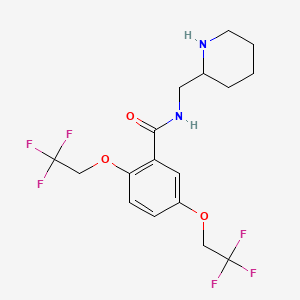
| Formula | C17H20F6N2O3 |
|---|---|
| Molecular weight | 414.35 g/mol |
| IUPAC name | N-(piperidin-2-ylmethyl)-2,5-bis(2,2,2-trifluoroethoxy)benzamide |
| CAS | 54143-55-4 |
| PubChem CID | 3356 |
| InChIKey | DJBNUMBKLMJRSA-UHFFFAOYSA-N |
| logP | 3.44 (XLogP 3.8) |
| Polar surface area | 59.59 Ų |
| H-bond acceptors / donors | 4 / 2 |
| Drug-likeness (QED) | 0.67 |
| Lipinski violations | 0 |
SMILES
O=C(NCC1CCCCN1)c1cc(OCC(F)(F)F)ccc1OCC(F)(F)FBiology & Pharmacokinetics
Pharmacokinetics
| BBB penetrant | No |
|---|
Enzyme interactions
| Enzyme | Role | Detail |
|---|---|---|
| CYP1A2 | Substrate | — |
| CYP2C19 | Substrate | — |
Receptor binding (top 1)
| Target | Action | Affinity |
|---|---|---|
| Kv1.7 (KCNA7) | Channel blocker | pKd 5.1 |
Transporters
BCRP (Inhibitor)BSEP (Inhibitor)BSEP (Inhibitor)MDR1 (Inhibitor)MRP1 (Inhibitor)OATP1B1 (Inhibitor)OATP1B3 (Inhibitor)OCT2 (Inhibitor)OCT3 (Inhibitor)P-gp (Inhibitor)MATE1 (Substrate)P-gp (Substrate)
Drug–drug interactions (100+, DDInter)
| Interacting drug | Severity | Management |
|---|---|---|
| Anagrelide | major | |
| Arsenic trioxide | major | |
| Cabozantinib | major | |
| Ceritinib | major | |
| Chloroquine | major | |
| Cisapride | major | |
| Cobicistat | major | |
| Crizotinib | major | |
| Dolasetron | major | |
| Eliglustat | major | |
| Fingolimod | major | |
| Halofantrine | major | |
| Hydroxychloroquine | major | |
| Ivosidenib | major | |
| Lumefantrine | major | |
| Macimorelin | major | |
| Nilotinib | major | |
| Osimertinib | major | |
| Ozanimod | major | |
| Panobinostat | major | |
| Papaverine | major | |
| Pasireotide | major | |
| Ribociclib | major | |
| Siponimod | major | |
| Toremifene | major | |
| Vandetanib | major | |
| Vemurafenib | major | |
| Abarelix | moderate | |
| Abiraterone | moderate | |
| Adalimumab | moderate | |
| Alectinib | moderate | |
| Alefacept | moderate | |
| Alimemazine | moderate | |
| Anakinra | moderate | |
| Apalutamide | moderate | |
| Astemizole | moderate | |
| Bicalutamide | moderate | |
| Bisacodyl | moderate | |
| Bosutinib | moderate | |
| Brigatinib | moderate |
Showing 40 of 100+.
Registered Products (10)
| Brand | Form / strength | Pack | Agent | Citizen (JOD) |
|---|---|---|---|---|
| Nailoren | Tablet 50.0 mg | 60 tab | UNITED PHARM.MFG.CO.LTD(UPM)/JORDAN | 3.930 |
| Gultrima | Tablet 50 mg | 60 tab pack varies | Amneal Pharmaceuticals,LLC | 4.360 |
| Gultrima | Tablet 100 mg | 60 tab pack varies | Al-Omawai Drug Store | 7.150 |
| Gultrima | Tablet 50 mg | 100 tab pack varies | Amneal Pharmaceuticals,LLC | 7.270 |
| Nailoren | Tablet 100.0 mg | 60 tab | UNITED PHARM.MFG.CO.LTD(UPM)/JORDAN | 9.620 |
| Tambocor | Tablet 100 mg | 60 tab | Sabbagh Drug Store | 10.220 |
| Gultrima | Tablet 150 mg | 60 tab pack varies | Al-Omawai Drug Store | 10.730 |
| Gultrima | Tablet 100 mg | 100 tab pack varies | Al-Omawai Drug Store | 11.920 |
| Tambocor Inj | Injection 10 mg/ml | 15 ml | Khraim Drug Store | 12.630 |
| Gultrima | Tablet 150 mg | 100 tab pack varies | Al-Omawai Drug Store | 16.580 |