Gemcitabine
JFDA label: Gemcitabine Thymoorgan 200mg For IV Infusion Vial
Mechanism of Action
Gemcitabine is a pyrimidine antimetabolite that inhibits DNA synthesis by inhibition of DNA polymerase and ribonucleotide reductase, cell cycle-specific for the S-phase of the cycle (also blocks cellular progression at G1/S-phase). Gemcitabine is phosphorylated intracellularly by deoxycytidine kinase to gemcitabine monophosphate, which is further phosphorylated to active metabolites gemcitabine diphosphate and gemcitabine triphosphate. Gemcitabine diphosphate inhibits DNA synthesis by inhibiting ribonucleotide reductase; gemcitabine triphosphate incorporates into DNA and inhibits DNA polymerase.
Indications
Approved
- Breast cancer (metastatic)
- Non-small cell lung cancer (inoperable, locally advanced, or metastatic)
- Ovarian cancer (advanced)
- Pancreatic cancer (locally advanced or metastatic)
Off-label
- Bladder cancer (advanced or metastatic)
- Bladder cancer (transitional cell, refractory)
- Cervical cancer (recurrent or persistent)
- Ewing sarcoma (refractory)
- Germ cell tumors (refractory) (pediatrics)
- Head and neck cancer: nasopharyngeal (advanced or metastatic)
- Hepatobiliary cancer (advanced)
- Hodgkin lymphoma (relapsed)
- Malignant pleural mesothelioma
- Non-Hodgkin lymphoma (relapsed/refractory)
- Osteosarcoma (refractory)
- Pancreatic cancer (adjuvant therapy)
- Renal carcinoma (metastatic)
- Small cell lung cancer (refractory or relapsed)
- Soft tissue sarcoma (advanced)
- Testicular cancer (refractory germ cell)
- Thymic malignancies (refractory)
- Unknown-primary carcinoma
- Uterine cancer
Class profile
| mechanismClass | Antimetabolite (cytidine analogue) |
|---|---|
| targetMolecule | RRM1/RRM2 + DNA polymerase |
| targetPathway | Pyrimidine synthesis/DNA replication |
| generation | Classic |
| primaryTumors | Pancreatic,Lung,Bladder,Ovarian,Breast |
| resistanceMechanisms | RRM1 overexpression,Reduced dCK (deoxycytidine kinase) activation,Nucleoside transporter loss (hENT1) |
| source | NCCN/OncoKB/Goodman&Gilman13ed |
Contraindications
Source: Lexicomp
- Hypersensitivity to gemcitabine or any component of the formulation Absolute
Adverse Reactions
Cardiac disorders (2)
Very Common edema · Peripheral edema
Nervous system disorders (2)
Very Common Drowsiness
Common Paresthesia
Renal and urinary disorders (4)
Very Common hematuria · Increased blood urea nitrogen · Proteinuria
Common Increased serum creatinine
Blood and lymphatic system disorders (4)
Very Common Anemia · hemorrhage, increased serum AST, increased serum alkaline phosphatase, increased serum bilirubin · neutropenia · thrombocytopenia
Gastrointestinal disorders (3)
Very Common diarrhea · Nausea and vomiting · stomatitis
Skin and subcutaneous tissue disorders (2)
Very Common alopecia · Skin rash
Respiratory, thoracic and mediastinal disorders (2)
Very Common Dyspnea
Common Bronchospasm (
Dosing
Source: Lexicomp
Warnings & Precautions
Source: Lexicomp
Bone marrow suppression
May cause bone marrow suppression (neutropenia, thrombocytopenia, and anemia); myelosuppression is generally the dose-limiting toxicity and is increased when used in combination with other chemotherapy. Monitor blood counts; dosage adjustments are frequently required.
Capillary leak syndrome
Capillary leak syndrome (CLS) with serious consequences has been reported, both with single-agent gemcitabine and with combination chemotherapy; discontinue if CLS develops.
Hemolytic uremic syndrome
Hemolytic uremic syndrome (HUS) has been reported; may lead to renal failure and dialysis (including fatalities); monitor for evidence of anemia with microangiopathic hemolysis (elevation of bilirubin or LDH, reticulocytosis, severe thrombocytopenia, and/or renal failure) and monitor renal function at baseline and periodically during treatment. Permanently discontinue if HUS or severe renal impairment occurs; renal failure may not be reversible despite discontinuation.
Hepatotoxicity
Serious hepatotoxicity (including liver failure and death) has been reported (when used alone or in combination with other hepatotoxic medications); use in patients with hepatic impairment (history of cirrhosis, hepatitis, or alcoholism) or in patients with hepatic metastases may lead to exacerbation of hepatic impairment. Monitor hepatic function at baseline and periodically during treatment; consider dose adjustments with elevated bilirubin; discontinue if severe liver injury develops.
Posterior reversible encephalopathy syndrome
Posterior reversible encephalopathy syndrome (PRES) has been reported, both with single-agent therapy and with combination chemotherapy. PRES may manifest with blindness, confusion, headache, hypertension, lethargy, seizure, and other visual and neurologic disturbances. If PRES diagnosis is confirmed (by MRI), discontinue therapy.
Pulmonary toxicity
Pulmonary toxicity, including adult respiratory distress syndrome, interstitial pneumonitis, pulmonary edema, and pulmonary fibrosis, has been observed; may lead to respiratory failure (some fatal) despite discontinuation. Onset for symptoms of pulmonary toxicity may be delayed up to 2 weeks beyond the last dose. Discontinue for unexplained dyspnea (with or without bronchospasm) or other evidence of pulmonary toxicity. Concurrent drug therapy issues:
Drug-drug interactions
Potentially significant interactions may exist, requiring dose or frequency adjustment, additional monitoring, and/or selection of alternative therapy. Consult drug interactions database for more detailed information. Special populations:
Radiation therapy recipients
Not indicated for use with concurrent radiation therapy; radiation toxicity, including tissue injury, severe mucositis, esophagitis, or pneumonitis, has been reported with concurrent and nonconcurrent administration; has radiosensitizing activity when gemcitabine and radiation therapy are given together or ≤7 days apart; radiation recall may occur when gemcitabine and radiation therapy are given >7 days apart. Dosage form specific issues:
Propylene glycol
Some dosage forms may contain propylene glycol; large amounts are potentially toxic and have been associated with hyperosmolality, lactic acidosis, seizures, and respiratory depression; use caution (AAP 1997; Zar 2007). See manufacturer's labeling. Other warnings/precautions:
Infusion duration/frequency
Prolongation of the infusion duration >60 minutes or more frequent than weekly dosing have been shown to alter the half-life and increase toxicity (hypotension, flu-like symptoms, myelosuppression, weakness). A fixed-dose rate (FDR) infusion rate of 10 mg/m2/minute has been studied in adults in order to optimize the pharmacokinetics (off-label); prolonged infusion times increase the intracellular accumulation of the active metabolite, gemcitabine triphosphate (Ko 2006; Tempero 2003). Patients who receive gemcitabine FDR experience more grade 3/4 hematologic toxicity (Ko 2006; Poplin 2009).
Multiple concentrations
Gemcitabine is available in multiple formulations and concentrations; verify product and concentration prior to admixture to assure appropriate dose preparation.
Pregnancy & Lactation
Pregnancy
Based on the mechanism of action and on findings from animal reproduction studies, gemcitabine may cause fetal harm if administered during pregnancy. Women of reproductive potential should use effective contraception during treatment and for 6 months after the final gemcitabine dose. Men with female partners of reproductive potential should use effective contraception during treatment and for 3 months after the final dose.
Lactation
It is not known if gemcitabine is present in breast milk. Due to the potential for serious adverse reactions in the breastfeeding infant, breastfeeding is not recommended during treatment and for 1 week after the last gemcitabine dose.
Monitoring
| Efficacy | Tumour response (RECIST criteria, tumour markers, imaging); progression-free survival; performance status (ECOG/Karnofsky) |
|---|---|
| Toxicity | CBC with differential (nadir timing depends on agent); LFTs; renal function; ECG (QT for relevant agents); echocardiogram for cardiotoxic agents (anthracyclines, trastuzumab); cumulative dose tracking for dose-limited toxicities |
| Clinical pearl | Treatment response is assessed after 2–3 cycles. Grade 3–4 toxicities typically require dose reduction or interruption per protocol-defined criteria. |
| Counseling | Attend all scheduled blood tests and imaging appointments. Report fever > 38°C (risk of neutropaenic sepsis — medical emergency), unusual bleeding, or new pain immediately. |
Chemistry & Properties
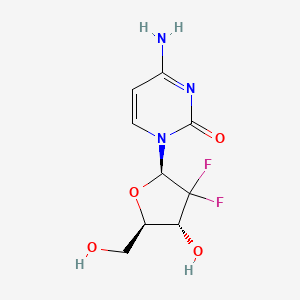
| Formula | C9H11F2N3O4 |
|---|---|
| Molecular weight | 263.2 g/mol |
| IUPAC name | 4-amino-1-[(2R,4R,5R)-3,3-difluoro-4-hydroxy-5-(hydroxymethyl)oxolan-2-yl]pyrimidin-2-one |
| CAS | 95058-81-4 |
| PubChem CID | 60750 |
| InChIKey | SDUQYLNIPVEERB-QPPQHZFASA-N |
| logP | -1.29 (XLogP -1.5) |
| Polar surface area | 110.6 Ų |
| H-bond acceptors / donors | 7 / 3 |
| Drug-likeness (QED) | 0.61 |
| Lipinski violations | 0 |
SMILES
Nc1ccn([C@@H]2O[C@H](CO)[C@@H](O)C2(F)F)c(=O)n1Biology & Pharmacokinetics
Pharmacokinetics
| BBB penetrant | No |
|---|
Enzyme interactions
| Enzyme | Role | Detail |
|---|---|---|
| CYP2C19 | Substrate | — |
| CYP2C9 | Substrate | — |
| CYP2D6 | Substrate | — |
| CYP3A4 | Substrate | — |
Transporters
BCRP (Inhibitor)BSEP (Inhibitor)BSEP (Inhibitor)CNT1 (Inhibitor)CNT2 (Inhibitor)CNT3 (Inhibitor)ENT1 (Inhibitor)ENT2 (Inhibitor)MATE1 (Inhibitor)MCT1 (Inhibitor)MRP1 (Inhibitor)MRP2 (Inhibitor)MRP3 (Inhibitor)MRP4 (Inhibitor)OATP1B1 (Inhibitor)OATP1B3 (Inhibitor)OATP1B3 (Inhibitor)P-gp (Inhibitor)MCT1 (Substrate)MDR1 (Substrate)P-gp (Substrate)SMVT (Substrate)
Drug–drug interactions (100+, DDInter)
| Interacting drug | Severity | Management |
|---|---|---|
| Adalimumab | major | |
| Bacillus calmette-guerin substrain tice live antigen | major | |
| Baricitinib | major | |
| Certolizumab pegol | major | |
| Cladribine | major | |
| Clozapine | major | |
| Deferiprone | major | |
| Etanercept | major | |
| Fingolimod | major | |
| Golimumab | major | |
| Infliximab | major | |
| Leflunomide | major | |
| Lomitapide | major | |
| Measles virus vaccine live attenuated | major | |
| Mipomersen | major | |
| Mumps virus strain B level jeryl lynn live antigen | major | |
| Natalizumab | major | |
| Ozanimod | major | |
| Pexidartinib | major | |
| Rotavirus vaccine | major | |
| Rubella virus vaccine | major | |
| Samarium (153Sm) lexidronam | major | |
| Siponimod | major | |
| Smallpox (Vaccinia) Vaccine, Live | major | |
| Talimogene laherparepvec | major | |
| Teriflunomide | major | |
| Thalidomide | major | |
| Tofacitinib | major | |
| Typhoid vaccine (live) | major | |
| Upadacitinib | major | |
| Varicella Zoster Vaccine (Recombinant) | major | |
| Yellow Fever Vaccine | major | |
| Aldesleukin | moderate | |
| Alefacept | moderate | |
| Alemtuzumab | moderate | |
| Anakinra | moderate | |
| Anisindione | moderate | |
| Anthrax vaccine | moderate | |
| Asparaginase Erwinia chrysanthemi | moderate | |
| Asparaginase Escherichia coli | moderate |
Showing 40 of 100+.
Registered Products (22)
| Brand | Form / strength | Pack | Agent | Citizen (JOD) |
|---|---|---|---|---|
| Chemozar | Vial 1 g | 1 vial | Al-Taqqadom Pharmaceutical Industries | — |
| Gemcilab | Vial 1 g | 1 vial | ORIENT DRUG STORE CO | — |
| Gemcitabin | Vial 40 mg/ml | 25 ml | Sabbagh Drug Store | — |
| Gemcitabin "Ebewe" | Vial 1000 mg/100 ml | 1 vial | Sabbagh Drug Store | — |
| Gemcitabin "Ebewe" | Vial 500 mg/50 ml | 1 vial | Sabbagh Drug Store | — |
| Gemcitabin "Ebewe" | Vial 200 mg/20 ml | 1 vial | Sabbagh Drug Store | — |
| Gemcitabin Ebewe | Vial 40 mg/ml | 50 ml | Sabbagh Drug Store | — |
| Gemcitabine | Vial 200 mg | 1 vial | Petra Drug Store | — |
| Gemcitabine | Vial (as hydrochloride) 1 g | 1 vial | Petra Drug Store | — |
| Gemcitabine | Vial 2 g | 1 vial | Petra Drug Store | — |
| Gemcitabine 1g Powder for solution for infusion | Infusion 1 g | 1 vial | شركة مستودع ادوية جرينلاند | — |
| Gemcitabine Accord | Vial 2 g | 1 vial | شركة مستودع ادوية جرينلاند | — |
| Gemcitabine Accord 200mg Powder For Solution For Infusion | Infusion 200 mg | 1 vial | شركة مستودع ادوية جرينلاند | — |
| Gemcitabine Actavis | Vial 1 g | 1 vial | Beta Drug Store | — |
| Gemcitabine Actavis | Vial 200 mg | 1 vial | Beta Drug Store | — |
| Gemcitabine Thymoorgan 200mg For IV Infusion Vial | Infusion as Hcl 200 mg | 1 Vail | Hikma Pharmaceuticals Co.Ltd/Jordan | — |
| Gemcitabine Thymoorgan1000mg Vial | Vial as Hcl 1000 mg | 1 vial | Hikma Pharmaceuticals Co.Ltd/Jordan | — |
| Gemnil Powder for Solution For Infusion | Infusion 1000 mg | 1 vial | Manar Drug Store | — |
| Gemnil Powder for Solution for infusion | Infusion 200 mg | 1 vial | Manar Drug Store | — |
| Gemtaz | Powder for Injection 1 g | 1 vial | Reda Jardaneh Drug Store | — |
| Neogem | Vial 1 g | 1 vial | THE JORDANIAN PHARMACEUTICAL MANUFACTURING COMPANY/JORDAN | — |
| Neogem | Vial 200 mg | 1 vial | THE JORDANIAN PHARMACEUTICAL MANUFACTURING COMPANY/JORDAN | — |