Lacosamide
JFDA label: Vimpat 100m g F.C tab
Mechanism of Action
Blocker of Sodium channel alpha subunit — Sodium channel alpha subunit blocker
| Target | Action | Gene / class |
|---|---|---|
| Sodium channel alpha subunit efficacy | BLOCKER |
Indications
Approved
- Partial-onset seizures
Off-label
- Status epilepticus, refractory (adults)
Contraindications
Source: Lexicomp
- Hypersensitivity to lacosamide or any component of the formulation Absolute
- There are no contraindications listed in manufacturer's labeling Absolute
- second- or third-degree atrioventricular (AV) block (current or history of) Absolute
Adverse Reactions
Cardiac disorders (1)
Common Syncope
Nervous system disorders (10)
Very Common ataxia · Dizziness · fatigue · headache
Common abnormal gait · depression · Drowsiness · equilibrium disturbance · memory impairment · vertigo
Hepatobiliary disorders (1)
Common Increased serum ALT
Blood and lymphatic system disorders (1)
Common Bruise
Gastrointestinal disorders (3)
Very Common Nausea · vomiting
Common Diarrhea
Skin and subcutaneous tissue disorders (1)
Common Pruritus
Musculoskeletal and connective tissue disorders (2)
Very Common Tremor
Common Weakness
Eye disorders (3)
Very Common blurred vision · Diplopia
Common Nystagmus
General disorders and administration site conditions (3)
Common Laceration · local irritation · Pain at injection site
Dosing
Source: Lexicomp
Warnings & Precautions
Source: Lexicomp
Cardiovascular effects
Lacosamide may prolong PR interval; second degree and complete AV block has also been reported. Use caution in patients with conduction problems (eg, first/second degree atrioventricular block and sick sinus syndrome without pacemaker), sodium channelopathies (eg, Brugada syndrome), myocardial ischemia, heart failure, structural heart disease, or if concurrent use with other drugs that prolong the PR interval; ECG is recommended prior to initiating therapy and when at the steady state maintenance dose. Monitor closely with IV lacosamide administration; bradycardia and AV block have occurred during infusions. Instruct patients to contact their healthcare provider if signs or symptoms of conduction problems occur (eg, low or irregular pulse, feeling of lightheadedness and fainting). During short-term trials, atrial fibrillation/flutter, or syncope occurred slightly more often in patients with diabetic neuropathy and/or cardiovascular disease. In addition, in open-label studies, syncope has been associated with a history of cardiac disease risk factors and use of drugs that slow AV conduction.
CNS effects
Dizziness and ataxia may occur during therapy; patients should be cautioned about performing tasks which require alertness (eg, operating machinery or driving).
Ophthalmic effects
Blurred vision and diplopia may occur during therapy. Patients with persistent visual disturbances may need further assessment. Consider increased monitoring in patients with preexisting ocular conditions or vision-related issues.
Suicidal ideation
Pooled analysis of trials involving various antiepileptics (regardless of indication) showed an increased risk of suicidal thoughts/behavior (incidence rate: 0.43% treated patients compared to 0.24% of patients receiving placebo); risk observed as early as 1 week after initiation and continued through duration of trials (most trials ≤24 weeks). Monitor all patients for notable changes in behavior that might indicate suicidal thoughts or depression; notify health care provider immediately if symptoms occur. Disease-related concerns:
Hepatic impairment
Not recommended for use in patients with severe hepatic impairment; dosage adjustment required for mild to moderate hepatic impairment. Further dosage adjustment may be necessary in patients with hepatic impairment taking concomitant strong CYP3A4 and/or CYP2C9 inhibitors.
Renal impairment
Use caution in patients with renal impairment; dosage adjustment required for severe renal impairment (CrCl ≤30 mL/minute) and supplementation may be necessary in hemodialysis. Patients with any degree of renal impairment taking concomitant strong CYP3A4 and/or CYP2C9 inhibitors may require dosage adjustment. Concurrent drug therapy issues:
Drug-drug interactions
Potentially significant interactions may exist, requiring dose or frequency adjustment, additional monitoring, and/or selection of alternative therapy. Consult drug interactions database for more detailed information. Dosage form specific issues:
Phenylalanine
Some products may contain phenylalanine.
Propylene glycol
Some dosage forms may contain propylene glycol; large amounts are potentially toxic and have been associated hyperosmolality, lactic acidosis, seizures and respiratory depression; use caution (AAP 1997; Zar 2007). Other warnings/precautions:
Withdrawal
Anticonvulsants should not be discontinued abruptly because of the possibility of increasing seizure frequency; therapy should be withdrawn gradually (≥1 week) to minimize the potential of increased seizure frequency, unless safety concerns require a more rapid withdrawal.
Pregnancy & Lactation
Pregnancy
Adverse events were observed in animal reproduction studies. Information related to pregnancy outcomes following maternal use of lacosamide is limited (Hoeltzenbein 2011). In general, maternal polytherapy with antiepileptic drugs may increase the risk of congenital malformations; monotherapy with the lowest effective dose is recommended. Newborns of women taking antiepileptic medications may be at an increased risk of adverse events (Harden and Meader 2009). Patients exposed to lacosamide during pregnancy are encouraged to enroll themselves into the NAAED Pregnancy Registry by calling 1-888-233-2334. Additional information is available at http://www.aedpregnancyregistry.org.
Lactation
It is not known if lacosamide is present in breast milk. According to the manufacturer, the decision to continue or discontinue breastfeeding during therapy should take into account the risk of exposure to the infant and the benefits of treatment to the mother.
Monitoring
| Clinical pearl | Patients with conduction problems, sodium channelopathies, concomitant medications that prolong PR interval or severe cardiac disease should have ECG tracing prior to start of therapy and when at steady-state. Monitor these patients closely during IV infusions (cases of bradycardia and AV block have occurred during infusions). Monitor for suicidality (eg, suicidal thoughts, depression, behavioral changes). |
|---|
Chemistry & Properties
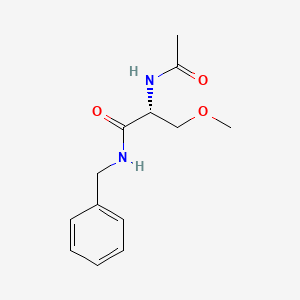
| Formula | C13H18N2O3 |
|---|---|
| Molecular weight | 250.3 g/mol |
| IUPAC name | (2R)-2-acetamido-N-benzyl-3-methoxypropanamide |
| CAS | 175481-36-4 |
| PubChem CID | 219078 |
| InChIKey | VPPJLAIAVCUEMN-GFCCVEGCSA-N |
| logP | 0.45 (XLogP 0.3) |
| Polar surface area | 67.43 Ų |
| H-bond acceptors / donors | 3 / 2 |
| Drug-likeness (QED) | 0.77 |
| Lipinski violations | 0 |
SMILES
COC[C@@H](NC(C)=O)C(=O)NCc1ccccc1Biology & Pharmacokinetics
Pharmacokinetics predicted
| Bioavailability | 70.0% |
|---|---|
| Half-life | 0.749 h |
| Volume of distribution | 0.593 L/kg |
| Protein binding | 11.8% |
| BBB penetrant | No |
Enzyme interactions
| Enzyme | Role | Detail |
|---|---|---|
| CYP2C19 | Substrate | — |
Transporters
BCRP (Inhibitor)BSEP (Inhibitor)BSEP (Inhibitor)MDR1 (Inhibitor)MRP1 (Inhibitor)MRP2 (Inhibitor)MRP3 (Inhibitor)MRP4 (Inhibitor)OATP1B1 (Inhibitor)OATP1B3 (Inhibitor)P-gp (Inhibitor)MDR1 (Substrate)P-gp (Substrate)
Drug–drug interactions (21, DDInter)
| Interacting drug | Severity | Management |
|---|---|---|
| Ceritinib | major | |
| Dolasetron | major | |
| Siponimod | major | |
| Alectinib | moderate | |
| Brigatinib | moderate | |
| Chloroquine | moderate | |
| Clarithromycin | moderate | |
| Cobicistat | moderate | |
| Crizotinib | moderate | |
| Ethanol | moderate | |
| Fingolimod | moderate | |
| Hydroxychloroquine | moderate | |
| Idelalisib | moderate | |
| Imatinib | moderate | |
| Ketoconazole | moderate | |
| Lidocaine | moderate | |
| Mefloquine | moderate | |
| Ozanimod | moderate | |
| Pasireotide | moderate | |
| Sunitinib | moderate | |
| Thalidomide | moderate |
Registered Products (21)
| Brand | Form / strength | Pack | Agent | Citizen (JOD) |
|---|---|---|---|---|
| LACOSAMIDE/GENEPHARM | Tablet 50 mg | 14 tab | Orient Montreal Drug Store | 5.320 |
| Trepadio | Tablet 50 mg | 14 tab | Hikma Pharmaceuticals Co.Ltd/Jordan | 11.750 |
| Trepadio | Solution 10 mg/1 ml | 150 ml | Hikma Pharmaceuticals Co.Ltd/Jordan | 18.340 |
| Losapil | Tablet 50.0 mg | 30 tab | UNITED PHARM.MFG.CO.LTD(UPM)/JORDAN | 23.210 |
| Lazure 50 mg Film Coated Tablets | Film-Coated Tablet Lacosamide 50 mg | 60 tab | Sukhtian Group | 27.350 |
| LACOSAMIDE/GENEPHARM | Tablet 100 mg | 56 tab | Orient Montreal Drug Store | 32.460 |
| Lakoza | Tablet 100 mg | 30 tab | JORDAN SWEDEN MEDICAL&STERILE.CO (JOSWE)/JORDAN / General | 36.320 |
| Losapil | Tablet 100.0 mg | 30 tab | UNITED PHARM.MFG.CO.LTD(UPM)/JORDAN | 38.050 |
| Lazure 100 mg Film Coated Tablets | Film-Coated Tablet Lacosamide 100 mg | 60 tab | Sukhtian Group | 44.850 |
| LACOSAMIDE/GENEPHARM | Tablet 150 mg | 56 tab | Orient Montreal Drug Store | 45.130 |
| Lakoza | Tablet 150 mg | 30 tab | JORDAN SWEDEN MEDICAL&STERILE.CO (JOSWE)/JORDAN / General | 54.480 |
| LACOSAMIDE/GENEPHARM | Tablet 200 mg | 56 tab | Orient Montreal Drug Store | 55.420 |
| Losapil | Tablet 150.0 mg | 30 tab | UNITED PHARM.MFG.CO.LTD(UPM)/JORDAN | 57.080 |
| Lazure 200 mg Film Coated Tablets | Film-Coated Tablet Lacosamide 200.00 mg | 60 tab | Sukhtian Group | 76.580 |
| Trepadio | Tablet 100 mg | 60 tab | Hikma Pharmaceuticals Co.Ltd/Jordan | 77.180 |
| Vimpat 100m g F.C tab | Film-Coated Tablet 100 mg | 56 tab | ORIENT DRUG STORE CO | 84.750 |
| Trepadio | Tablet 150 mg | 60 tab | Hikma Pharmaceuticals Co.Ltd/Jordan | 115.770 |
| Trepadio | Tablet 200 mg | 60 tab | Hikma Pharmaceuticals Co.Ltd/Jordan | 126.580 |
| Vimpat 150mg F.C Tab | Film-Coated Tablet 150 mg | 56 tab | ORIENT DRUG STORE CO | 127.130 |
| Trepadio | Vial 200 mg/20 ml | 5 vial | / HIKMA PHARMACEUTICALS.IND/JORDAN / General | — |
| Vimpat 200mg/20ml Solution For Infusion | Infusion 200/20 ml | 5 vial | ORIENT DRUG STORE CO | — |