Sunitinib
JFDA label: Sutent 50 mg
- Hepatotoxicity:
Mechanism of Action
Inhibitor of Macrophage colony-stimulating factor 1 receptor — Macrophage colony stimulating factor receptor inhibitor; Inhibitor of Vascular endothelial growth factor receptor 2 — Vascular endothelial growth factor receptor 2 inhibitor; Inhibitor of Mast/stem cell growth factor receptor Kit — Stem cell growth factor receptor inhibitor; Inhibitor of Platelet-derived growth factor receptor beta — Platelet-derived growth factor receptor beta inhibitor; Inhibitor of Platelet-derived growth factor receptor alpha — Platelet-derived growth factor receptor alpha inhibitor; Inhibitor of Vascular endothelial growth factor receptor 1 — Vascular endothelial growth factor receptor 1 inhibitor; Inhibitor of Vascular endothelial growth factor receptor 3 — Vascular endothelial growth factor receptor 3 inhibitor; Inhibitor of Receptor-type tyrosine-protein kinase FLT3 — Tyrosine-protein kinase receptor FLT3 inhibitor; Inhibitor of Proto-oncogene tyrosine-protein kinase receptor Ret — Tyrosine-protein kinase receptor RET inhibitor
| Target | Action | Gene / class |
|---|---|---|
| Macrophage colony-stimulating factor 1 receptor efficacy | INHIBITOR | CSF1R |
| Mast/stem cell growth factor receptor Kit efficacy | INHIBITOR | KIT |
| Platelet-derived growth factor receptor alpha efficacy | INHIBITOR | PDGFRA |
| Platelet-derived growth factor receptor beta efficacy | INHIBITOR | PDGFRB |
| Proto-oncogene tyrosine-protein kinase receptor Ret efficacy | INHIBITOR | RET |
| Receptor-type tyrosine-protein kinase FLT3 efficacy | INHIBITOR | FLT3 |
| Vascular endothelial growth factor receptor 1 efficacy | INHIBITOR | FLT1 |
| Vascular endothelial growth factor receptor 2 efficacy | INHIBITOR | KDR |
| Vascular endothelial growth factor receptor 3 efficacy | INHIBITOR | FLT4 |
Indications
Approved
- Gastrointestinal stromal tumor
- Pancreatic neuroendocrine tumors, advanced
- Renal cell carcinoma
Off-label
- Soft tissue sarcoma (non-GIST)
- Thyroid cancer
Class profile
| mechanismClass | Multi-kinase inhibitor (TKI) |
|---|---|
| targetMolecule | VEGFR1-3,PDGFR,KIT,FLT3,CSF1R |
| targetPathway | Angiogenesis + tumor proliferation |
| generation | 1st generation multi-kinase |
| primaryTumors | RCC,GIST (imatinib-resistant),PNET |
| resistanceMechanisms | Axl/FGFR/EphA receptor upregulation,Tumor hypoxia,Epithelial-mesenchymal transition |
| source | NCCN/OncoKB/Goodman&Gilman13ed |
Contraindications
Source: Lexicomp
- Hypersensitivity to sunitinib or any component of the formulation Absolute
- There are no contraindications listed in the manufacturer's US labeling Absolute
Adverse Reactions
Cardiac disorders (7)
Very Common chest pain · decreased left ventricular ejection fraction · Hypertension · peripheral edema · severe hypertension
Common Deep vein thrombosis · pulmonary embolism
Nervous system disorders (8)
Very Common chills · depression · dizziness · Fatigue · glossalgia · headache · insomnia · mouth pain
Hepatobiliary disorders (5)
Very Common increased indirect serum bilirubin · increased serum alkaline phosphatase · increased serum ALT · Increased serum AST · increased serum bilirubin
Renal and urinary disorders (1)
Very Common Increased serum creatinine
Blood and lymphatic system disorders (6)
Very Common abnormal absolute lymphocyte count · Decreased hemoglobin · decreased neutrophils · decreased platelet count · hemorrhage · leukocyte disorder
Metabolism and nutrition disorders (13)
Very Common decreased serum albumin · decreased serum calcium · decreased serum magnesium · decreased serum phosphate · decreased serum potassium · decreased serum sodium · hypothyroidism · increased serum calcium · increased serum glucose · increased serum potassium · increased serum sodium · Increased uric acid
Common Hypoglycemia
Gastrointestinal disorders (17)
Very Common abdominal pain · anorexia · constipation · Diarrhea · dysgeusia · dyspepsia · flatulence · gastroesophageal reflux disease · increased serum amylase · increased serum lipase · mucositis · nausea · vomiting · weight loss · xerostomia
Common Hemorrhoids · pancreatitis
Skin and subcutaneous tissue disorders (8)
Very Common alopecia · erythema · hair discoloration · palmar-plantar erythrodysesthesia · pruritus · Skin discoloration · skin rash · xeroderma
Musculoskeletal and connective tissue disorders (6)
Very Common arthralgia · back pain · Increased creatine phosphokinase · limb pain · myalgia · weakness
General disorders and administration site conditions (1)
Very Common Fever
Respiratory, thoracic and mediastinal disorders (7)
Very Common Cough · dyspnea · epistaxis · nasopharyngitis · oropharyngeal pain · upper respiratory tract infection
Common Flu-like symptoms
Dosing
Source: Lexicomp
Warnings & Precautions
Source: Lexicomp
Cardiovascular events
Cardiovascular events (some fatal), including heart failure (HF), cardiomyopathy, myocardial ischemia and myocardial infarction (MI) have been reported. Consider left ventricular ejection fraction (LVEF) baseline evaluation prior to treatment in patients without cardiac risk factors; monitor closely for signs/symptoms of HF during sunitinib treatment; consider periodic LVEF evaluations. Discontinue with clinical signs and symptoms of HF. In patients without clinical signs/symptoms of HF, interrupt therapy and/or decrease dose with LVEF 20% from baseline or below the lower limit of normal (if baseline ejection fraction is not available). In some patients, HF may recover. Patients with cardiac events (MI [including severe/unstable angina], bypass graft, symptomatic HF, cerebrovascular accident, transient ischemic attack, and pulmonary embolism) within the previous 12 months were excluded from clinical trials, and it is not known if the risk for left ventricular dysfunction is increased in patients with these conditions.
Dermatologic toxicities
Severe cutaneous reactions, including erythema multiforme (EM), Stevens-Johnson syndrome (SJS), and toxic epidermal necrolysis (TEN) have been reported (some fatal); if signs/symptoms of EM, SJS, or TEN (progressive skin rash, often with blisters or mucosal lesions) are present, discontinue sunitinib. Do not restart treatment if SJS or TEN are suspected. Necrotizing fasciitis (with fatalities) has been reported, including perineum necrotizing fasciitis and fasciitis secondary to fistula formation. Discontinue sunitinib in patients who develop necrotizing fasciitis. Sunitinib may cause skin and/or hair depigmentation or discoloration.
GI complications
Serious and fatal GI complications, including GI perforation, have occurred (rarely) in patients with intra-abdominal malignancies. Pancreatitis has been observed in RCC patients.
Hand-foot skin reaction
Hand-foot skin reaction (HFSR) observed with tyrosine kinase inhibitors (TKIs), including sunitinib, and is distinct from hand-foot syndrome (palmar-plantar erythrodysesthesia) associated with traditional chemotherapy agents; HFSR due to TKIs is localized with defined hyperkeratotic lesions; symptoms include burning, dysesthesia, paresthesia, or tingling on the palms/soles, and generally occur within the first 2 to 4 weeks of treatment; pressure and flexor areas may develop blisters (callus-like), dry/cracked skin, edema, erythema, desquamation, or hyperkeratosis (Appleby 2011). The following treatments may be used in addition to the recommended dosage modifications (Lacouture 2008). Prior to treatment initiation, a pedicure is recommended to remove hyperkeratotic areas/calluses, which may predispose to HFSR; avoid vigorous exercise/activities that may stress hands or feet. During therapy, patients should reduce exposure to hot water (may exacerbate hand-foot symptoms); avoid constrictive footwear and excessive skin friction. Patients may also wear thick cotton gloves or socks and should wear shoes with padded insoles. Grade 1 HFSR may be relieved with moisturizing creams, cotton gloves and socks (at night) and/or keratolytic creams such as urea (20% to 40%) or salicylic acid (6%). Apply topical steroid (eg, clobetasol ointment) twice daily to erythematous areas of grade 2 HFSR; topical anesthetics (eg, lidocaine 2%) and then systemic analgesics (if appropriate) may be used f
Hemorrhage
Hemorrhagic events (some fatal) have been reported through postmarketing surveillance. Events (including grades 3 and 4 toxicity) have included GI, respiratory, tumor, urinary tract, and brain hemorrhages. Epistaxis was the most commonly observed hemorrhagic event, while GI hemorrhage was the most common ≥ grade 3 event. Tumor-related hemorrhage has been reported, and may occur suddenly. In patients with pulmonary tumors, severe and life-threatening hemoptysis or pulmonary hemorrhage may occur; cases of pulmonary hemorrhage with some fatalities have been reported. Monitor for signs/symptoms of bleeding/hemorrhage and obtain complete blood counts as clinically necessary.
Hepatotoxicity
Hepatotoxicity, which may be severe and/or fatal, has been observed in clinical trials and in postmarketing surveillance. Monitor hepatic function and interrupt, reduce, or discontinue dosing as recommended. Signs of liver failure include jaundice, elevated transaminases, and/or hyperbilirubinemia, in conjunction with encephalopathy, coagulopathy and/or renal failure. Monitor liver function tests at baseline, with each treatment cycle and if clinically indicated. Withhold treatment for grade 3 or 4 hepatotoxicity; discontinue if hepatotoxicity does not resolve. Do not reinitiate in patients with severe changes in liver function tests or other signs/symptoms of liver failure. Sunitinib has not been studied in patients with ALT or AST >2.5 times ULN (or >5 times ULN if due to liver metastases).
Hypertension
Sunitinib may cause hypertension; for severe hypertension, interrupt therapy until hypertension is controlled. Monitor blood pressure routinely during sunitinib treatment; if indicated, initiate appropriate antihypertensive treatment to reduce the risk for cardiotoxicity (Armenian 2017).
Hypoglycemia
Symptomatic hypoglycemia has been associated with sunitinib; may result in loss of consciousness or require hospitalization. Hypoglycemia occurred infrequently in patients with renal cell cancer and gastrointestinal stromal tumors (GIST); however, the incidence is higher (~10%) in patients with pancreatic neuroendocrine tumors (PNET); preexisting glucose homeostasis abnormalities were not always present in hypoglycemic patients with PNET. Blood glucose decreases may be worse in patients with diabetes. Monitor blood glucose levels regularly during and following discontinuation of treatment. Dose modifications of antidiabetic medications may be necessary to minimize the risk of hypoglycemia.
Osteonecrosis of the jaw
Osteonecrosis of the jaw (ONJ), also referred to as medication-related osteonecrosis of the jaw (MRONJ), has been reported with sunitinib. Concurrent bisphosphonate use or dental disease may increase the risk for ONJ. According to a position paper by the American Association of Maxillofacial Surgeons (AAOMS), MRONJ has been associated with bisphosphonates and other antiresorptive agents (denosumab), and antiangiogenic agents (eg, bevacizumab, sunitinib) used for the treatment of osteoporosis or malignancy. Antiangiogenic agents, when given concomitantly with antiresorptive agents, are associated with an increased risk of ONJ. Other risk factors for MRONJ include dentoalveolar surgery (eg, tooth extraction, dental implants), preexisting inflammatory dental disease, and concomitant corticosteroid use. Consider a dental examination and preventive dentistry prior to initiation of sunitinib (and during therapy); if possible, avoid invasive dental procedures in patients with current or prior bisphosphonate use (particularly IV bisphosphonate use). The AAOMS suggests that if medically permissible, initiation of antiangiogenic agents for cancer therapy should be delayed until optimal dental health is attained (if extractions are required, antiangiogenesis therapy should delayed until the extraction site has mucosalized or until after adequate osseous healing). Once antiangiogenic therapy for oncologic disease is initiated, procedures that involve direct osseous injury and placement o
Proteinuria/nephrotic syndrome
Proteinuria and nephrotic syndrome have been reported; some cases have led to renal failure and fatal outcomes. Monitor for new onset or worsening proteinuria with baseline and periodic urinalysis and follow up with 24-hour urine protein if clinically indicated. If urine protein is ≥3 g/24 hours, interrupt treatment and reduce the dose. Discontinue treatment in patients with nephrotic syndrome or persistent urine protein ≥3 g/24 hours despite dose reductions. The safety of continuing treatment with sunitinib in patients with moderate to severe proteinuria has not been evaluated.
QTc prolongation
QTc prolongation and torsade de pointes have been observed (dose dependent); use caution in patients with a history of QTc prolongation, with medications known to increase sunitinib levels or prolong the QT interval, or patients with preexisting (relevant) cardiac disease, bradycardia, or electrolyte imbalance. Consider baseline and periodic 12-lead ECGs; correct electrolyte abnormalities prior to treatment and monitor and correct potassium, calcium, and magnesium levels during therapy.
Reversible posterior leukoencephalopathy syndrome
Reversible posterior leukoencephalopathy syndrome (RPLS) has been reported rarely (some fatal). Symptoms of RPLS include confusion, headache, hypertension, lethargy, seizure, blindness and/or other vision, or neurologic disturbances; interrupt treatment and begin medical management, including management of hypertension.
Thyroid disorders
Thyroid dysfunction (eg, hypothyroidism, hyperthyroidism, thyroiditis) may occur. Hyperthyroidism, sometimes followed by hypothyroidism, has also been reported. Monitor thyroid function at baseline and monitor for signs/symptoms of thyroid dysfunction during treatment. Patients not receiving thyroid hormone replacement therapy at sunitinib initiation should be monitored (TSH) every 4 weeks for 4 months and then every 2 to 3 months; those patients already receiving levothyroxine prior to initiating sunitinib should have TSH monitored every 4 weeks until levels and levothyroxine dose are stable, then monitor every 2 months (Hamnvik 2011).
Thrombotic microangiopathy
Thrombotic microangiopathy (including thrombotic thrombocytopenic purpura and hemolytic uremic syndrome), sometimes leading to renal failure or fatality, has been reported with sunitinib, both as monotherapy and in combination with bevacizumab. Discontinue sunitinib if thrombotic microangiopathy develops; effects may be reversible after discontinuation.
Tumor lysis syndrome
Tumor lysis syndrome (TLS), including fatalities, has been reported, predominantly in patients with RCC or GIST. Risk for TLS is higher in patients with a high tumor burden prior to treatment; monitor closely. Correct clinically significant dehydration and treat high uric acid levels prior to initiation of treatment.
Wound healing complications
Impaired wound healing has been reported with sunitinib; temporarily withhold treatment for patients undergoing major surgical procedures. The optimal time to resume treatment after a procedure has not been determined; the decision to resume sunitinib following a major surgical procedure should be based on clinical judgement of recovery from surgery. Disease-related concerns:
Renal insufficiency
An increased incidence of fatigue, thyroid dysfunction and treatment-induced hypertension was reported in patients with renal insufficiency (CrCl ≤60 mL/minute) who received sunitinib for the treatment of renal cell cancer (Gupta 2011). Concurrent drug therapy issues:
Drug-drug interactions
Potentially significant interactions may exist, requiring dose or frequency adjustment, additional monitoring, and/or selection of alternative therapy. Consult drug interactions database for more detailed information. Other warnings/precautions:
Administration
Dosing schedules vary by indication; some treatment regimens are continuous daily dosing; other treatment schedules are daily dosing for 4 weeks of a 6-week cycle (4 weeks on, 2 weeks off).
Pregnancy & Lactation
Pregnancy
Based on animal reproduction studies and its mechanism of action, sunitinib may cause fetal harm if administered to a pregnant woman. Because sunitinib inhibits angiogenesis, a critical component of fetal development, adverse effects on pregnancy would be expected. Obtain a pregnancy test prior to treatment initiation in women of reproductive potential; effective contraception should be used during treatment and for at least 4 weeks after the last sunitinib dose. Male patients with female partners of reproductive potential should use effective contraception during treatment and for 7 weeks after the last sunitinib dose. Male and female fertility may be affected.
Lactation
It is not known if sunitinib is present in human milk. Due to the potential for serious adverse reactions in the breastfed infant, breastfeeding is not recommended by the manufacturer during treatment and for at least 4 weeks after the last sunitinib dose.
Monitoring
| Efficacy | Tumour response (RECIST criteria, tumour markers, imaging); progression-free survival; performance status (ECOG/Karnofsky) |
|---|---|
| Toxicity | CBC with differential (nadir timing depends on agent); LFTs; renal function; ECG (QT for relevant agents); echocardiogram for cardiotoxic agents (anthracyclines, trastuzumab); cumulative dose tracking for dose-limited toxicities |
| Clinical pearl | Treatment response is assessed after 2–3 cycles. Grade 3–4 toxicities typically require dose reduction or interruption per protocol-defined criteria. |
| Counseling | Attend all scheduled blood tests and imaging appointments. Report fever > 38°C (risk of neutropaenic sepsis — medical emergency), unusual bleeding, or new pain immediately. |
Chemistry & Properties
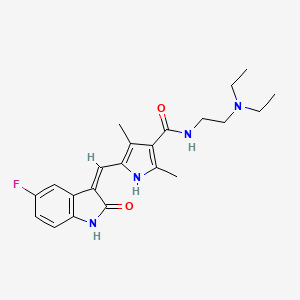
| Formula | C22H27FN4O2 |
|---|---|
| Molecular weight | 398.48 g/mol |
| IUPAC name | N-[2-(diethylamino)ethyl]-5-[(Z)-(5-fluoro-2-oxo-1H-indol-3-ylidene)methyl]-2,4-dimethyl-1H-pyrrole-3-carboxamide |
| CAS | 557795-19-4 |
| PubChem CID | 5329102 |
| InChIKey | WINHZLLDWRZWRT-ATVHPVEESA-N |
| logP | 3.33 (XLogP 2.6) |
| Polar surface area | 77.23 Ų |
| H-bond acceptors / donors | 3 / 3 |
| Drug-likeness (QED) | 0.63 |
| Lipinski violations | 0 |
SMILES
CCN(CC)CCNC(=O)c1c(C)[nH]c(/C=C2\C(=O)Nc3ccc(F)cc32)c1CBiology & Pharmacokinetics
Pharmacokinetics
| BBB penetrant | Yes |
|---|
Enzyme interactions
| Enzyme | Role | Detail |
|---|---|---|
| CYP3A4 | Substrate | — |
Receptor binding (top 11)
| Target | Action | Affinity |
|---|---|---|
| KIT proto-oncogene, receptor tyrosine kinase (KIT) | Inhibitor | pKd 9.4 |
| ret proto-oncogene (RET) | Inhibitor | pIC50 8.8 |
| platelet derived growth factor receptor beta (PDGFRB) | Inhibitor | pIC50 8.2 |
| fms related receptor tyrosine kinase 3 (FLT3) | Inhibitor | pIC50 8.2 |
| platelet derived growth factor receptor beta (PDGFRB) | Inhibitor | pKi 8.1 |
| fms related receptor tyrosine kinase 4 (FLT4) | Inhibitor | pIC50 8.1 |
| KIT proto-oncogene, receptor tyrosine kinase (KIT) | Inhibitor | pIC50 7.9 |
| kinase insert domain receptor (KDR) | Inhibitor | pIC50 7.7 |
| large tumor suppressor kinase 2 (LATS2) | Inhibitor | pKd 6.3 |
| large tumor suppressor kinase 1 (LATS1) | Inhibitor | pKd 6.2 |
| fibroblast growth factor receptor 1 (FGFR1) | Inhibitor | pKi 6.1 |
Transporters
BCRP (Inhibitor)BCRP (Inhibitor)BSEP (Inhibitor)BSEP (Inhibitor)MATE1 (Inhibitor)MATE2 (Inhibitor)MDR1 (Inhibitor)MRP1 (Inhibitor)MRP2 (Inhibitor)OATP1B1 (Inhibitor)OATP1B3 (Inhibitor)OCT1 (Inhibitor)P-gp (Inhibitor)BCRP (Substrate)MDR1 (Substrate)MRP2 (Substrate)OATP1B1 (Substrate)OCT1 (Substrate)P-gp (Substrate)
Drug–drug interactions (100+, DDInter)
| Interacting drug | Severity | Management |
|---|---|---|
| Amiodarone | major | |
| Amisulpride | major | |
| Anagrelide | major | |
| Apalutamide | major | |
| Arsenic trioxide | major | |
| Avapritinib | major | |
| Bedaquiline | major | |
| Bepridil | major | |
| Bevacizumab | major | |
| Bexarotene | major | |
| Cabozantinib | major | |
| Carbamazepine | major | |
| Ceritinib | major | |
| Chloroquine | major | |
| Cisapride | major | |
| Citalopram | major | |
| Clozapine | major | |
| Crizotinib | major | |
| Deferiprone | major | |
| Disopyramide | major | |
| Dofetilide | major | |
| Dolasetron | major | |
| Dronedarone | major | |
| Droperidol | major | |
| Efavirenz | major | |
| Enzalutamide | major | |
| Escitalopram | major | |
| Fingolimod | major | |
| Fosphenytoin | major | |
| Gatifloxacin | major | |
| Grepafloxacin | major | |
| Halofantrine | major | |
| Haloperidol | major | |
| Hydroxychloroquine | major | |
| Ibutilide | major | |
| Iloperidone | major | |
| Ivabradine | major | |
| Ivosidenib | major | |
| Lefamulin | major | |
| Leflunomide | major |
Showing 40 of 100+.
Registered Products (9)
| Brand | Form / strength | Pack | Agent | Citizen (JOD) |
|---|---|---|---|---|
| Renis | Capsule 50 mg | 30 cap | Hikma Pharmaceuticals Co.Ltd/Jordan | — |
| Renis | Capsule 25 mg | 30 cap | Hikma Pharmaceuticals Co.Ltd/Jordan | — |
| Renis | Capsule 12.5 mg | 30 cap | Hikma Pharmaceuticals Co.Ltd/Jordan | — |
| Sunitinib Pharmacare 12.5 mg hard capsules | Capsule Sunitinib 12.5 mg | 30 cap | Sabbagh Drug Store | — |
| Sunitinib Pharmacare 25 mg hard capsules | Capsule Sunitinib 25 mg | 30 cap | Sabbagh Drug Store | — |
| Sunitinib Pharmacare 50 mg hard capsules | Capsule Sunitinib 50 mg | 30 cap | Sabbagh Drug Store | — |
| Sutent | Capsule 50 mg | 30 cap | Petra Drug Store | — |
| Sutent | Capsule 12.5 mg | 30 cap | Petra Drug Store | — |
| Sutent | Capsule 25 mg | 30 cap | Petra Drug Store | — |