Imatinib
JFDA label: Cemivil 400mg F.C Tab
Mechanism of Action
Imatinib inhibits Bcr-Abl tyrosine kinase, the constitutive abnormal gene product of the Philadelphia chromosome in chronic myeloid leukemia (CML). Inhibition of this enzyme blocks proliferation and induces apoptosis in Bcr-Abl positive cell lines as well as in fresh leukemic cells in Philadelphia chromosome positive CML. Also inhibits tyrosine kinase for platelet-derived growth factor (PDGF), stem cell factor (SCF), c-Kit, and cellular events mediated by PDGF and SCF.
Indications
Approved
- Acute lymphoblastic leukemia
- Aggressive systemic mastocytosis
- Chronic myeloid leukemia
- Dermatofibrosarcoma protuberans
- Gastrointestinal stromal tumors
- Hypereosinophilic syndrome and/or chronic eosinophilic leukemia
- Myelodysplastic/Myeloproliferative diseases
Off-label
- Chordoma
- Chronic myeloid leukemia (CML) post-stem cell transplantation (SCT) (allogeneic) (follow-up treatment)
- Desmoid tumor
- Melanoma, advanced or metastatic (C-KIT mutated tumors)
Class profile
| mechanismClass | Tyrosine kinase inhibitor (TKI) |
|---|---|
| targetMolecule | BCR-ABL,KIT,PDGFRA |
| targetPathway | BCR-ABL/KIT/PDGFR signaling |
| generation | 1st generation ABL TKI |
| primaryTumors | CML,Ph+ ALL,GIST,DFSP |
| resistanceMechanisms | BCR-ABL kinase domain mutations (T315I=gate-keeper,E255K/V,F317L,Y253H/F),BCR-ABL amplification,Src activation bypass |
| source | NCCN/OncoKB/Goodman&Gilman13ed |
Contraindications
Source: Lexicomp
- Hypersensitivity to imatinib or any component of the formulation Absolute
- There are no contraindications listed in the manufacturer's US labeling Absolute
Adverse Reactions
Cardiac disorders (9)
Very Common chest pain · Edema · facial edema · hypotension (Ph+ ALL; children, adolescents, adults) · peripheral edema
Common cardiac failure · flushing · hypertension · Palpitations
Nervous system disorders (14)
Very Common anxiety · chills · depression · dizziness · Fatigue · headache · insomnia · pain · paresthesia · rigors · taste disorder
Common Cerebral hemorrhage · hypoesthesia · peripheral neuropathy
Hepatobiliary disorders (5)
Very Common increased alkaline phosphatase · increased serum ALT · Increased serum AST · increased serum bilirubin · increased serum transaminases
Renal and urinary disorders (1)
Very Common Increased serum creatinine
Blood and lymphatic system disorders (11)
Very Common anemia · Hemorrhage · hypoproteinemia · leukopenia · neutropenia · thrombocytopenia
Common eosinophilia · febrile neutropenia · Lymphocytopenia · pancytopenia · purpura
Metabolism and nutrition disorders (10)
Very Common decreased serum albumin · hypokalemia · Increased lactate dehydrogenase · weight gain
Common fluid retention · hyperglycemia · hyperkalemia · hypocalcemia · Hypophosphatemia · weight loss
Gastrointestinal disorders (18)
Very Common abdominal distension · abdominal pain · anorexia · constipation · diarrhea · dyspepsia · flatulence · Nausea · stomatitis · upper abdominal pain · vomiting
Common Decreased appetite · gastritis · gastroenteritis · gastroesophageal reflux · gastrointestinal hemorrhage · increased serum lipase · xerostomia
Skin and subcutaneous tissue disorders (10)
Very Common alopecia · dermatitis · diaphoresis · night sweats · pruritus · Skin rash
Common erythema · nail disease · Skin photosensitivity · xeroderma
Musculoskeletal and connective tissue disorders (9)
Very Common arthralgia · back pain · limb pain · Muscle cramps · musculoskeletal pain · myalgia · ostealgia · weakness
Common Joint swelling
Eye disorders (7)
Very Common blurred vision · eyelid edema · increased lacrimation · Periorbital edema
Common conjunctival hemorrhage · Conjunctivitis · dry eyes
Infections and infestations (2)
Very Common infection (Ph+ ALL; children, adolescents, adults · Influenza
General disorders and administration site conditions (1)
Very Common Fever
Respiratory, thoracic and mediastinal disorders (15)
Very Common cough · dyspnea · flu-like symptoms · Nasopharyngitis · pharyngitis · pharyngolaryngeal pain · pneumonia · rhinitis · sinusitis · upper respiratory tract infection
Common epistaxis · Hypoxia · oropharyngeal pain · pleural effusion · pneumonitis (Ph+ ALL; children, adolescents, adults)
Dosing
Source: Lexicomp
Warnings & Precautions
Source: Lexicomp
Bone marrow suppression
May cause bone marrow suppression (anemia, neutropenia, and thrombocytopenia), usually occurring within the first several months of treatment. Median duration of neutropenia is 2 to 3 weeks; median duration of thrombocytopenia is 2 to 4 weeks. Monitor blood counts weekly for the first month, biweekly for the second month, and as clinically necessary thereafter. In chronic myeloid leukemia (CML), cytopenias are more common in accelerated or blast phase than in chronic phase.
Cardiovascular effects
Severe heart failure (HF) and left ventricular dysfunction (LVD) have been reported (occasionally). Cardiac adverse events usually occur in patients with advanced age or comorbidities. Carefully monitor patients with preexisting cardiac disease or risk factors for HF or history of renal failure. With initiation of imatinib treatment, cardiogenic shock and/or LVD have been reported in patients with hypereosinophilic syndrome (HES) and cardiac involvement (reversible with systemic steroids, circulatory support and temporary cessation of imatinib). Echocardiogram and serum troponin monitoring may be considered in patients with HES/chronic eosinophilic leukemia (CEL) and in patients with myelodysplastic/myeloproliferative (MDS/MPD) disease or aggressive systemic mastocytosis associated with high eosinophil levels. Patients with high eosinophil levels and an abnormal echocardiogram or abnormal serum troponin level may benefit from prophylactic systemic steroids (for 1 to 2 weeks) with the initiation of imatinib. In a scientific statement from the American Heart Association, imatinib has been determined to be an agent that may either cause direct myocardial toxicity (rare) or exacerbate underlying myocardial dysfunction (magnitude: moderate) (AHA [Page 2016]).
Dermatologic reactions
Severe bullous dermatologic reactions, including erythema multiforme and Stevens-Johnson syndrome, have been reported; recurrence has been described with rechallenge. Case reports of successful resumption at a lower dose (with corticosteroids and/or antihistamine) have been described; however, some patients may experience recurrent reactions. Drug reaction with eosinophilia and systemic symptoms (DRESS) has been reported. Symptoms of DRESS include fever, severe skin eruption, lymphadenopathy, hematologic abnormalities (eosinophilia or atypical lymphocytes), and internal organ involvement. If symptoms of DRESS occur, interrupt therapy and consider permanently discontinuing; symptoms regressed upon discontinuation of therapy, however, symptoms recurred in all cases when rechallenged.
Driving/heavy machinery
Caution is recommended while driving/operating motor vehicles and heavy machinery when taking imatinib; advise patients regarding side effects such as dizziness, blurred vision, or somnolence. Reports of accidents have been received, but it is unclear if imatinib has been the direct cause in any case.
Fluid retention/edema
Imatinib is commonly associated with fluid retention, weight gain, and edema (risk increases with higher doses and age >65 years); may be occasionally serious and lead to significant complications, including pleural effusion, pericardial effusion, pulmonary edema, and ascites. Monitor regularly for rapid weight gain or other signs/symptoms of fluid retention; rapid unexpected weight gain should be evaluated and managed appropriately. Use with caution in patients where fluid accumulation may be poorly tolerated, such as in cardiovascular disease (HF or hypertension) and pulmonary disease.
GI toxicity
Imatinib is associated with a moderate emetic potential; antiemetics may be recommended to prevent nausea and vomiting (Dupuis 2011, Hesketh 2017, Roila 2016). May cause GI irritation; take with food and water to minimize irritation. There have been rare reports (including fatalities) of GI perforation.
Hemorrhage
Severe hemorrhage (grades 3 and 4) has been reported with use, including GI hemorrhage and/or tumor hemorrhage. The incidence of hemorrhage is higher in patients with gastrointestinal stromal tumors (GIST) (GI tumors may have been hemorrhage source). Gastric antral vascular ectasia (a rare cause of gastrointestinal bleeding) has also been reported (Alshehry 2014; Saad Aldin 2012). Monitor for GI symptoms with treatment initiation.
Hepatotoxicity
Hepatotoxicity may occur; fatal hepatic failure and severe hepatic injury requiring liver transplantation have been reported with both short- and long-term use; monitor liver function (transaminases, bilirubin, and alkaline phosphatase) prior to initiation and monthly or as needed thereafter; therapy interruption or dose reduction may be necessary. Transaminase and bilirubin elevations, and acute liver failure have been observed with imatinib in combination with chemotherapy.
Nephrotoxicity
Imatinib is associated with a decline in renal function; may be associated with duration of therapy. The median estimated GFR declined from 85 mL/minute/1.73 m2 at baseline to 75 mL/minute/1.73 m2 at 12 months and to 69 mL/minute/1.73 m2 at 60 months (in patients with newly diagnosed chronic myeloid leukemia and malignant GIST). Evaluate renal function prior to imatinib initiation and monitor during therapy. Patients with risk factors for renal dysfunction (eg, preexisting renal impairment, diabetes mellitus, hypertension, congestive heart failure) may be at higher risk for nephrotoxicity.
Tumor lysis syndrome
Tumor lysis syndrome (TLS), including fatalities, has been reported in patients with acute lymphoblastic leukemia (ALL), CML eosinophilic leukemias, and GIST. Risk for TLS is higher in patients with a high tumor burden or high proliferation rate; monitor closely. Correct clinically significant dehydration and treat high uric acid levels prior to initiation of imatinib. Disease-related concerns:
Hepatic impairment
Use with caution in patients with hepatic impairment; dosage adjustment recommended in patients with severe impairment.
Gastric surgery
Imatinib exposure may be reduced in patients who have had gastric surgery (eg, bypass, major gastrectomy, or resection); monitor imatinib trough concentrations (Liu 2011; Pavlovsky 2009; Yoo 2010).
Renal impairment
Use with caution in patients with renal impairment; dosage adjustment recommended for moderate and severe renal impairment (CrCl • Thyroid disease: Hypothyroidism has been reported in thyroidectomy patients who were receiving thyroid hormone replacement therapy prior to initiation of imatinib; monitor thyroid function. The average onset for imatinib-induced hypothyroidism is 2 weeks; consider doubling levothyroxine doses upon initiation of imatinib (Hamnvik 2011). Concurrent drug therapy issues:
Drug-drug interactions
Potentially significant interactions may exist, requiring dose or frequency adjustment, additional monitoring, and/or selection of alternative therapy. Consult drug interactions database for more detailed information. Special populations:
Elderly
The incidence of edema was increased with age older than 65 years in CML and GIST studies.
Pediatric
Growth retardation has been reported in children receiving imatinib for the treatment of CML; generally where treatment was initiated in prepubertal children; growth velocity was usually restored as pubertal age was reached (Shima 2011). Monitor growth closely. Other warnings/precautions:
Appropriate use
Determine PDGFRb gene rearrangements status (for MDS/MPD), D816V c-Kit mutation status (for aggressive systemic mastocytosis [ASM]), Philadelphia chromosome status for acute lymphoblastic leukemia and chronic myeloid leukemia, Kit (CD117)-positivity for GIST, and FIP1L1–platelet-derived growth factor (PDGF) receptor status for HES or CEL prior to initiating treatment.
Pregnancy & Lactation
Pregnancy
Imatinib crosses the placenta (Burwick 2017). Spontaneous abortion and congenital anomalies (including skeletal, renal, and GI malformations [Lishner 2016]) have been reported (case reports) following imatinib exposure during pregnancy. Pregnancy should be avoided during imatinib treatment. Pregnancy testing should be conducted in females of reproductive potential prior to therapy; women of reproductive potential should use highly effective contraception during imatinib treatment and for 2 weeks after the last imatinib dose. The European Society for Medical Oncology (ESMO) has published guidelines for diagnosis, treatment, and follow-up of cancer during pregnancy. The guidelines suggest that imatinib should only be used for the treatment of chronic myeloid leukemia (CML) in the second and third trimester and recommend referral to a facility with expertise in cancer during pregnancy; a multidisciplinary team (obstetrician, neonatologist, oncology team) is encouraged (Peccatori 2013).
Lactation
Imatinib and its active metabolite are present in human breast milk; the milk/plasma ratio is 0.5 for imatinib and 0.9 for the active metabolite. Based on body weight, up to 10% of a therapeutic maternal dose could potentially be received by a breastfed infant. Due to the potential for serious adverse reactions in the breastfed infant, breastfeeding is not recommended by the manufacturer during treatment and for 1 month after the last imatinib dose.
Monitoring
| Efficacy | Tumour response (RECIST criteria, tumour markers, imaging); progression-free survival; performance status (ECOG/Karnofsky) |
|---|---|
| Toxicity | CBC with differential (nadir timing depends on agent); LFTs; renal function; ECG (QT for relevant agents); echocardiogram for cardiotoxic agents (anthracyclines, trastuzumab); cumulative dose tracking for dose-limited toxicities |
| Clinical pearl | Treatment response is assessed after 2–3 cycles. Grade 3–4 toxicities typically require dose reduction or interruption per protocol-defined criteria. |
| Counseling | Attend all scheduled blood tests and imaging appointments. Report fever > 38°C (risk of neutropaenic sepsis — medical emergency), unusual bleeding, or new pain immediately. |
Chemistry & Properties
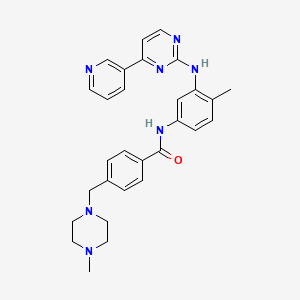
| Formula | C29H31N7O |
|---|---|
| Molecular weight | 493.62 g/mol |
| IUPAC name | 4-[(4-methylpiperazin-1-yl)methyl]-N-[4-methyl-3-[(4-pyridin-3-ylpyrimidin-2-yl)amino]phenyl]benzamide |
| CAS | 152459-95-5 |
| PubChem CID | 5291 |
| InChIKey | KTUFNOKKBVMGRW-UHFFFAOYSA-N |
| logP | 4.59 (XLogP 3.5) |
| Polar surface area | 86.28 Ų |
| H-bond acceptors / donors | 7 / 2 |
| Drug-likeness (QED) | 0.39 |
| Lipinski violations | 0 |
SMILES
Cc1ccc(NC(=O)c2ccc(CN3CCN(C)CC3)cc2)cc1Nc1nccc(-c2cccnc2)n1Biology & Pharmacokinetics
Pharmacokinetics
| BBB penetrant | No (logBB -1.5) |
|---|
Enzyme interactions
| Enzyme | Role | Detail |
|---|---|---|
| CYP1A2 | Substrate | — |
| CYP2B6 | Inhibitor | — |
| CYP2C8 | Inhibitor | — |
| CYP2D6 | Inhibitor | — |
| CYP3A4 | Inhibitor | Ki 14.299999999999986 µM |
| CYP3A4 | Substrate | — |
Receptor binding (top 3)
| Target | Action | Affinity |
|---|---|---|
| ABL proto-oncogene 1, non-receptor tyrosine kinase (ABL1) | Inhibitor | pIC50 6.7 |
| discoidin domain receptor tyrosine kinase 1 (DDR1) | Inhibitor | pIC50 6.5 |
| discoidin domain receptor tyrosine kinase 2 (DDR2) | Inhibitor | pIC50 6.2 |
Transporters
BCRP (Inhibitor)BCRP (Inhibitor)BSEP (Inhibitor)BSEP (Inhibitor)CNT1 (Inhibitor)CNT3 (Inhibitor)ENT1 (Inhibitor)ENT2 (Inhibitor)MATE1 (Inhibitor)MATE2 (Inhibitor)MDR1 (Inhibitor)MRP1 (Inhibitor)MRP2 (Inhibitor)MRP3 (Inhibitor)MRP4 (Inhibitor)NTCP (Inhibitor)OAT3 (Inhibitor)OATP1B1 (Inhibitor)OATP1B1 (Inhibitor)OATP1B3 (Inhibitor)OATP1B3 (Inhibitor)OCT1 (Inhibitor)OCT2 (Inhibitor)OCT3 (Inhibitor)OCTN1 (Inhibitor)OCTN2 (Inhibitor)P-gp (Inhibitor)BCRP (Substrate)MDR1 (Substrate)MRP2 (Substrate)OATP1A2 (Substrate)OATP1B3 (Substrate)OCT1 (Substrate)OCTN2 (Substrate)P-gp (Substrate)Transporter(unspecified) (Substrate)
Drug–drug interactions (100+, DDInter)
| Interacting drug | Severity | Management |
|---|---|---|
| Acalabrutinib | major | |
| Adalimumab | major | |
| Alfentanil | major | |
| Aminolevulinic acid | major | |
| Apalutamide | major | |
| Avanafil | major | |
| Avapritinib | major | |
| Avatrombopag | major | |
| Bacillus calmette-guerin substrain tice live antigen | major | |
| Baricitinib | major | |
| Benzhydrocodone | major | |
| Bosutinib | major | |
| Brexpiprazole | major | |
| Brigatinib | major | |
| Butorphanol | major | |
| Carbamazepine | major | |
| Certolizumab pegol | major | |
| Cilostazol | major | |
| Cisapride | major | |
| Cladribine | major | |
| Clozapine | major | |
| Cobimetinib | major | |
| Colchicine | major | |
| Deferiprone | major | |
| Deflazacort | major | |
| Eliglustat | major | |
| Encorafenib | major | |
| Entrectinib | major | |
| Enzalutamide | major | |
| Eplerenone | major | |
| Etanercept | major | |
| Everolimus | major | |
| Fentanyl | major | |
| Fingolimod | major | |
| Flibanserin | major | |
| Fosphenytoin | major | |
| Ginseng | major | |
| Golimumab | major | |
| Guanfacine | major | |
| Halofantrine | major |
Showing 40 of 100+.
Registered Products (19)
| Brand | Form / strength | Pack | Agent | Citizen (JOD) |
|---|---|---|---|---|
| AVATIB | Capsule 100 mg | 60 cap | Suleiman Tannous & Sons Co. Ltd | — |
| AVATIB | Capsule 400 mg | 30 cap | Suleiman Tannous & Sons Co. Ltd | — |
| Cemivil 100 mg F.C Tab | Film-Coated Tablet (as mesylate)100 mg | 30 tab | Hikma Pharmaceuticals Co.Ltd/Jordan | — |
| Cemivil 400mg F.C Tab | Film-Coated Tablet (as Mesylate) 400 mg | 30 tab | Hikma Pharmaceuticals Co.Ltd/Jordan | — |
| Glivec | Tablet 100 mg | 60 tab | The Jordan Drugstore Co | — |
| Glivec | Tablet 400 mg | 30 tab | The Jordan Drugstore Co | — |
| Imalek | Tablet 400 mg | 30 tab | Reda Jardaneh Drug Store | — |
| Imalek | Tablet 100 mg | 60 tab | Reda Jardaneh Drug Store | — |
| Imarem | Tablet 400 mg | 30 tab | JAWEDA INT. DRUD STORE | — |
| Imarem | Tablet 100 mg | 60 tab | JAWEDA INT. DRUD STORE | — |
| Imatinib AqVida | Capsule 100 mg | 60 cap | Trust Drug Store | — |
| Imatinib AqVida | Capsule 400 mg | 30 cap | Trust Drug Store | — |
| Imatis | Tablet 400 mg | 30 tab | Reda Jardaneh Drug Store | — |
| Imatis | Tablet 100 mg | 120 tab | Reda Jardaneh Drug Store | — |
| Sagitta | Capsule 400 mg(Imatinib mesylate 477.88 mg) | 30 Hard Caps | Adonis Drug Store | — |
| Sagitta | Capsule 100 mg(Imatinib mesylate 119.47 mg) | 60 Hard Cap | Adonis Drug Store | — |
| TYKONIB | Tablet 400.00 mg | 10 tab pack varies | Manar Drug Store | — |
| TYKONIB | Tablet 400.00 mg | 30 tab pack varies | Manar Drug Store | — |
| TYKONIB | Tablet 400.00 mg | 100 tab pack varies | Manar Drug Store | — |