Meropenem
🧬 Cross-allergy: Carbapenems
JFDA label: Merolab 500mg I.V Powder for Solution
Mechanism of Action
Inhibitor of Bacterial penicillin-binding protein — Bacterial penicillin-binding protein inhibitor
| Target | Action | Gene / class |
|---|---|---|
| Bacterial penicillin-binding protein efficacy | INHIBITOR |
Indications
Approved
- Bacterial meningitis
- Intra-abdominal infections
- Skin and skin structure infections, complicated
Off-label
- Bacterital meningitis
- Catheter-related blood stream infections
- Cystic fibrosis, pulmonary exacerbation
- Febrile neutropenia
- Gynecologic and pelvis infection
- Melioidosis (Burkholderia pseudomallei)
- Pneumonia, hospital-acquired or ventilator-associated
- Prosthetic joint infection
- Skin and soft tissue necrotizing infections
- Surgical site Infection
- Urinary tract infection
Antimicrobial Spectrum
Expected / intrinsic spectrum (EUCAST breakpoints & labels) — not local resistance. Source: EUCAST v16 · curated · openfda-label.
Bacteria
| Organism | Activity | MIC |
|---|---|---|
| Acinetobacter baumannii | Susceptible | 2.0 mg/L |
| Acinetobacter spp. | Susceptible | 2.0 mg/L |
| Anaerobes | Susceptible | 1.0 mg/L |
| Bacillus spp. | Susceptible | 0.25 mg/L |
| Bacteroides fragilis | Active | — |
| Bacteroides ovatus | Active | — |
| Bacteroides thetaiotaomicron | Active | — |
| Bacteroides uniformis | Active | — |
| Bacteroides ureolyticus | Active | — |
| Bacteroides vulgatus | Active | — |
| Burkholderia cepacia complex | Susceptible | 8.0 mg/L |
| Campylobacter jejuni | Active | — |
| Citrobacter freundii | Active | — |
| Citrobacter koseri | Active | — |
| Clostridium difficile | Active | — |
| Clostridium perfringens | Active | — |
| Enterobacter cloacae | Susceptible | 2.0 mg/L |
| Enterobacterales | Susceptible | 2.0 mg/L |
| Enterococcus faecalis | Active | — |
| Escherichia coli | Susceptible | 2.0 mg/L |
| Haemophilus influenzae | Susceptible | 2.0 mg/L |
| Klebsiella oxytoca | Active | — |
| Klebsiella pneumoniae | Susceptible | 2.0 mg/L |
| Listeria monocytogenes | Susceptible | 0.25 mg/L |
| Moraxella catarrhalis | Susceptible | 2.0 mg/L |
| Morganella morganii | Active | — |
| Neisseria meningitidis | Susceptible | 0.25 mg/L |
| Pasteurella multocida | Active | — |
| Prevotella bivia | Active | — |
| Prevotella intermedia | Active | — |
| Prevotella melaninogenica | Active | — |
| Proteus mirabilis | Active | — |
| Proteus vulgaris | Active | — |
| Pseudomonas aeruginosa | Susceptible | 2.0 mg/L |
| Pseudomonas aeruginosa | Susceptible | 82.0 mg/L |
| Serratia marcescens | Active | — |
| Staphylococcus aureus | Active | — |
| Staphylococcus epidermidis | Active | — |
| Streptococcus agalactiae | Active | — |
| Streptococcus pneumoniae | Susceptible | 2.0 mg/L |
| Streptococcus pyogenes | Active | — |
| Vibrio spp. | Susceptible | 0.5 mg/L |
| Viridans group streptococci | Susceptible | 2.0 mg/L |
| Acinetobacter baumannii | Resistant | 8.0 mg/L |
| Escherichia coli | Resistant | 8.0 mg/L |
| Klebsiella pneumoniae | Resistant | 8.0 mg/L |
| Pseudomonas aeruginosa | Resistant | 8.0 mg/L |
Class profile
| gramStatus | Both |
|---|---|
| spectrumBreadth | Extended |
| atypicalCoverage | No |
| isBactericidal | 1 |
| moaCategory | Cell wall synthesis inhibitor (beta-lactam, carbapenem) |
| pdIndex | Time-dependent |
| postAntibioticEffect | Short |
| mrsaCoverage | 0 |
| resistanceMechanisms | Carbapenemase (KPC,NDM,OXA-48),OprD porin loss,Efflux pumps |
Contraindications
Source: Lexicomp
- Hypersensitivity to meropenem, other drugs in the same class, or any component of the formulation Absolute
- patients who have experienced anaphylactic reactions to beta-lactams Absolute
Adverse Reactions
Cardiac disorders (13)
Common bradycardia · cardiac arrest · cardiac failure · chest pain · hypertension · hypotension · myocardial infarction · peripheral edema · Peripheral vascular disease · pulmonary embolism · shock · syncope · tachycardia
Nervous system disorders (2)
Common convulsions, pruritus, dermal ulcer, diaphoresis, urticaria · Headache
Hepatobiliary disorders (1)
Common Hyperbilirubinemia
Renal and urinary disorders (5)
Common Dysuria · pelvic pain · Renal failure · urinary incontinence · vulvovaginal candidiasis
Blood and lymphatic system disorders (2)
Common Anemia · hypochromic anemia
Metabolism and nutrition disorders (2)
Common hypervolemia · Hypoglycemia
Gastrointestinal disorders (13)
Common abdominal pain · anorexia · constipation · diarrhea · dyspepsia · enlargement of abdomen · flatulence · gastrointestinal disease · glossitis · intestinal obstruction · Nausea · oral candidiasis · vomiting
Musculoskeletal and connective tissue disorders (2)
Common Back pain · weakness
General disorders and administration site conditions (3)
Common Accidental injury · fever · Inflammation at injection site
Respiratory, thoracic and mediastinal disorders (10)
Common apnea · asthma · cough · dyspnea · hypoxia · Pharyngitis · pleural effusion · pneumonia · pulmonary edema · respiratory tract disease
Dosing
Source: Lexicomp
Warnings & Precautions
Source: Lexicomp
Anaphylaxis/hypersensitivity reactions
Serious hypersensitivity reactions, including anaphylaxis, have been reported (some without a history of previous allergic reactions to beta-lactams).
CNS effects
Carbapenems have been associated with CNS adverse effects, including confusional states and seizures (myoclonic); use caution with CNS disorders (eg, brain lesions and history of seizures) and adjust dose in renal impairment to avoid drug accumulation, which may increase seizure risk. Outpatient use may result in paresthesias, seizures, delirium and/or headaches that can impair neuromotor function and alertness; patients should not operate machinery or drive until it is established that meropenem is well tolerated.
Superinfection
Prolonged use may result in fungal or bacterial superinfection, including C. difficile-associated diarrhea (CDAD) and pseudomembranous colitis; CDAD has been observed >2 months postantibiotic treatment. Disease-related concerns:
Renal impairment
Use with caution in patients with renal impairment; dosage adjustment required in patients with creatinine clearance ≤50 mL/minute. Increased seizure risk and thrombocytopenia have been reported in patients with renal impairment. Concurrent drug therapy issues:
Elderly
Lower doses (based upon renal function) are often required in the elderly.
Pregnancy & Lactation
Pregnancy
Adverse events were not observed in animal reproduction studies. Incomplete transplacental transfer of meropenem was found using an ex vivo human perfusion model.
Lactation
Small amounts of meropenem are excreted into breast milk (case report). The manufacturer recommends that caution be exercised when administering meropenem to breastfeeding women. Nondose-related effects could include modification of bowel flora.
Monitoring
| Efficacy | Culture and susceptibility testing; clinical resolution (temperature, WBC, CRP, procalcitonin) |
|---|---|
| Toxicity | Renal function (dose adjustment in renal impairment); hepatic function for hepatically cleared agents; signs of C. difficile infection (diarrhoea) |
| Clinical pearl | Culture results guide de-escalation to narrower-spectrum therapy. Review antibiotic appropriateness at 48–72 h (antimicrobial stewardship). |
| Counseling | Complete the full course. Report persistent diarrhoea, rash, or lack of improvement after 48–72 h. |
Chemistry & Properties
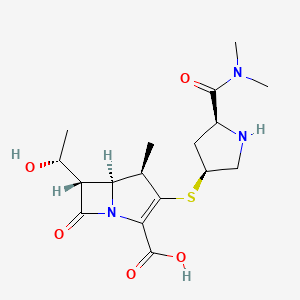
| Formula | C17H25N3O5S |
|---|---|
| Molecular weight | 383.47 g/mol |
| IUPAC name | (4R,5S,6S)-3-[(3S,5S)-5-(dimethylcarbamoyl)pyrrolidin-3-yl]sulfanyl-6-[(1R)-1-hydroxyethyl]-4-methyl-7-oxo-1-azabicyclo[3.2.0]hept-2-ene-2-carboxylic acid |
| CAS | 96036-03-2 |
| PubChem CID | 441130 |
| InChIKey | DMJNNHOOLUXYBV-PQTSNVLCSA-N |
| logP | -0.31 (XLogP -2.4) |
| Polar surface area | 110.18 Ų |
| H-bond acceptors / donors | 6 / 3 |
| Drug-likeness (QED) | 0.56 |
| Lipinski violations | 0 |
SMILES
C[C@@H](O)[C@H]1C(=O)N2C(C(=O)O)=C(S[C@@H]3CN[C@H](C(=O)N(C)C)C3)[C@H](C)[C@H]12Biology & Pharmacokinetics
Pharmacokinetics
| BBB penetrant | No |
|---|
Enzyme interactions
| Enzyme | Role | Detail |
|---|---|---|
| CYP2B6 | Inhibitor | — |
Transporters
ASBT (Inhibitor)BCRP (Inhibitor)BSEP (Inhibitor)BSEP (Inhibitor)MRP1 (Inhibitor)MRP2 (Inhibitor)MRP3 (Inhibitor)MRP4 (Inhibitor)OATP1B1 (Inhibitor)OATP1B1 (Inhibitor)OATP1B3 (Inhibitor)OATP1B3 (Inhibitor)P-gp (Inhibitor)OAT3 (Substrate)P-gp (Substrate)
Drug–drug interactions (14, DDInter)
| Interacting drug | Severity | Management |
|---|---|---|
| Bupropion | major | |
| Iohexol | major | |
| Iopamidol | major | |
| Alpelisib | moderate | |
| Encorafenib | moderate | |
| Ethinylestradiol | moderate | |
| Lindane | moderate | |
| Mycophenolic acid | moderate | |
| Nitisinone | moderate | |
| Pemetrexed | moderate | |
| Picosulfuric acid | moderate | |
| Polyethylene glycol (3350 with electrolytes) | moderate | |
| Sodium sulfate | moderate | |
| Teriflunomide | moderate |
Registered Products (20)
| Brand | Form / strength | Pack | Agent | Citizen (JOD) |
|---|---|---|---|---|
| Aropem | Vial 0.5 g | 1 vial | Adonis Drug Store | — |
| Aropem | Vial 1 g | 1 vial | Adonis Drug Store | — |
| Emorpeen | Vial Meropenem 500 mg | 10 vial | AL-TAQADDOM PHARMACEUTICAL INDUSTRIES/JORDAN | — |
| Emorpeen | Vial Meropenem 1000 mg | 10 vial | AL-TAQADDOM PHARMACEUTICAL INDUSTRIES/JORDAN | — |
| Merolab 1gm Powder for solution for infusion | Infusion 1 g | 10 vial | ORIENT DRUG STORE CO | — |
| Merolab 500mg I.V Powder for Solution | Solution 500 mg | 10 vial | ORIENT DRUG STORE CO | — |
| Meronem | Powder for Injection 500 mg | 10 vial | Khoury Drug Store | — |
| Meronem Injection | Powder for Injection 1.140 g | 10 vial | Khoury Drug Store | — |
| Meropa | Vial 1000 mg | 10 vial | The Arab Pharmaceutical Manufacturing PSC/Salt | — |
| Meropa | Vial 500 mg | 10 vial | The Arab Pharmaceutical Manufacturing PSC/Salt | — |
| Meropenem Kabi | Vial 1140 mg | 10 vial | Sun Set Drug Store | — |
| Meropenem Kabi | Vial 570 mg | 10 vial | Sun Set Drug Store | — |
| Ropenem | Vial 1 g | 1 vial | Reda Jardaneh Drug Store | — |
| Vabomere | Vial (as Trihydrate) 1000 mg, 1000 mg | 6 vial | Hikma Pharmaceuticals Co.Ltd/Jordan | — |
| merozan | Vial 500 mg | 1 vial pack varies | Al Hilal Drug Store | — |
| merozan | Vial 1140 mg | 50 vial pack varies | Al Hilal Drug Store | — |
| merozan | Vial 1140 mg | 1 vial pack varies | Al Hilal Drug Store | — |
| merozan | Vial 1140 mg | 10 vial pack varies | Al Hilal Drug Store | — |
| merozan | Vial 500 mg | 10 vial pack varies | Al Hilal Drug Store | — |
| merozan | Vial 500 mg | 50 vial pack varies | Al Hilal Drug Store | — |