Midostaurin
JFDA label: Rydapt
Mechanism of Action
Inhibitor of Receptor-type tyrosine-protein kinase FLT3 — Tyrosine-protein kinase receptor FLT3 inhibitor; Inhibitor of Mast/stem cell growth factor receptor Kit — Stem cell growth factor receptor inhibitor; Inhibitor of Platelet-derived growth factor receptor — Platelet-derived growth factor receptor inhibitor; Inhibitor of Protein kinase C (PKC) — Protein kinase C (PKC) inhibitor; Inhibitor of Vascular endothelial growth factor receptor 2 — Vascular endothelial growth factor receptor 2 inhibitor
| Target | Action | Gene / class |
|---|---|---|
| Mast/stem cell growth factor receptor Kit efficacy | INHIBITOR | KIT |
| Platelet-derived growth factor receptor efficacy | INHIBITOR | |
| Protein kinase C (PKC) efficacy | INHIBITOR | |
| Receptor-type tyrosine-protein kinase FLT3 efficacy | INHIBITOR | FLT3 |
| Vascular endothelial growth factor receptor 2 efficacy | INHIBITOR | KDR |
Indications
Approved
- Acute myeloid leukemia, FLT3-positive
- Mast cell leukemia
- Systemic mastocytosis
Contraindications
Source: Lexicomp
- Hypersensitivity to midostaurin or any component of the formulation Absolute
Adverse Reactions
Cardiac disorders (9)
Very Common Edema · prolonged Q-T interval on ECG
Common cardiac failure · hypertension · Hypotension · ischemia · myocardial infarction · pericardial effusion · thrombosis
Nervous system disorders (8)
Very Common dizziness · fatigue · Headache · insomnia
Common chills · Disturbance in attention · mental status changes · vertigo
Hepatobiliary disorders (4)
Very Common hyperbilirubinemia · increased serum alkaline phosphatase · Increased serum ALT · increased serum AST
Renal and urinary disorders (3)
Very Common Increased serum creatinine · renal insufficiency · Urinary tract infection
Blood and lymphatic system disorders (10)
Very Common anemia · Febrile neutropenia · leukopenia · lymphocytopenia · neutropenia · petechia · prolonged partial thromboplastin time · thrombocytopenia
Common Bruise · hematoma
Immune system disorders (1)
Common Hypersensitivity
Metabolism and nutrition disorders (13)
Very Common Hyperglycemia · hyperkalemia · hypernatremia · hyperuricemia · hypoalbuminemia · hypocalcemia · hypokalemia · hypomagnesemia · hyponatremia · hypophosphatemia · increased gamma-glutamyl transferase
Common hypercalcemia · Weight gain
Gastrointestinal disorders (12)
Very Common abdominal pain · constipation · diarrhea · gastrointestinal hemorrhage · hemorrhoids · increased serum amylase · increased serum lipase · mucositis · Nausea · vomiting
Common Dyspepsia · gastritis
Skin and subcutaneous tissue disorders (5)
Very Common Hyperhidrosis · skin rash
Common cellulitis · erysipelas · Xeroderma
Musculoskeletal and connective tissue disorders (3)
Very Common arthralgia · Musculoskeletal pain
Common Tremor
Eye disorders (1)
Common Eyelid edema
Infections and infestations (4)
Very Common Localized infection
Common fungal infection · Herpes virus infection · sepsis
General disorders and administration site conditions (1)
Very Common Fever
Respiratory, thoracic and mediastinal disorders (11)
Very Common cough · dyspnea · epistaxis · pleural effusion · Upper respiratory tract infection
Common bronchitis · interstitial pulmonary disease · oropharyngeal pain · Pneumonia · pneumonitis · pulmonary edema
Dosing
Source: Lexicomp
Warnings & Precautions
Source: Lexicomp
Bone marrow suppression
Lymphopenia, leukopenia, neutropenia, thrombocytopenia and anemia have been commonly observed in patients with systemic mastocytosis. Although the incidence of hematologic toxicity in acute myeloid leukemia (AML) may be confounded by concomitant chemotherapy, febrile neutropenia was reported at a slightly higher incidence in patients with AML receiving chemotherapy plus midostaurin (compared to chemotherapy plus placebo). Monitor blood counts.
GI toxicity
Nausea and vomiting commonly occur; premedicate with antiemetics prior to administration. Diarrhea, abdominal pain, and constipation also occur frequently. Mucositis has also been reported. · ·
Hypersensitivity
Hypersensitivity reactions, including anaphylactic shock, angioedema, dyspnea, chest pain and flushing have been observed.
Pulmonary toxicity
Interstitial lung disease and pneumonitis have been reported with midostaurin (either as monotherapy or in combination with other chemotherapy), some cases have been fatal. Monitor for pulmonary symptoms; discontinue in patients who develop signs/symptoms of interstitial lung disease or pneumonitis (without an infectious etiology). Concurrent drug therapy issues:
Drug-drug/drug-food interactions
Potentially significant interactions may exist, requiring dose or frequency adjustment, additional monitoring, and/or selection of alternative therapy. Consult drug interactions database for more detailed information. Other warnings/precautions:
FLT3 mutation positivity
In the treatment of acute myeloid leukemia, midostaurin is approved for use only in patients who are FLT3 mutation-positive (as detected by an approved test).
Pregnancy & Lactation
Pregnancy
Adverse events were observed in animal reproduction studies with doses providing less than the human exposure at the recommended dose based on AUC. Based on the mechanism of action, midostaurin may cause fetal harm if used in pregnant women. Pregnancy status should be verified within 7 days prior to therapy initiation. Females of reproductive potential and males with female partners of reproductive potential should use effective contraception during therapy and for at least 4 months after the last dose. Based on animal data, treatment with midostaurin may impair fertility in males and females.
Lactation
It is not known if midostaurin is present in breast milk. Due to the potential for adverse reactions in the breastfed infant, breastfeeding is not recommended by the manufacturer during therapy and for at least 4 months after the last dose.
Monitoring
| Clinical pearl | FLT3 mutation status (in AML); CBC with differential (in patients with systemic mastocytosis: at least weekly for the first 4 weeks, every other week for the next 8 weeks, and monthly thereafter or as clinically indicated); pregnancy status within 7 days of therapy initiation in women of reproductive potential; signs/symptoms of pulmonary toxicity (interstitial lung disease and pneumonitis); consider ECG for QT interval assessment in patients on concurrent medications that may prolong the QT interval. |
|---|
Chemistry & Properties
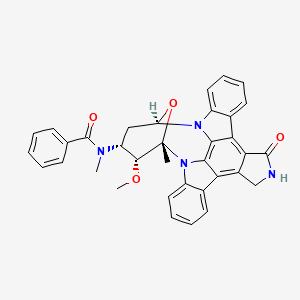
| Formula | C35H30N4O4 |
|---|---|
| Molecular weight | 570.65 g/mol |
| IUPAC name | N-[(2S,3R,4R,6R)-3-methoxy-2-methyl-16-oxo-29-oxa-1,7,17-triazaoctacyclo[12.12.2.12,6.07,28.08,13.015,19.020,27.021,26]nonacosa-8,10,12,14,19,21,23,25,27-nonaen-4-yl]-N-methylbenzamide |
| CAS | 120685-11-2 |
| PubChem CID | 9829523 |
| InChIKey | BMGQWWVMWDBQGC-IIFHNQTCSA-N |
| logP | 5.91 (XLogP 4.8) |
| Polar surface area | 77.73 Ų |
| H-bond acceptors / donors | 6 / 1 |
| Drug-likeness (QED) | 0.29 |
| Lipinski violations | 2 |
SMILES
CO[C@@H]1[C@H](N(C)C(=O)c2ccccc2)C[C@H]2O[C@]1(C)n1c3ccccc3c3c4c(c5c6ccccc6n2c5c31)C(=O)NC4Biology & Pharmacokinetics
Pharmacokinetics predicted
| Bioavailability | 70.0% |
|---|---|
| Half-life | 0.947 h |
| Volume of distribution | 1.625 L/kg |
| Protein binding | 99.1% |
| BBB penetrant | Yes |
Enzyme interactions
| Enzyme | Role | Detail |
|---|---|---|
| CYP2B6 | Inhibitor | — |
| CYP2C19 | Inhibitor | — |
| CYP2C19 | Substrate | — |
| CYP2C8 | Inhibitor | — |
| CYP2C9 | Inhibitor | — |
| CYP3A4 | Inhibitor | — |
| CYP3A4 | Substrate | — |
Receptor binding (top 4)
| Target | Action | Affinity |
|---|---|---|
| fms related receptor tyrosine kinase 3 (FLT3) | Inhibitor | pKd 8.0 |
| fms related receptor tyrosine kinase 3 (FLT3) | Inhibitor | pIC50 6.3 |
| large tumor suppressor kinase 1 (LATS1) | Inhibitor | pKd 6.0 |
| large tumor suppressor kinase 2 (LATS2) | Inhibitor | pKd 5.7 |
Transporters
BCRP (Inhibitor)BCRP (Inhibitor)BSEP (Inhibitor)MRP1 (Inhibitor)OAT1 (Inhibitor)OAT3 (Inhibitor)OATP1B1 (Inhibitor)OATP1B3 (Inhibitor)P-gp (Inhibitor)MDR1 (Substrate)MRP2 (Substrate)P-gp (Substrate)Transporter(unspecified) (Substrate)
Drug–drug interactions (100+, DDInter)
| Interacting drug | Severity | Management |
|---|---|---|
| Adalimumab | major | |
| Amiodarone | major | |
| Amisulpride | major | |
| Anagrelide | major | |
| Apalutamide | major | |
| Arsenic trioxide | major | |
| Atazanavir | major | |
| Bacillus calmette-guerin substrain tice live antigen | major | |
| Baricitinib | major | |
| Bedaquiline | major | |
| Bepridil | major | |
| Boceprevir | major | |
| Cabozantinib | major | |
| Carbamazepine | major | |
| Ceritinib | major | |
| Certolizumab pegol | major | |
| Chloroquine | major | |
| Cisapride | major | |
| Citalopram | major | |
| Cladribine | major | |
| Clarithromycin | major | |
| Clozapine | major | |
| Cobicistat | major | |
| Colchicine | major | |
| Conivaptan | major | |
| Crizotinib | major | |
| Deferiprone | major | |
| Delavirdine | major | |
| Disopyramide | major | |
| Dofetilide | major | |
| Dolasetron | major | |
| Dronedarone | major | |
| Droperidol | major | |
| Edoxaban | major | |
| Enzalutamide | major | |
| Escitalopram | major | |
| Etanercept | major | |
| Fingolimod | major | |
| Fosphenytoin | major | |
| Gatifloxacin | major |
Showing 40 of 100+.
Registered Products (2)
| Brand | Form / strength | Pack | Agent | Citizen (JOD) |
|---|---|---|---|---|
| Rydapt | Capsule 25 mg | 112 cap pack varies | The Jordan Drugstore Co | — |
| Rydapt | Capsule 25 mg | 56 cap pack varies | The Jordan Drugstore Co | — |