Norepinephrine
JFDA label: Levophed Amp
- Antidote for extravasation ischemia:
Mechanism of Action
Stimulates beta1-adrenergic receptors and alpha-adrenergic receptors causing increased contractility and heart rate as well as vasoconstriction, thereby increasing systemic blood pressure and coronary blood flow; clinically, alpha effects (vasoconstriction) are greater than beta effects (inotropic and chronotropic effects)
Indications
Approved
- Cardiogenic shock
- Hypotension/shock
- Septic shock
Contraindications
Source: Lexicomp
- Hypotension from hypovolemia except as an emergency measure to maintain coronary and cerebral perfusion until volume could be replaced Absolute
- during anesthesia with cyclopropane (not available in US) or halothane (not available in US) anesthesia Documentation of allergenic cross-reactivity for vasopressors is limited. However, because of similarities in chemical structure and/or pharmacologic actions, the possibility of cross-sensitivity can not be ruled out with certainty Absolute
- mesenteric or peripheral vascular thrombosis unless it is a lifesaving procedure Absolute
Adverse Reactions
Cardiac disorders (3)
Not Known Bradycardia · cardiac arrhythmia · peripheral ischemia (digital)
Nervous system disorders (2)
Not Known Anxiety · transient headache
Skin and subcutaneous tissue disorders (1)
Not Known Skin necrosis (with extravasation)
Respiratory, thoracic and mediastinal disorders (1)
Not Known Dyspnea
Dosing
Source: Lexicomp
Warnings & Precautions
Source: Lexicomp
Extravasation
Vesicant; ensure proper needle or catheter placement prior to and during infusion. Avoid extravasation; infuse into a large vein if possible. Avoid infusion into leg veins. Monitor IV site closely. [US Boxed Warning]: If extravasation occurs, infiltrate the area with diluted phentolamine (5 to 10 mg in saline) with a fine hypodermic needle. Phentolamine should be administered as soon as possible after extravasation is noted to prevent sloughing /necrosis. Disease-related concerns:
Hypoxia/hypercarbia
Use in patients with profound hypoxia or hypercarbia may produce ventricular tachycardia or fibrillation; use with extreme caution. Concurrent drug therapy issues:
Drug-drug interactions
Potentially significant interactions may exist, requiring dose or frequency adjustment, additional monitoring, and/or selection of alternative therapy. Consult drug interactions database for more detailed information. Dosage form specific issues:
Sodium metabisulfite
Product may contain sodium metabisulfite; use caution in patients with asthma or a sulfite allergy. Other warnings/precautions:
Administration
Administer infusions into a large vein, particularly an antecubital vein; some clinicians have indicated that the femoral vein is also an acceptable route. Avoid catheter tie-in technique, if possible. Avoid leg veins in elderly patients or in those suffering from occlusive disorders (eg, atherosclerosis, arteriosclerosis, diabetic endarteritis, Buerger disease). Gangrene has been reported in a lower extremity when infusions were given in an ankle vein.
Appropriate use
Assure adequate circulatory volume to minimize need for vasoconstrictors. Avoid hypertension; monitor blood pressure closely and adjust infusion rate.
Pregnancy & Lactation
Pregnancy
Animal reproduction studies have not been conducted. Norepinephrine is an endogenous catecholamine and crosses the placenta (Minzter 2010; Wang 1999). Medications used for the treatment of cardiac arrest in pregnancy are the same as in the non-pregnant woman. Appropriate medications should not be withheld due to concerns of fetal teratogenicity. Norepinephrine use during the post-resuscitation phase may be considered; however, the effects of vasoactive medications on the fetus should also be considered. Doses and indications should follow current Advanced Cardiovascular Life Support guidelines (Jeejeebhoy [AHA] 2015).
Lactation
It is not known if norepinephrine is present in breast milk. The manufacturer recommends that caution be exercised when administering norepinephrine to breastfeeding women.
Monitoring
| Clinical pearl | Blood pressure (or mean arterial pressure), heart rate; cardiac output (as appropriate), intravascular volume status, pulmonary capillary wedge pressure (as appropriate); urine output, peripheral perfusion; monitor infusion site closely Consult individual institutional policies and procedures. |
|---|
Chemistry & Properties
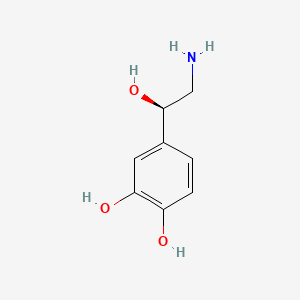
| Formula | C8H11NO3 |
|---|---|
| Molecular weight | 169.18 g/mol |
| IUPAC name | 4-[(1R)-2-amino-1-hydroxyethyl]benzene-1,2-diol |
| CAS | 51-41-2 |
| PubChem CID | 439260 |
| InChIKey | SFLSHLFXELFNJZ-QMMMGPOBSA-N |
| logP | 0.09 (XLogP -1.2) |
| Polar surface area | 86.71 Ų |
| H-bond acceptors / donors | 4 / 4 |
| Drug-likeness (QED) | 0.47 |
| Lipinski violations | 0 |
SMILES
NC[C@H](O)c1ccc(O)c(O)c1Biology & Pharmacokinetics
Pharmacokinetics predicted
| Bioavailability | 70.0% |
|---|---|
| Half-life | 2.304 h |
| Volume of distribution | 1.001 L/kg |
| Protein binding | 19.9% |
| BBB penetrant | No |
Receptor binding (top 8)
| Target | Action | Affinity |
|---|---|---|
| β1-adrenoceptor (ADRB1) | Agonist | pEC50 7.9 |
| α2B-adrenoceptor (ADRA2B) | Agonist | pIC50 7.8 |
| α2B-adrenoceptor (ADRA2B) | Agonist | pEC50 7.8 |
| α2C-adrenoceptor (ADRA2C) | Agonist | pEC50 7.7 |
| β3-adrenoceptor (ADRB3) | Agonist | pEC50 7.2 |
| α2A-adrenoceptor (ADRA2A) | Agonist | pIC50 6.6 |
| β2-adrenoceptor (ADRB2) | Agonist | pEC50 6.4 |
| α2A-adrenoceptor (ADRA2A) | Agonist | pEC50 5.3 |
Transporters
BCRP (Inhibitor)BSEP (Inhibitor)BSEP (Inhibitor)MATE1 (Inhibitor)MATE2 (Inhibitor)MRP1 (Inhibitor)OATP1B1 (Inhibitor)OATP1B1 (Inhibitor)OATP1B3 (Inhibitor)OATP1B3 (Inhibitor)OCT1 (Inhibitor)OCT2 (Inhibitor)OCT3 (Inhibitor)OCTN2 (Inhibitor)P-gp (Inhibitor)OCT1 (Substrate)OCT2 (Substrate)OCT3 (Substrate)P-gp (Substrate)
Drug–drug interactions (70, DDInter)
| Interacting drug | Severity | Management |
|---|---|---|
| Cocaine (nasal) | major | |
| Cocaine (topical) | major | |
| Doxepin | major | |
| Acarbose | moderate | |
| Acetohexamide | moderate | |
| Albiglutide | moderate | |
| Alogliptin | moderate | |
| Canagliflozin | moderate | |
| Chlorpropamide | moderate | |
| Dapagliflozin | moderate | |
| Desmopressin | moderate | |
| Diethylpropion | moderate | |
| Doxapram | moderate | |
| Dulaglutide | moderate | |
| Empagliflozin | moderate | |
| Ertugliflozin | moderate | |
| Exenatide | moderate | |
| Formoterol | moderate | |
| Glimepiride | moderate | |
| Glipizide | moderate | |
| Glyburide | moderate | |
| Indacaterol | moderate | |
| Insulin aspart (aspart protamine) | moderate | |
| Insulin aspart (aspart) | moderate | |
| Insulin degludec | moderate | |
| Insulin detemir | moderate | |
| Insulin glargine | moderate | |
| Insulin glulisine | moderate | |
| Insulin human | moderate | |
| Insulin human (inhalation, rapid acting) | moderate | |
| Insulin human (isophane) | moderate | |
| Insulin human (regular) | moderate | |
| Insulin human (zinc extended) | moderate | |
| Insulin human (zinc) | moderate | |
| Insulin lispro | moderate | |
| Insulin lispro (protamine) | moderate | |
| Isoprenaline | moderate | |
| Levothyroxine | moderate | |
| Linagliptin | moderate | |
| Liothyronine | moderate |
Showing 40 of 70.
Registered Products (3)
| Brand | Form / strength | Pack | Agent | Citizen (JOD) |
|---|---|---|---|---|
| Levophed Amp | Ampoule 4 mg/4 ml | 10 amp | Petra Drug Store | — |
| Noradrenaline Aguettant (Sulphites Free) 1mg/ml Concentrate for solution for infusion | Infusion 1 mg/ml | 10 amp | شركة مستودع ادوية جرينلاند | — |
| Noradrenaline Hikma | Ampoule 4 mg/4 ml | 10 amp | Hikma Pharmaceuticals Co.Ltd/Jordan | — |