Penicillamine
JFDA label: ARTAMIN Cap
- Experienced physician:
- Toxicity symptoms:
Mechanism of Action
Chelating Agent of Copper — Copper chelating agent
| Target | Action | Gene / class |
|---|---|---|
| Copper efficacy | CHELATING AGENT |
Indications
Off-label
- Lead poisoning (third-line therapy) (children)
Contraindications
Source: Lexicomp
- Additional contraindications (not in US labeling): Hypersensitivity to penicillamine or any component of the formulation Absolute
- Renal insufficiency (in patients with rheumatoid arthritis) Absolute
- breast-feeding Absolute
- concomitant use with gold therapy, antimalarial or cytotoxic drugs, oxyphenbutazone or phenylbutazone Absolute
- patients with previous penicillamine-related aplastic anemia or agranulocytosis Absolute
- pregnancy (in patients with chronic lead poisoning) Absolute
- pregnancy (in patients with rheumatoid arthritis) Absolute
- use in patients with chronic lead poisoning who have radiographic evidence of lead-containing substances in the GI tract Absolute
Adverse Reactions
Cardiac disorders (2)
Not Known Local thrombophlebitis · vasculitis (including renal vasculitis)
Nervous system disorders (10)
Not Known agitation · Anxiety · dystonia · Guillain-Barre syndrome · hyperpyrexia · myasthenia (including extraocular muscles) · myasthenia gravis · neurological deterioration · neuropathy · psychiatric disturbance
Hepatobiliary disorders (4)
Not Known hepatic failure · Increased serum alkaline phosphatase · intrahepatic cholestasis · toxic hepatitis
Renal and urinary disorders (6)
Common Proteinuria
Not Known Breast disease (mammary hyperplasia) · Goodpasture's syndrome · hematuria · nephrotic syndrome · Renal failure
Blood and lymphatic system disorders (14)
Common leukopenia · Thrombocytopenia
Not Known Agranulocytosis · aplastic anemia · change in platelet count (increase) · eosinophilia · hemolytic anemia · increased monocytes · leukocytosis · lymphadenopathy · positive ANA titer · pure red cell aplasia · sideroblastic anemia · thrombotic thrombocytopenic purpura
Metabolism and nutrition disorders (3)
Not Known Hypoglycemia · increased lactate dehydrogenase · thyroiditis
Gastrointestinal disorders (11)
Very Common Diarrhea · dysgeusia
Not Known Anorexia · epigastric pain · glossitis · nausea · oral mucosa ulcer · pancreatitis · peptic ulcer (reactivation) · stomatitis (gingivostomatitis) · vomiting
Skin and subcutaneous tissue disorders (14)
Common Skin rash
Not Known Alopecia · cheilosis · exfoliative dermatitis · fragile skin (friability increased) · lichen planus · papule (white papules at venipuncture and surgical sites) · pemphigus · pruritus · skin atrophy (anetoderma) · toxic epidermal necrolysis · urticaria · wrinkling of skin (excessive) · yellow nail syndrome
Musculoskeletal and connective tissue disorders (6)
Not Known Arthralgia · connective tissue disease (elastosis perforans serpiginosa) · dermatomyositis · lupus-like syndrome · polyarthralgia (migratory, often with objective synovitis) · polymyositis
Eye disorders (4)
Not Known Blepharoptosis · diplopia · optic neuritis · visual disturbance
Ear and labyrinth disorders (1)
Not Known Tinnitus
General disorders and administration site conditions (1)
Not Known Fever
Respiratory, thoracic and mediastinal disorders (5)
Not Known Asthma · bronchiolitis obliterans · hypersensitivity pneumonitis · interstitial pneumonitis · pulmonary fibrosis
Dosing
Source: Lexicomp
Warnings & Precautions
Source: Lexicomp
Allergic reactions
Approximately 33% of patients will experience an allergic reaction. Rash may occur early (more commonly) or late in therapy; early-onset rash typically resolves within days of discontinuation of therapy and does not recur upon rechallenge with reduced dose; discontinue therapy for late-onset rash (eg, after >6 months) and do not rechallenge; rash typically recurs with rechallenge. Discontinue therapy for skin reactions accompanied by lymphadenopathy, fever, arthralgia, or other allergic reactions.
Bronchiolitis obliterans
Has been reported rarely with use; instruct patients to report pulmonary symptoms (eg, unexplained wheezing or cough, exertional dyspnea) and consider pulmonary function testing in such patients.
Dermatologic
Penicillamine increases the amount of soluble collagen; may increase skin friability, particularly at sites subject to pressure or trauma (eg, knees, elbows shoulders). Purpuric areas with localized bleeding (if skin is broken) or vesicles with dark blood may be observed. Effects are considered localized and do not necessitate discontinuation of therapy; may not recur with dose reduction. Macular cutaneous eruptions are sometimes observed in conjunction with drug fever, usually 2 -3 weeks after therapy initiation. Dose reduction may be considered prior to surgical procedures. May resume normal recommended dosing postoperatively once wound healing is complete.
Drug fever
Drug fever may be observed, usually 2-3 weeks after therapy initiation. Discontinue use in patients with rheumatoid arthritis, Wilson’s disease, or cystinuria who develop a marked febrile response. Consider alternative therapy for patients with rheumatoid arthritis due to high incidence of fever reoccurrence with penicillamine rechallenge. May resume therapy at a reduced dose in Wilson’s disease or cystinuria upon resolution of fever; dose should then be gradually titrated to effective dose.
Gastrointestinal
Taste alteration may occur (rare in Wilson’s disease); usually self-limited with continued therapy, however may last ≥2 months and result in total loss of taste. Oral ulceration (eg, stomatitis) may occur; typically recurs on rechallenge but often resolves with dose reduction. Other dose-related lesions (eg, glossitis, gingivostomatitis) have been observed with use and may require therapy discontinuation.
Goodpasture's syndrome
Penicillamine has been associated with fatalities due to Goodpasture's syndrome. Discontinue therapy immediately in patients with abnormal urinary findings in association with hemoptysis and pulmonary infiltrates on chest x-ray.
Hematologic toxicities
Penicillamine has been associated with fatalities due to agranulocytosis, aplastic anemia, and thrombocytopenia. Discontinue therapy for WBC 3. Withhold therapy at least temporarily for platelet counts 3 or a progressive fall in WBC or platelets in 3 successive determinations, even though values may remain within the normal range. Monitor for signs/symptoms of leukopenia and thrombocytopenia.
Hepatotoxicity
Monitor liver function tests periodically due to rare reports of intrahepatic cholestasis or toxic hepatitis. More frequent monitoring is required during the first year of therapy in patients with Wilson’s disease.
Lupus erythematosus-like syndrome
May be observed in some patients; positive antinuclear antibody (ANA) test does not necessitate therapy discontinuation but should alert clinicians of possible future development of lupus erythematosus-like syndrome.
Pemphigus
May occur early or late in therapy; discontinue use with suspicion of pemphigus. May treat with high-dose corticosteroids alone, or in conjunction with an immunosuppressant; treatment duration can range from weeks to >1 year.
Penicillin cross-sensitivity
Patients with a penicillin allergy may theoretically have cross-sensitivity to penicillamine; however, the possibility has been eliminated now that penicillamine is produced synthetically and no longer contains trace amounts of penicillin.
Proteinuria/hematuria
Proteinuria or hematuria may develop; monitor for membranous glomerulopathy which can lead to nephrotic syndrome. In rheumatoid arthritis patients, discontinue if gross hematuria or persistent microscopic hematuria develop and discontinue therapy or reduce dose for proteinuria that is either >1 g/day or progressively increasing. Dose reduction may lead to resolution of proteinuria.
Myasthenia gravis
Penicillamine has been associated with myasthenic syndrome, and in some cases, progression to myasthenia gravis. Resolution of symptoms has been observed in most cases following discontinuation of therapy.
Toxicity symptoms
Patients should be warned to report promptly any symptoms suggesting toxicity (fever, sore throat, chills, bruising, or bleeding); toxicity may be dose related. Disease-related concerns:
Cystinuria
Continue treatment on a daily basis; interruptions of even a few days have been followed by hypersensitivity with reinstitution of therapy. Patients should receive pyridoxine supplementation (25 mg/day).
Lead poisoning
Investigate, identify, and remove sources of lead exposure and confirm lead-containing substances are absent from the GI tract prior to initiating therapy. Do not permit patients to re-enter the contaminated environment until lead abatement has been completed. Penicillamine is considered to be a third-line agent for the treatment of lead poisoning in children due to the overall toxicity associated with its use (AAP, 2005; Chandran, 2010); penicillamine should only be used when unacceptable reactions have occurred with edetate CALCIUM disodium and succimer. Primary care providers should consult experts in the chemotherapy of lead toxicity before using chelation drug therapy.
Rheumatoid arthritis
Patients with rheumatoid arthritis and impaired nutrition should receive pyridoxine supplementation (25 mg/day).
Wilson's disease
Continue treatment on a daily basis; interruptions of even a few days have been followed by hypersensitivity with reinstitution of therapy. Worsening of neurologic symptoms may occur during initiation of therapy however discontinuation of therapy is not recommended; may consider concomitant use of short term dimercaprol in patients whose symptoms continue to worsen 1 month following therapy initiation. Patients should receive pyridoxine supplementation (25-50 mg/day; Roberts, 2008). Concurrent drug therapy issues:
Hematopoietic-depressant drugs
Use with caution in patients on other hematopoietic-depressant drugs (eg, gold, immunosuppressants, antimalarials, phenylbutazone; Canadian labeling contraindicates concomitant use with these agents); hematologic and renal adverse reactions are similar. Special populations:
Elderly
Use with caution in the elderly; may be more susceptible to skin rash and/or taste alterations. Other warnings/precautions:
Experienced physician
Should be administered under the close supervision of a physician familiar with the toxicity and dosage considerations.
Pregnancy & Lactation
Pregnancy
Birth defects, including congenital cutix laxa and associated defects, have been reported in infants following penicillamine exposure during pregnancy. Use for the treatment of rheumatoid arthritis during pregnancy is contraindicated. Use for the treatment of cystinuria only if the possible benefits to the mother outweigh the potential risks to the fetus. Continued treatment of Wilson's disease during pregnancy protects the mother against relapse. Discontinuation has detrimental maternal and fetal effects. Daily dosage should be limited to 750 mg. For planned cesarean section, reduce dose to 250 mg/day for the last 6 weeks of pregnancy, and continue at this dosage until wound healing is complete.
Lactation
It is not known if penicillamine is excreted in breast milk. Use while breast-feeding is contraindicated by the manufacturer.
Monitoring
| Clinical pearl | Urinalysis, CBC with differential, platelet count, skin, lymph nodes, and body temperature twice weekly during the first month of therapy, then every 2 weeks for 5 months, then monthly; LFTs every 6 months; signs/symptoms of hypersensitivity Cystinuria: Urinary cystine, annual X-ray for renal stones Lead poisoning: Serum lead concentration (baseline and 7-21 days after completing chelation therapy); hemoglobin or hematocrit, iron status, free erythrocyte protoporphyrin or zinc protoporphyrin; neurodevelopmental changes Wilson's disease: Serum non-ceruloplasmin bound copper, 24-hour urinary copper excretion, LFTs every 3 months (at least) during the first year of treatment; periodic ophthalmic exam Urinalysis: Monitor for proteinuria and hematuria. A quantitative 24-hour urine protein at 1- to 2-week intervals initially (first 2-3 months) is recommended if proteinuria develops. |
|---|
Chemistry & Properties
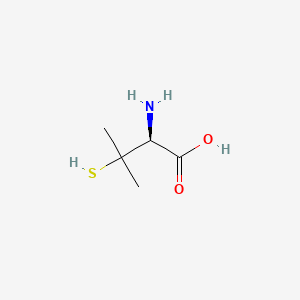
| Formula | C5H11NO2S |
|---|---|
| Molecular weight | 149.21 g/mol |
| IUPAC name | (2S)-2-amino-3-methyl-3-sulfanylbutanoic acid |
| CAS | 52-67-5 |
| PubChem CID | 5852 |
| InChIKey | VVNCNSJFMMFHPL-VKHMYHEASA-N |
| logP | 0.11 (XLogP -1.8) |
| Polar surface area | 63.32 Ų |
| H-bond acceptors / donors | 3 / 3 |
| Drug-likeness (QED) | 0.49 |
| Lipinski violations | 0 |
SMILES
CC(C)(S)[C@@H](N)C(=O)OBiology & Pharmacokinetics
Pharmacokinetics predicted
| Bioavailability | 10.0% |
|---|---|
| Half-life | 1.588 h |
| Volume of distribution | 1.366 L/kg |
| Protein binding | 78.0% |
| BBB penetrant | No |
Enzyme interactions
| Enzyme | Role | Detail |
|---|---|---|
| CYP2C19 | Substrate | — |
| CYP2D6 | Substrate | — |
Transporters
BCRP (Inhibitor)BSEP (Inhibitor)BSEP (Inhibitor)MRP1 (Inhibitor)MRP2 (Inhibitor)MRP4 (Inhibitor)OATP1B1 (Inhibitor)OATP1B1 (Inhibitor)OATP1B3 (Inhibitor)OATP1B3 (Inhibitor)P-gp (Inhibitor)OATP1B1 (Substrate)P-gp (Substrate)
Drug–drug interactions (48, DDInter)
| Interacting drug | Severity | Management |
|---|---|---|
| Cladribine | major | |
| Deferiprone | major | |
| Diatrizoate | major | |
| Iodipamide | major | |
| Iodixanol | major | |
| Iohexol | major | |
| Iopamidol | major | |
| Iopromide | major | |
| Iothalamic acid | major | |
| Ioversol | major | |
| Ioxilan | major | |
| Leflunomide | major | |
| Teriflunomide | major | |
| Alemtuzumab | moderate | |
| Aluminum hydroxide | moderate | |
| Attapulgite | moderate | |
| Azathioprine | moderate | |
| Calcium Phosphate | moderate | |
| Calcium acetate | moderate | |
| Calcium carbonate | moderate | |
| Calcium citrate | moderate | |
| Calcium glubionate anhydrous | moderate | |
| Calcium gluconate | moderate | |
| Calcium lactate | moderate | |
| Chloroquine | moderate | |
| Clofarabine | moderate | |
| Ferrous fumarate | moderate | |
| Ferrous gluconate | moderate | |
| Hydroxychloroquine | moderate | |
| Iron | moderate | |
| Kaolin | moderate | |
| Lanthanum carbonate | moderate | |
| Magaldrate | moderate | |
| Magnesium carbonate | moderate | |
| Magnesium chloride | moderate | |
| Magnesium citrate | moderate | |
| Magnesium gluconate | moderate | |
| Magnesium hydroxide | moderate | |
| Magnesium oxide | moderate | |
| Magnesium sulfate | moderate |
Showing 40 of 48.
Registered Products (1)
| Brand | Form / strength | Pack | Agent | Citizen (JOD) |
|---|---|---|---|---|
| ARTAMIN Cap | Capsule 250 mg | 50 cap | Nabulsi Drug Store | 12.200 |