Phenoxymethylpenicillin
🧬 Cross-allergy: Penicillins
JFDA label: Ospen 1500mg tablet
Mechanism of Action
Inhibitor of Bacterial penicillin-binding protein — Bacterial penicillin-binding protein inhibitor
| Target | Action | Gene / class |
|---|---|---|
| Bacterial penicillin-binding protein efficacy | INHIBITOR |
Indications
Approved
- Fusospirochetosis (Vincent gingivitis and pharyngitis)
- Pneumococcal infections
- Rheumatic fever and/or chorea prophylaxis
- Staphylococcal infections (penicillin G-sensitive)
- Streptococcal infections (without bacteremia)
Off-label
- Actinomycosis
- Bite wounds (animal)
- Chronic antimicrobial suppression of prosthetic joint infection
- Cutaneous anthrax
- Cutaneous erysipeloid
- GAS chronic carrier
- Pneumococcal prophylaxis in asplenia/sickle cell
- Pneumococcal prophylaxis in hematopoietic cell transplant
- Pneumonia, community-acquired (children)
Antimicrobial Spectrum
Expected / intrinsic spectrum (EUCAST breakpoints & labels) — not local resistance. Source: openfda-label.
Bacteria
| Organism | Activity | MIC |
|---|---|---|
| Bacillus anthracis | Active | — |
| Listeria monocytogenes | Active | — |
| Neisseria gonorrhoeae | Active | — |
| Staphylococcus aureus | Active | — |
| Streptococcus pneumoniae | Active | — |
| Treponema pallidum | Active | — |
Class profile
| gramStatus | Gram+ |
|---|---|
| spectrumBreadth | Narrow |
| atypicalCoverage | No |
| isBactericidal | 1 |
| moaCategory | Cell wall synthesis inhibitor (beta-lactam, PBP binding) |
| pdIndex | Time-dependent |
| postAntibioticEffect | None |
| mrsaCoverage | 0 |
| resistanceMechanisms | Beta-lactamase production,PBP mutations |
Contraindications
Source: Lexicomp
- Hypersensitivity to penicillin or any component of the formulation Absolute
Adverse Reactions
Other (5)
Very Common Gastrointestinal: Melanoglossia · mild diarrhea · nausea · oral candidiasis · vomiting
Dosing
Source: Lexicomp
Warnings & Precautions
Source: Lexicomp
Anaphylactic/hypersensitivity reactions
Serious and occasionally severe or fatal hypersensitivity (anaphylactic) reactions have been reported in patients on penicillin therapy, especially with a history of beta-lactam hypersensitivity or history of sensitivity to multiple allergens.). Use with caution in asthmatic patients. If a serious reaction occurs, treatment with supportive care measures and airway protection should be instituted immediately.
Superinfection
Prolonged use may result in fungal or bacterial superinfection, including C. difficile-associated diarrhea (CDAD) and pseudomembranous colitis; CDAD has been observed >2 months postantibiotic treatment. Disease-related concerns:
Renal impairment
Use with caution in patients with severe renal impairment.
Seizure disorders
Use with caution in patients with a history of seizure disorder; high levels, particularly in the presence of renal impairment, may increase risk of seizures. Concurrent drug therapy related issues:
Drug-drug interactions
Potentially significant interactions may exist, requiring dose or frequency adjustment, additional monitoring, and/or selection of alternative therapy. Consult drug interactions database for more detailed information. Dosage form specific issues:
Benzyl alcohol and derivatives
Some dosage forms may contain sodium benzoate/benzoic acid; benzoic acid (benzoate) is a metabolite of benzyl alcohol; large amounts of benzyl alcohol (≥99 mg/kg/day) have been associated with a potentially fatal toxicity (“gasping syndrome”) in neonates; the “gasping syndrome” consists of metabolic acidosis, respiratory distress, gasping respirations, CNS dysfunction (including convulsions, intracranial hemorrhage), hypotension, and cardiovascular collapse (AAP ["Inactive" 1997]; CDC, 1982); some data suggests that benzoate displaces bilirubin from protein binding sites (Ahlfors 2001); avoid or use dosage forms containing benzyl alcohol derivative with caution in neonates. See manufacturer’s labeling. Other warnings/precautions:
Prolonged use
Extended duration of therapy or use associated with high serum concentrations (eg, in renal insufficiency) may be associated with an increased risk for some adverse reactions (neutropenia, hemolytic anemia, serum sickness).
Pregnancy & Lactation
Pregnancy
Penicillin crosses the placenta. Maternal use of penicillins has generally not resulted in an increased risk of adverse fetal effects. Due to pregnancy-induced physiologic changes, some pharmacokinetic parameters of penicillin V may be altered in the second and third trimester (Heikkilä 1993). If treatment for the management of Bacillus anthracis is needed in pregnant women, other agents are preferred (Meaney-Delman 2014)
Lactation
Penicillin V is excreted into breast milk and may be detected in the urine of some breast-feeding infants. Loose stools and rash have been reported in nursing infants (Matheson 1988).
Monitoring
| Efficacy | Culture and susceptibility testing; clinical resolution (temperature, WBC, CRP, procalcitonin) |
|---|---|
| Toxicity | Renal function (dose adjustment in renal impairment); hepatic function for hepatically cleared agents; signs of C. difficile infection (diarrhoea) |
| Clinical pearl | Culture results guide de-escalation to narrower-spectrum therapy. Review antibiotic appropriateness at 48–72 h (antimicrobial stewardship). |
| Counseling | Complete the full course. Report persistent diarrhoea, rash, or lack of improvement after 48–72 h. |
Chemistry & Properties
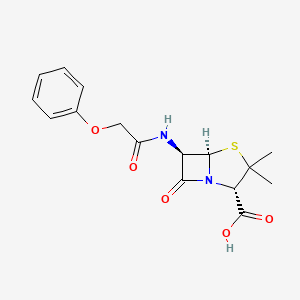
| Formula | C16H18N2O5S |
|---|---|
| Molecular weight | 350.4 g/mol |
| IUPAC name | (2S,5R,6R)-3,3-dimethyl-7-oxo-6-[(2-phenoxyacetyl)amino]-4-thia-1-azabicyclo[3.2.0]heptane-2-carboxylic acid |
| CAS | 87-08-1 |
| PubChem CID | 6869 |
| InChIKey | BPLBGHOLXOTWMN-MBNYWOFBSA-N |
| logP | 0.7 (XLogP 2.1) |
| Polar surface area | 95.94 Ų |
| H-bond acceptors / donors | 5 / 2 |
| Drug-likeness (QED) | 0.76 |
| Lipinski violations | 0 |
SMILES
CC1(C)S[C@@H]2[C@H](NC(=O)COc3ccccc3)C(=O)N2[C@H]1C(=O)OBiology & Pharmacokinetics
Pharmacokinetics
| BBB penetrant | No |
|---|
Enzyme interactions
| Enzyme | Role | Detail |
|---|---|---|
| CYP2C19 | Substrate | — |
| CYP2D6 | Inhibitor | — |
Transporters
BCRP (Inhibitor)BSEP (Inhibitor)MRP1 (Inhibitor)OATP1B1 (Inhibitor)OATP1B3 (Inhibitor)P-gp (Inhibitor)P-gp (Substrate)
Drug–drug interactions (18, DDInter)
| Interacting drug | Severity | Management |
|---|---|---|
| Methotrexate | major | |
| Balsalazide | moderate | |
| Demeclocycline | moderate | |
| Dicoumarol | moderate | |
| Doxycycline | moderate | |
| Ethinylestradiol | moderate | |
| Iodide I-123 | moderate | |
| Iodide I-131 | moderate | |
| Minocycline | moderate | |
| Mycophenolic acid | moderate | |
| Neomycin | moderate | |
| Oxytetracycline | moderate | |
| Pemetrexed | moderate | |
| Picosulfuric acid | moderate | |
| Tetracycline | moderate | |
| Warfarin | moderate | |
| Clarithromycin | minor | |
| Erythromycin | minor |
Registered Products (3)
| Brand | Form / strength | Pack | Agent | Citizen (JOD) |
|---|---|---|---|---|
| Orvek 125 Syrup | Syrup 125 mg/5 ml | 60 ml pack varies | Hikma Pharmaceuticals Co.Ltd/Jordan | 0.750 |
| Orvek 125 Syrup | Syrup 125 mg/5 ml | 100 ml pack varies | Hikma Pharmaceuticals Co.Ltd/Jordan | 1.170 |
| Ospen | Tablet 1.5 MIU | 12 tab | Nabulsi Drug Store | 3.550 |