Procyclidine
JFDA label: Kemadrin Tablets
Mechanism of Action
Thought to act by blocking excess acetylcholine at cerebral synapses; many of its effects are due to its pharmacologic similarities with atropine; it exerts an antispasmodic effect on smooth muscle, is a potent mydriatic; inhibits salivation
Indications
Approved
- Extrapyramidal side effects
- Parkinson disease
Contraindications
Source: Lexicomp
- Angle-closure glaucoma Absolute
Adverse Reactions
Nervous system disorders (1)
Not Known Dizziness
Immune system disorders (1)
Not Known Hypersensitivity reaction
Gastrointestinal disorders (5)
Not Known Constipation · epigastric distress · nausea · vomiting · xerostomia
Skin and subcutaneous tissue disorders (1)
Not Known Skin rash
Musculoskeletal and connective tissue disorders (1)
Not Known Weakness
Eye disorders (2)
Not Known Blurred vision · mydriasis
Dosing
Source: Lexicomp
Warnings & Precautions
Source: Lexicomp
Anhidrosis/hyperthermia
Anticholinergic agents may cause anhidrosis and hyperthermia, which may be severe; use with caution in hot weather or during exercise. The risk is increased in hot environments, particularly in the elderly, alcoholics, patients with CNS disease, and those with prolonged outdoor exposure.
CNS effects
May be associated with restlessness, confusion, hallucinations, or other CNS effects, particularly in the elderly and generally at higher dosages; intensification of symptoms or toxic psychosis may occur in patients with mental disorders. Dose reductions/discontinuation of therapy may be necessary. May cause CNS depression, which may impair physical or mental abilities; patients must be cautioned about performing tasks which require mental alertness (eg, operating machinery or driving). Disease-related concerns:
Cardiovascular disease
Use with caution in patients with tachycardia, cardiac arrhythmias, hypertension, or hypotension.
GI obstruction
Use with caution in patients with obstructive disease of the GI.
Hepatic impairment
Use with caution in patients with hepatic impairment.
Prostatic hyperplasia/urinary stricture
Use with caution in patients with prostatic hyperplasia and/or urinary stricture or retention.
Renal impairment
Use with caution in patients with renal impairment. Concurrent drug therapy issues:
Drug-drug interactions
Potentially significant interactions may exist, requiring dose or frequency adjustment, additional monitoring, and/or selection of alternative therapy. Consult drug interactions database for more detailed information. Special populations:
Elderly
Frequently develop increased sensitivity and require strict dosage regulation - side effects may be more severe in elderly patients with atherosclerotic changes.
Pregnancy & Lactation
Pregnancy
Safe use during pregnancy or in women considering pregnancy has not been established.
Lactation
It is not known if procyclidine is excreted in breast milk
Monitoring
| Clinical pearl | Symptoms of EPS or Parkinson's disease, pulse, anticholinergic effects (ie, CNS, bowel and bladder function) |
|---|
Chemistry & Properties
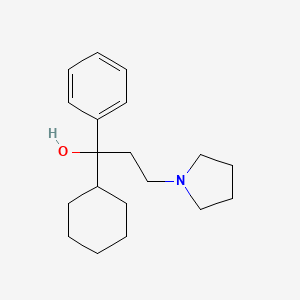
| Formula | C19H29NO |
|---|---|
| Molecular weight | 287.45 g/mol |
| IUPAC name | 1-cyclohexyl-1-phenyl-3-pyrrolidin-1-ylpropan-1-ol |
| CAS | 77-37-2 |
| PubChem CID | 4919 |
| InChIKey | WYDUSKDSKCASEF-UHFFFAOYSA-N |
| logP | 3.94 (XLogP 4.1) |
| Polar surface area | 23.47 Ų |
| H-bond acceptors / donors | 2 / 1 |
| Drug-likeness (QED) | 0.89 |
| Lipinski violations | 0 |
SMILES
OC(CCN1CCCC1)(c1ccccc1)C1CCCCC1Biology & Pharmacokinetics
Pharmacokinetics
| BBB penetrant | Yes |
|---|
Enzyme interactions
| Enzyme | Role | Detail |
|---|---|---|
| CYP2B6 | Inhibitor | — |
| CYP2D6 | Inhibitor | — |
| CYP2D6 | Substrate | — |
| CYP3A4 | Substrate | — |
Receptor binding (top 5)
| Target | Action | Affinity |
|---|---|---|
| Cholinergic, muscarinic M1 (CHRM1) | Binding | pKi 8.3 |
| Cholinergic, muscarinic M4 (CHRM4) | Binding | pKi 8.2 |
| Cholinergic, muscarinic M3 (CHRM3) | Binding | pKi 7.9 |
| Cholinergic, muscarinic M5 (CHRM5) | Binding | pKi 7.6 |
| Cholinergic, muscarinic M2 (CHRM2) | Binding | pKi 7.6 |
Transporters
BCRP (Inhibitor)BCRP (Inhibitor)BSEP (Inhibitor)BSEP (Inhibitor)MRP1 (Inhibitor)MRP2 (Inhibitor)MRP3 (Inhibitor)MRP4 (Inhibitor)OATP1B1 (Inhibitor)OATP1B1 (Inhibitor)OATP1B3 (Inhibitor)OATP1B3 (Inhibitor)OCT2 (Inhibitor)P-gp (Inhibitor)MDR1 (Substrate)P-gp (Substrate)
Drug–drug interactions (70, DDInter)
| Interacting drug | Severity | Management |
|---|---|---|
| Potassium chloride | major | |
| Potassium citrate | major | |
| Aclidinium | moderate | |
| Acrivastine | moderate | |
| Alimemazine | moderate | |
| Atropine | moderate | |
| Azatadine | moderate | |
| Brimonidine (ophthalmic) | moderate | |
| Brimonidine (topical) | moderate | |
| Brompheniramine | moderate | |
| Carbinoxamine | moderate | |
| Cetirizine | moderate | |
| Chlorcyclizine | moderate | |
| Chlorphenesin | moderate | |
| Chlorpheniramine | moderate | |
| Clemastine | moderate | |
| Clidinium | moderate | |
| Clofedanol | moderate | |
| Codeine | moderate | |
| Cyclizine | moderate | |
| Cyproheptadine | moderate | |
| Dexbrompheniramine | moderate | |
| Dextromethorphan | moderate | |
| Dicyclomine | moderate | |
| Diphenhydramine | moderate | |
| Doxepin | moderate | |
| Doxepin (topical) | moderate | |
| Doxylamine | moderate | |
| Dronabinol | moderate | |
| Edrophonium | moderate | |
| Eluxadoline | moderate | |
| Ethanol | moderate | |
| Glycopyrronium | moderate | |
| Glycopyrronium (topical) | moderate | |
| Hydrocodone | moderate | |
| Hyoscyamine | moderate | |
| Ipratropium | moderate | |
| Ketoconazole | moderate | |
| Levocetirizine | moderate | |
| Loperamide | moderate |
Showing 40 of 70.
Registered Products (2)
| Brand | Form / strength | Pack | Agent | Citizen (JOD) |
|---|---|---|---|---|
| Kemadrin Tablets | Tablet 5 mg | 100 tab | Suleiman Tannous & Sons Co. Ltd | 4.490 |
| Kemadrin Ampoules | Ampoule 10 mg/2 ml | 2 ml | Suleiman Tannous & Sons Co. Ltd | 6.690 |