Propafenone
JFDA label: RYTMONORM 300MG TAB
- Mortality:
Mechanism of Action
Propafenone is a class 1c antiarrhythmic agent which possesses local anesthetic properties, blocks the fast inward sodium current, and slows the rate of increase of the action potential. Prolongs conduction and refractoriness in all areas of the myocardium, with a slightly more pronounced effect on intraventricular conduction; it prolongs effective refractory period, reduces spontaneous automaticity and exhibits some beta-blockade activity.
Indications
Approved
- Extended release capsule
Off-label
- Paroxysmal atrial fibrillation (pharmacological cardioversion)
Contraindications
Source: Lexicomp
- Additional contraindications (not in US labeling): MI within past 3 months Absolute
- Brugada syndrome, sinus bradycardia Absolute
- Hypersensitivity to propafenone or any component of the formulation Absolute
- bronchospastic disorders or severe obstructive pulmonary disease Absolute
- cardiogenic shock Absolute
- concurrent use with ritonavir Absolute
- marked hypotension Absolute
- myasthenia gravis Absolute
- severe hepatic impairment Absolute
- sinoatrial, AV, and intraventricular disorders of impulse generation and/or conduction (except in patients with a functioning artificial pacemaker) Absolute
- uncompensated cardiac failure Absolute
- uncorrected electrolyte abnormalities Absolute
Adverse Reactions
Cardiac disorders (16)
Common angina pectoris · atrial fibrillation · bradycardia · bundle branch block · Cardiac arrhythmia · cardiac conduction delay · cardiac failure · chest pain · edema · first degree atrioventricular block · hypotension · palpitations · syncope · ventricular premature contractions · ventricular tachycardia · widened QRS complex on ECG
Nervous system disorders (8)
Very Common dizziness · Unusual taste
Common anxiety · ataxia · drowsiness · Fatigue · headache · insomnia
Gastrointestinal disorders (9)
Very Common Nausea · vomiting
Common abdominal pain · anorexia · Constipation · diarrhea · dyspepsia · flatulence · xerostomia
Skin and subcutaneous tissue disorders (2)
Common diaphoresis · Skin rash
Musculoskeletal and connective tissue disorders (3)
Common arthralgia · tremor · Weakness
Eye disorders (1)
Common Blurred vision
Respiratory, thoracic and mediastinal disorders (1)
Common Dyspnea
Dosing
Source: Lexicomp
Warnings & Precautions
Source: Lexicomp
Agranulocytosis
Agranulocytosis has been reported; generally occurring within the first 2 months of therapy. Upon therapy discontinuation, WBC usually normalized by 14 days.
CNS effects
May cause dizziness, fatigue, blurred vision; caution patients about performing dangerous tasks (eg, driving, operating machinery).
Conduction disturbances
Slows atrioventricular conduction, potentially leading to first degree AV block; degree of PR interval prolongation and increased QRS duration are dose and concentration related. Avoid in patients with conduction disturbances (unless functioning pacemaker present).
Hepatotoxicity
Hepatic abnormalities (including fulminant hepatitis and fatalities) have been reported; toxicity appeared due to hepatocellular injury and/or cholestasis.
Proarrhythmic effects
Can cause life-threatening drug-induced arrhythmias, including ventricular fibrillation, ventricular tachycardia, asystole, and torsade de pointes (Hii, 1991). The manufacturer notes that propafenone may increase the QT interval; however, due to QRS prolongation; changes in the QT interval are difficult to interpret. In an evaluation of propafenone (450 mg/day) in healthy individuals compared to other selected antiarrhythmic agents, propafenone did not affect repolarization time (eg, QT, QTc, JT, JTc) only depolarization time (ie, QRS interval) (Sarubbi, 1998). Monitor for proarrhythmic effects, and when necessary, adjust dose to prevent QTc prolongation. Disease-related concerns:
Brugada syndrome
Initiation of propafenone may unmask Brugada syndrome; obtain ECG after treatment initiation and discontinue if ECG indicative of Brugada syndrome.
Electrolyte imbalance
Use is contraindicated in patients with uncorrected electrolyte abnormalities. Correct electrolyte disturbances, especially hypokalemia or hypomagnesemia, prior to use and throughout therapy.
Heart failure (HF)
Avoid use in patients with HF; similar agents have been shown to increase mortality in this population; may precipitate or exacerbate condition (Lindenfeld, 2010).
Hepatic impairment
Use with caution in patients with hepatic impairment.
Lupus erythematosus
Positive ANA titers have been reported with use. Titers have decreased with and without therapy discontinuation. Positive titers have not usually been associated with clinical symptoms, although at least one case of drug induced lupus erythematosus has been reported. Consider therapy discontinuation in symptomatic patients with positive ANA titers.
Myasthenia gravis
Use with caution in patients with myasthenia gravis; may exacerbate condition.
Pulmonary disease
Propafenone use may be considered in patients with obstructive lung disease who do not have bronchospasm (AHA/ACC/HRS [January, 2014]). Use in patients with bronchospastic disease or severe obstructive lung disease is contraindicated.
Renal impairment
Use with caution in patients with renal impairment. Concurrent drug therapy issues:
Drug-drug interactions
Potentially significant interactions may exist, requiring dose or frequency adjustment, additional monitoring, and/or selection of alternative therapy. Consult drug interactions database for more detailed information. Other warnings/precautions:
CAST trial
In the Cardiac Arrhythmia Suppression Trial (CAST), recent (>6 days but An increased mortality or nonfatal cardiac arrest rate (7.7%) was seen in the active treatment group compared with patients in the placebo group (3%). The applicability of the CAST results to other populations is unknown. Antiarrhythmic agents should be reserved for patients with life-threatening ventricular arrhythmias.
Pacemakers
May alter pacing and sensing thresholds of artificial pacemakers.
Pregnancy & Lactation
Pregnancy
Adverse events were observed in some animal reproduction studies. Propafenone and its metabolite cross the placenta and can be detected in the newborn (Libardoni 1991). Guidelines are available for use during pregnancy (ESG [Regitz-Zagrosek 2011]). Propafenone may be used for the ongoing management of pregnant women with highly symptomatic SVT. The lowest effective dose is recommended; avoid use during the first trimester if possible (Page [ACC/AHA/HRS 2015]).Until more information is available, when treatment of AF or long term treatment of SVT is needed in pregnant women, propafenone is generally reserved for use when other agents are not effective (ESG [Regitz-Zagrosek 2011]).
Lactation
Propafenone is excreted in breast milk. Due to the potential for serious adverse reactions in the nursing infant, the manufacturer recommends a decision be made whether to discontinue nursing or to discontinue the drug, taking into account the importance of treatment to the mother.
Monitoring
| Clinical pearl | ECG, blood pressure, pulse (particularly at initiation of therapy) |
|---|
Chemistry & Properties
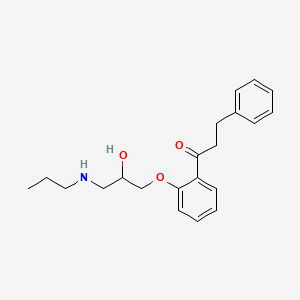
| Formula | C21H27NO3 |
|---|---|
| Molecular weight | 341.45 g/mol |
| IUPAC name | 1-[2-[2-hydroxy-3-(propylamino)propoxy]phenyl]-3-phenylpropan-1-one |
| CAS | 54063-53-5 |
| PubChem CID | 4932 |
| InChIKey | JWHAUXFOSRPERK-UHFFFAOYSA-N |
| logP | 3.24 (XLogP 3.3) |
| Polar surface area | 58.56 Ų |
| H-bond acceptors / donors | 4 / 2 |
| Drug-likeness (QED) | 0.49 |
| Lipinski violations | 0 |
SMILES
CCCNCC(O)COc1ccccc1C(=O)CCc1ccccc1Biology & Pharmacokinetics
Pharmacokinetics
| BBB penetrant | No |
|---|
Enzyme interactions
| Enzyme | Role | Detail |
|---|---|---|
| CYP1A2 | Inhibitor | IC₅₀ 3.2920000000000007 µM |
| CYP1A2 | Substrate | — |
| CYP2C19 | Substrate | — |
| CYP2D6 | Inhibitor | IC₅₀ 4.603399999999999 µM |
| CYP2D6 | Substrate | — |
| CYP3A4 | Inhibitor | — |
| CYP3A4 | Substrate | — |
Receptor binding (top 2)
| Target | Action | Affinity |
|---|---|---|
| β2-adrenoceptor (ADRB2) | Antagonist | pKi 7.4 |
| β1-adrenoceptor (ADRB1) | Antagonist | pKi 6.7 |
Transporters
ASBT (Inhibitor)BCRP (Inhibitor)BCRP (Inhibitor)BSEP (Inhibitor)BSEP (Inhibitor)MDR1 (Inhibitor)MRP1 (Inhibitor)MRP2 (Inhibitor)MRP3 (Inhibitor)MRP4 (Inhibitor)NTCP (Inhibitor)OATP1B1 (Inhibitor)OATP1B3 (Inhibitor)OATP1B3 (Inhibitor)OCT1 (Inhibitor)OCT2 (Inhibitor)OCTN1 (Inhibitor)P-gp (Inhibitor)OCT1 (Substrate)P-gp (Substrate)
Drug–drug interactions (100+, DDInter)
| Interacting drug | Severity | Management |
|---|---|---|
| Anagrelide | major | |
| Arsenic trioxide | major | |
| Betrixaban | major | |
| Cabozantinib | major | |
| Ceritinib | major | |
| Chloroquine | major | |
| Cisapride | major | |
| Cobicistat | major | |
| Crizotinib | major | |
| Dolasetron | major | |
| Eliglustat | major | |
| Fingolimod | major | |
| Halofantrine | major | |
| Hydroxychloroquine | major | |
| Ivosidenib | major | |
| Lumefantrine | major | |
| Macimorelin | major | |
| Nilotinib | major | |
| Osimertinib | major | |
| Ozanimod | major | |
| Panobinostat | major | |
| Papaverine | major | |
| Pasireotide | major | |
| Pazopanib | major | |
| Ribociclib | major | |
| Siponimod | major | |
| Tamoxifen | major | |
| Toremifene | major | |
| Vandetanib | major | |
| Vemurafenib | major | |
| Venetoclax | major | |
| Abarelix | moderate | |
| Abiraterone | moderate | |
| Adalimumab | moderate | |
| Alectinib | moderate | |
| Alefacept | moderate | |
| Alimemazine | moderate | |
| Alosetron | moderate | |
| Aminophylline | moderate | |
| Anakinra | moderate |
Showing 40 of 100+.
Registered Products (2)
| Brand | Form / strength | Pack | Agent | Citizen (JOD) |
|---|---|---|---|---|
| RYTMONORM | Tablet 150 mg | 50 tab | Sukhtian Group | 5.840 |
| RYTMONORM | Tablet 300 mg | 50 tab | Sukhtian Group | 12.030 |