Rasagiline
JFDA label: Parcalin 1mg
Mechanism of Action
Potent, irreversible and selective inhibitor of brain monoamine oxidase (MAO) type B, which plays a major role in the catabolism of dopamine. Inhibition of dopamine depletion in the striatal region of the brain reduces the symptomatic motor deficits of Parkinson’s disease. There is also experimental evidence of rasagiline conferring neuroprotective effects (antioxidant, antiapoptotic), which may delay onset of symptoms and progression of neuronal deterioration.
Indications
Approved
- Parkinson disease
Contraindications
Source: Lexicomp
- Concomitant use of an MAO inhibitor (including selective MAO-B inhibitors), meperidine, methadone, propoxyphene, or tramadol within 14 days of rasagiline Absolute
- concomitant use with cyclobenzaprine, dextromethorphan, or St John’s wort Absolute
Adverse Reactions
Cardiac disorders (7)
Very Common hypotension · Orthostatic hypotension
Common angina · bundle branch block · chest pain · increased blood pressure · Peripheral edema
Nervous system disorders (15)
Very Common Headache
Common abnormal dreams · anxiety · ataxia · depression · Dizziness · drowsiness · dystonia · falling · hallucinations · insomnia · malaise · myasthenia · paresthesia · vertigo
Hepatobiliary disorders (1)
Common Liver function tests increased
Renal and urinary disorders (3)
Common Albuminuria · Hematuria · urinary incontinence
Blood and lymphatic system disorders (2)
Common Hemorrhage · leukopenia
Metabolism and nutrition disorders (3)
Common impotence · libido decreased · Weight loss
Gastrointestinal disorders (12)
Very Common Nausea
Common abdominal pain · anorexia · Constipation · diarrhea · dyspepsia · gastroenteritis · gastrointestinal hemorrhage · gingivitis · hernia · vomiting · xerostomia
Skin and subcutaneous tissue disorders (6)
Common alopecia · diaphoresis · ecchymosis · skin carcinoma · Skin rash · vesiculobullous rash
Musculoskeletal and connective tissue disorders (11)
Very Common Dyskinesia
Common abnormal gait · Arthralgia · arthritis · back pain · hyperkinesias · hypertonia · neck pain · neuropathy · tenosynovitis · weakness
Eye disorders (1)
Common Conjunctivitis
Infections and infestations (1)
Common Infection
General disorders and administration site conditions (3)
Very Common Trauma
Common allergic reaction · Fever
Respiratory, thoracic and mediastinal disorders (6)
Common asthma · cough · dyspnea · Flu-like symptoms · rhinitis · upper respiratory tract infection
Dosing
Source: Lexicomp
Warnings & Precautions
Source: Lexicomp
CNS effects
May cause new or worsening mental status and behavioral changes, which may be severe, including paranoid ideation, delusions, hallucinations, confusion, psychotic-like behavior, disorientation, aggressive behavior, agitation, and delirium after starting or increasing the dose of rasagiline. Intense urges to gamble or spend money, increased sexual urges, binge eating, and/or other intense urges, as well as the inability to control these urges, have also been reported. Monitor for these symptoms. If symptoms develop, consider dose reduction or discontinue of therapy.
Dyskinesia
Dyskinesia, exacerbation of preexisting dyskinesia, or increased dopaminergic side effects may occur when used as an adjunct to levodopa. Decreasing the dose of levodopa may mitigate these side effects.
Hypertension
May cause exacerbation of hypertension; monitor for new onset hypertension or hypertension not adequately controlled after starting rasagiline. Medication adjustment may be necessary if blood pressure elevation is sustained.
Melanoma
Risk of melanoma may be increased with rasagiline, although increased risk has been associated with Parkinson’s disease itself; patients should have regular and frequent skin examinations.
Orthostatic hypotension
May cause orthostatic hypotension, particularly in combination with levodopa. Orthostatic hypotension occurs most frequently during the first 2 months of therapy and decreases over time.
Serotonin syndrome/neuroleptic malignant syndrome-like reactions
Serotonin syndrome (SS) has been reported with concomitant antidepressant (eg, SSRI, SNRI, TCA, tetracyclic and triazolopyridine antidepressants) use; concomitant use is not recommended within 14 days of rasagiline administration (within 5 weeks for antidepressants with long half-lives such as fluoxetine). SS has also been reported with concomitant use of MAO inhibitors (including selective MAO-B inhibitors), meperidine, methadone, propoxyphene, and tramadol; concomitant use within 14 days of rasagiline administration is contraindicated. A symptom complex resembling neuroleptic malignant syndrome (NMS) has been reported in association with rapid dose reduction, withdrawal of, or changes in drugs that increase central dopaminergic tone. Identification and differentiation of SS (eg, tremor, myoclonus, agitation) and more severe NMS-like reactions (eg, hyperthermia, muscle rigidity, autonomic instability, mental status changes) can be complex; monitor patients closely for either syndrome. The diagnosis of SS can be made using the Hunter Serotonin Toxicity Criteria (Dunkley, 2003). Discontinue treatment (and any concomitant antidepressants) immediately if signs/symptoms arise.
Somnolence
Somnolence and falling asleep while engaged in activities of daily living (including operation of motor vehicles) have been reported; some cases reported that there were no warning signs for the onset of symptoms. Symptom onset may occur well after initiation of treatment; some events have occurred >1 year after initiation of rasagiline. Prior to treatment initiation, evaluate for factors that may increase these risks such as concomitant sedating medications, the presence of sleep disorders, and concomitant medications that increase rasagiline plasma levels (eg, ciprofloxacin). Monitor for drowsiness or sleepiness. If significant daytime sleepiness or episodes of falling asleep during activities that require active participation occur (eg, driving, conversations, eating), discontinue rasagiline. There is insufficient information to suggest that dose reductions will eliminate these symptoms. If therapy is continued, advise patient to avoid driving and other potentially dangerous activities. Disease-related concerns:
Hepatic impairment
Use with caution in patients with mild hepatic impairment; dose reduction recommended. Avoid use in patients with moderate-to-severe impairment.
Psychotic disorders
Avoidance of use is recommended in patients with major psychotic disorder due to the risk of exacerbating psychosis with an increase in central dopaminergic tone. Many treatments for psychosis that decrease central dopaminergic tone may also decrease the effectiveness of rasagiline. Concurrent drug therapy issues:
Drug-drug interactions
Potentially significant interactions may exist, requiring dose or frequency adjustment, additional monitoring, and/or selection of alternative therapy. Consult drug interactions database for more detailed information. Special populations:
Surgical patients
According to many of the MOA inhibitor manufacturers, use within 10 days prior to elective surgery is contraindicated. The decision to continue or withhold MAO inhibitors must be done in collaboration with the patient's psychiatrist. Currently, an MAO-safe anesthetic technique which excludes the use of meperidine and indirect-acting adrenergic agonists is recommended for patients requiring continued MAO inhibitor therapy (Huyse, 2006). Other warnings/precautions:
Tyramine-containing products
In patients taking recommended doses of rasagiline, dietary restriction of most tyramine-containing products is not necessary; however, certain foods (eg, aged cheeses) may contain high amounts (>150 mg) of tyramine and could lead to hypertensive crisis. Avoid concomitant use with foods high in tyramine. Rasagiline is a selective inhibitor of MAO-B at the recommended doses; however, MAO-B selectivity diminishes in a dose-related manner above the recommended daily doses.
Pregnancy & Lactation
Pregnancy
Adverse effects have been observed in animal reproduction studies.
Lactation
It is not known if rasagiline is excreted in breast milk. The manufacturer recommends caution be exercised when administering rasagiline to nursing women.
Monitoring
| Clinical pearl | Blood pressure; symptoms of parkinsonism; new or worsening mental status and behavioral changes ; somnolence and falling asleep during activities of daily living; skin examination for presence of melanoma (higher incidence in Parkinson’s patients- drug causation not established) |
|---|
Chemistry & Properties
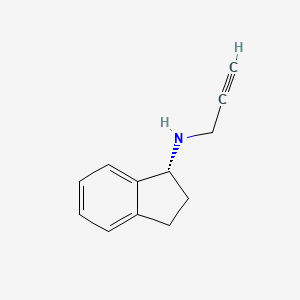
| Formula | C12H13N |
|---|---|
| Molecular weight | 171.24 g/mol |
| IUPAC name | (1R)-N-prop-2-ynyl-2,3-dihydro-1H-inden-1-amine |
| CAS | 136236-51-6 |
| PubChem CID | 3052776 |
| InChIKey | RUOKEQAAGRXIBM-GFCCVEGCSA-N |
| logP | 1.9 (XLogP 1.8) |
| Polar surface area | 12.03 Ų |
| H-bond acceptors / donors | 1 / 1 |
| Drug-likeness (QED) | 0.67 |
| Lipinski violations | 0 |
SMILES
C#CCN[C@@H]1CCc2ccccc21Biology & Pharmacokinetics
Pharmacokinetics
| BBB penetrant | Yes |
|---|
Enzyme interactions
| Enzyme | Role | Detail |
|---|---|---|
| CYP1A2 | Inhibitor | — |
| CYP1A2 | Substrate | — |
| CYP2C19 | Inhibitor | — |
| CYP2C19 | Substrate | — |
| CYP2C9 | Inhibitor | — |
| CYP2D6 | Inhibitor | — |
| CYP3A4 | Substrate | — |
Receptor binding (top 1)
| Target | Action | Affinity |
|---|---|---|
| Monoamine oxidase B (MAOB) | Inhibitor | pIC50 7.8 |
Transporters
BCRP (Inhibitor)BSEP (Inhibitor)BSEP (Inhibitor)MRP1 (Inhibitor)MRP2 (Inhibitor)MRP3 (Inhibitor)MRP4 (Inhibitor)OATP1B1 (Inhibitor)OATP1B3 (Inhibitor)P-gp (Inhibitor)P-gp (Substrate)
Drug–drug interactions (100+, DDInter)
| Interacting drug | Severity | Management |
|---|---|---|
| Bupropion | major | |
| Codeine | major | |
| Deferasirox | major | |
| Dexfenfluramine | major | |
| Dextromethorphan | major | |
| Doxepin | major | |
| Doxepin (topical) | major | |
| Fenfluramine | major | |
| Iobenguane (I-131) | major | |
| Methoxsalen | major | |
| Methylene blue | major | |
| Morphine | major | |
| Morphine (liposomal) | major | |
| Osilodrostat | major | |
| Ozanimod | major | |
| Pentoxyverine | major | |
| Procarbazine | major | |
| Rucaparib | major | |
| Sibutramine | major | |
| Thiabendazole | major | |
| Ticlopidine | major | |
| Vemurafenib | major | |
| Acetohexamide | moderate | |
| Aldesleukin | moderate | |
| Alimemazine | moderate | |
| Amyl Nitrite | moderate | |
| Anagrelide | moderate | |
| Azatadine | moderate | |
| Azelastine (nasal) | moderate | |
| Brimonidine (ophthalmic) | moderate | |
| Brimonidine (topical) | moderate | |
| Brompheniramine | moderate | |
| Caffeine | moderate | |
| Carbinoxamine | moderate | |
| Chlorcyclizine | moderate | |
| Chlorphenesin | moderate | |
| Chlorpheniramine | moderate | |
| Chlorpropamide | moderate | |
| Cimetidine | moderate | |
| Clemastine | moderate |
Showing 40 of 100+.
Registered Products (5)
| Brand | Form / strength | Pack | Agent | Citizen (JOD) |
|---|---|---|---|---|
| Ralzyo | Tablet 0.5 mg | 30 tab | / UNITED PHARM.MFG.CO.LTD(UPM)/JORDAN / General | 9.390 |
| Ralzyo | Tablet 1 mg | 30 tab | UNITED PHARM.MFG.CO.LTD(UPM)/JORDAN | 15.490 |
| Parcalin | Tablet 1 mg | 28 tab pack varies | AL-TAQADDOM PHARMACEUTICAL INDUSTRIES/JORDAN | 20.640 |
| Parcalin | Tablet 1 mg | 30 tab pack varies | AL-TAQADDOM PHARMACEUTICAL INDUSTRIES/JORDAN | 22.110 |
| Razarem | Tablet 1 mg | 30 tab | JAWEDA INT. DRUD STORE | 44.160 |