Rotigotine
JFDA label: Neupro 4mg/24Hr Transdermal Patch
Mechanism of Action
Agonist of D2-like dopamine receptor — D2-like dopamine receptor agonist
| Target | Action | Gene / class |
|---|---|---|
| D2-like dopamine receptor efficacy | AGONIST |
Indications
Approved
- Parkinson disease
- Restless legs syndrome
Contraindications
Source: Lexicomp
- Hypersensitivity to rotigotine or any component of the formulation Absolute
Adverse Reactions
Cardiac disorders (8)
Very Common peripheral edema · Systolic hypotension
Common abnormal T waves on ECG · atrioventricular block · hypertension · Increased diastolic blood pressure · syncope · systolic hypertension
Nervous system disorders (17)
Very Common dizziness · Drowsiness · fatigue · hallucination · headache · insomnia · malaise · orthostatic hypotension · sleep disorder
Common Abnormal dreams · depression · equilibrium disturbance · irritability · narcolepsy · nightmares · paresthesia · vertigo
Renal and urinary disorders (2)
Common Change in WBC count · Increased blood urea nitrogen
Blood and lymphatic system disorders (4)
Very Common Decreased hematocrit · decreased hemoglobin
Common Basal cell carcinoma · leukocyturia
Metabolism and nutrition disorders (6)
Very Common Decreased serum glucose
Common change in libido · hot flash · low serum ferritin · menstrual disorder · Weight gain
Gastrointestinal disorders (8)
Very Common Nausea · vomiting
Common anorexia · Constipation · diarrhea · dyspepsia · viral gastroenteritis · xerostomia
Skin and subcutaneous tissue disorders (3)
Very Common Hyperhidrosis
Common erythema · Pruritus
Musculoskeletal and connective tissue disorders (5)
Very Common arthralgia · Dyskinesia · weakness
Common muscle spasm · Tremor
Eye disorders (1)
Common Visual disturbance
Ear and labyrinth disorders (1)
Common Tinnitus
Infections and infestations (1)
Common Herpes simplex infection
General disorders and administration site conditions (2)
Very Common Application site reaction
Common Hiccups
Respiratory, thoracic and mediastinal disorders (5)
Common cough · nasal congestion · Nasopharyngitis · sinus congestion · sinusitis
Dosing
Source: Lexicomp
Warnings & Precautions
Source: Lexicomp
Application site reactions
Dose-dependent application site reactions, potentially severe, have been observed; daily rotation of application sites has been shown to decrease incidence of reactions. If a generalized (nonapplication site) skin reaction occurs; discontinue therapy.
Fibrosis
Rare cases of pleural effusion, pleural thickening, pulmonary infiltrates, retroperitoneal fibrosis, pericarditis and/or cardiac valvulopathy have been reported in patients treated with ergot-derived dopamine agonists. The potential of rotigotine, a nonergot derived dopamine agonist, to cause similar fibrotic complications is unknown. Discontinuation of therapy may resolve complications, but not in all cases.
Fluid retention
Weight gain and fluid retention have been reported, primarily associated with development of peripheral edema in Parkinson disease patients; use caution and monitor for weight gain in patients with concomitant illnesses (eg, heart failure or renal insufficiency).
Hallucinations/psychotic-like behavior
May cause hallucinations (dose-related) and other psychotic-like behaviors (eg, agitation, delirium, delusions, aggression). In general, avoid use in patients with preexisting major psychotic disorders.
Impulse control disorders
Dopamine agonists used for Parkinson disease or restless legs syndrome have been associated with compulsive behaviors and/or loss of impulse control, which has manifested as pathological gambling, libido increases (hypersexuality), and/or binge eating. Causality has not been established, and controversy exists as to whether this phenomenon is related to the underlying disease, prior behaviors/addictions and/or drug therapy. Dose reduction or discontinuation of therapy has been reported to reverse these behaviors in some, but not all cases.
Melanoma
Risk for melanoma development is increased in Parkinson disease patients; drug causation or factors contributing to risk have not been established. Patients receiving therapy for any indication should be monitored closely and periodic skin examinations should be performed.
Orthostatic hypotension
Dopamine agonists may cause orthostatic hypotension and syncope; Parkinson disease patients appear to have an impaired capacity to respond to a postural challenge. Use with caution in patients at risk of hypotension (such as those receiving antihypertensive drugs) or where transient hypotensive episodes would be poorly tolerated (cardiovascular disease or cerebrovascular disease). Parkinson and RLS patients being treated with dopaminergic agonists ordinarily require careful monitoring for signs and symptoms of postural hypotension, especially during dose escalation, and should be informed of this risk.
Somnolence
Use is commonly associated with somnolence. In addition, falling asleep during activities of daily living, including while driving, has also been reported and may occur without significant warning signs. Monitor for daytime somnolence or pre-existing sleep disorder. Patients must be cautioned about performing tasks which require mental alertness (eg, operating machinery or driving). Use with caution in patients receiving other CNS depressants or psychoactive agents; discontinue if significant daytime sleepiness or episodes of falling asleep occur. Effects with other sedative drugs or ethanol may be potentiated. Disease-related concerns:
Cardiovascular disease
Use with caution in patients with pre-existing cardiovascular disease; therapy has been associated with increases in blood pressure (as well as orthostatic hypotension), which may be significant (>40 mm Hg or ≥20 mm Hg increase in systolic or diastolic measurements, respectively), increased heart rate, syncope, and weight gain/fluid retention.
Dyskinesia
Use with caution in patients with preexisting dyskinesia; therapy may cause or exacerbate dyskinesia. Special populations:
Restless legs syndrome
Augmentation (earlier onset of symptoms each day and/or an overall increase in symptom severity) may occur in some restless leg syndrome (RLS) patients. Risk factors for dopaminergic-induced augmentation include higher doses of dopaminergic agents, use of shorter-acting dopamine agonists (ie, pramipexole, ropinirole) or levodopa, low iron stores, and increased severity of symptoms prior to treatment initiation. To minimize risk of augmentation, use the lowest effective dose and avoid exceeding recommended doses. Patients may also be switched to alternative therapy if augmentation occurs (Garcia-Borreguero 2016). End-of-dose rebound (reappearance of symptoms in the early morning hours) may also occur. Consider dosage adjustment or discontinuation of treatment if rebound symptoms occur. Dosage form specific issues:
Aluminum
Patch contains aluminum; remove patch prior to magnetic resonance imaging or cardioversion to avoid skin burns.
Heat application
Avoid exposure of application site to any direct external heat sources (eg, hair dryers, heating pads, electric blankets, saunas, hot tubs, direct sunlight); heat exposure has not been studied with the rotigotine patch, but an increase in the rate and extent of absorption has been observed with other transdermal products.
Sulfites
Patch contains sodium metabisulfite which may cause allergic reaction in susceptible individuals. Other warnings/precautions:
Discontinuation of therapy
Taper treatment when discontinuing therapy; do not stop abruptly. Other dopaminergic agents have been associated with a syndrome resembling neuroleptic malignant syndrome on withdrawal and/or significant dosage reduction.
Pregnancy & Lactation
Pregnancy
Adverse events have been observed in animal reproduction studies.
Lactation
It is not known if rotigotine is excreted in breast milk. Rotigotine decreases prolactin secretion and lactation may be inhibited. The manufacturer recommends that caution be exercised when administering rotigotine to nursing women.
Monitoring
| Clinical pearl | Blood pressure (including orthostatic); daytime alertness; periodic skin evaluations (melanoma development) |
|---|
Chemistry & Properties
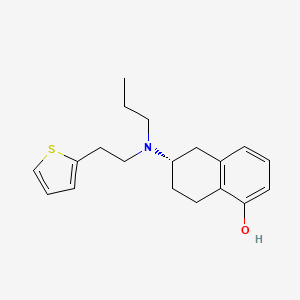
| Formula | C19H25NOS |
|---|---|
| Molecular weight | 315.48 g/mol |
| IUPAC name | (6S)-6-[propyl(2-thiophen-2-ylethyl)amino]-5,6,7,8-tetrahydronaphthalen-1-ol |
| CAS | 99755-59-6 |
| PubChem CID | 59227 |
| InChIKey | KFQYTPMOWPVWEJ-INIZCTEOSA-N |
| logP | 4.27 (XLogP 4.9) |
| Polar surface area | 23.47 Ų |
| H-bond acceptors / donors | 3 / 1 |
| Drug-likeness (QED) | 0.86 |
| Lipinski violations | 0 |
SMILES
CCCN(CCc1cccs1)[C@H]1CCc2c(O)cccc2C1Biology & Pharmacokinetics
Pharmacokinetics predicted
| Bioavailability | 70.0% |
|---|---|
| Half-life | 0.293 h |
| Volume of distribution | 5.895 L/kg |
| Protein binding | 90.2% |
| BBB penetrant | Yes |
Enzyme interactions
| Enzyme | Role | Detail |
|---|---|---|
| CYP1A2 | Inhibitor | — |
| CYP1A2 | Substrate | — |
| CYP2B6 | Inhibitor | — |
| CYP2C19 | Inhibitor | — |
| CYP2C8 | Inhibitor | — |
| CYP2D6 | Inhibitor | — |
| CYP2D6 | Substrate | — |
| CYP3A4 | Substrate | — |
Receptor binding (top 5)
| Target | Action | Affinity |
|---|---|---|
| D2 receptor (DRD2) | Agonist | pKi 10.2 |
| D3 receptor (DRD3) | Agonist | pKi 8.4 |
| D4 receptor (DRD4) | Agonist | pKi 7.3 |
| D5 receptor (DRD5) | Agonist | pKi 6.0 |
| D1 receptor (DRD1) | Agonist | pKi 5.6 |
Transporters
BCRP (Inhibitor)BSEP (Inhibitor)MDR1 (Inhibitor)MRP1 (Inhibitor)OATP1B1 (Inhibitor)OATP1B3 (Inhibitor)P-gp (Inhibitor)MDR1 (Substrate)P-gp (Substrate)
Drug–drug interactions (46, DDInter)
| Interacting drug | Severity | Management |
|---|---|---|
| Alimemazine | moderate | |
| Azatadine | moderate | |
| Azelastine (nasal) | moderate | |
| Brimonidine (ophthalmic) | moderate | |
| Brimonidine (topical) | moderate | |
| Brompheniramine | moderate | |
| Carbinoxamine | moderate | |
| Cetirizine | moderate | |
| Chlorphenesin | moderate | |
| Chlorpheniramine | moderate | |
| Clemastine | moderate | |
| Clofedanol | moderate | |
| Codeine | moderate | |
| Cyclizine | moderate | |
| Cyproheptadine | moderate | |
| Dexbrompheniramine | moderate | |
| Dextromethorphan | moderate | |
| Difenoxin | moderate | |
| Diphenhydramine | moderate | |
| Diphenoxylate | moderate | |
| Doxepin | moderate | |
| Doxepin (topical) | moderate | |
| Doxylamine | moderate | |
| Dronabinol | moderate | |
| Ethanol | moderate | |
| Hydrocodone | moderate | |
| Ioflupane I-123 | moderate | |
| Levocetirizine | moderate | |
| Meclizine | moderate | |
| Mepyramine | moderate | |
| Methdilazine | moderate | |
| Metoclopramide | moderate | |
| Morphine | moderate | |
| Morphine (liposomal) | moderate | |
| Nabilone | moderate | |
| Olopatadine (nasal) | moderate | |
| Opium | moderate | |
| Pentoxyverine | moderate | |
| Phenindamine | moderate | |
| Promethazine | moderate |
Showing 40 of 46.
Registered Products (2)
| Brand | Form / strength | Pack | Agent | Citizen (JOD) |
|---|---|---|---|---|
| Neupro 4mg/24Hr Transdermal Patch | Patch 4 mg/24h | 28 | ORIENT DRUG STORE CO | 80.110 |
| Neupro 6mg/24 Hr Transdermal Patch | Patch 6 mg/24h | 28 | ORIENT DRUG STORE CO | 80.110 |