Sorafenib
JFDA label: Nexavar
Mechanism of Action
Multikinase inhibitor; inhibits tumor growth and angiogenesis by inhibiting intracellular Raf kinases (CRAF, BRAF, and mutant BRAF), and cell surface kinase receptors (VEGFR-1, VEGFR-2, VEGFR-3, PDGFR-beta, cKIT, FLT-3, RET, and RET/PTC)
Indications
Approved
- Hepatocellular cancer
- Renal cell cancer, advanced
- Thyroid cancer, differentiated
Off-label
- Angiosarcoma, recurrent or metastatic
- Gastrointestinal stromal tumor, resistant
Class profile
| mechanismClass | Multi-kinase inhibitor (TKI) |
|---|---|
| targetMolecule | RAF,VEGFR,PDGFR,KIT,FLT3 |
| targetPathway | RAS/RAF/MAPK + angiogenesis |
| generation | 1st generation multi-kinase |
| primaryTumors | HCC,RCC,Thyroid |
| resistanceMechanisms | RAS/MEK mutations downstream,VEGFR upregulation of bypass,FGF/Ang-2 compensation |
| source | NCCN/OncoKB/Goodman&Gilman13ed |
Contraindications
Source: Lexicomp
- Known severe hypersensitivity to sorafenib or any component of the formulation Absolute
- use in combination with carboplatin and paclitaxel in patients with squamous cell lung cancer Absolute
Adverse Reactions
Cardiac disorders (4)
Very Common Hypertension, headache, mouth pain, voice disorder, peripheral sensory neuropathy, pain
Common cardiac failure · flushing · Ischemic heart disease
Nervous system disorders (2)
Common Depression · glossalgia
Hepatobiliary disorders (4)
Very Common hepatic insufficiency · Increased serum ALT · increased serum AST
Common Increased serum transaminases (transient)
Renal and urinary disorders (3)
Common Erectile dysfunction · proteinuria · Renal failure
Blood and lymphatic system disorders (2)
Common anemia · Squamous cell carcinoma of skin
Metabolism and nutrition disorders (8)
Very Common Hypoalbuminemia · hypocalcemia · hypophosphatemia · increased amylase · weight loss
Common Hypokalemia · hyponatremia · hypothyroidism
Gastrointestinal disorders (7)
Very Common Diarrhea, thrombocytopenia, increased INR, neutropenia, hemorrhage, leukopenia
Common Dysgeusia · dyspepsia · dysphagia · gastroesophageal reflux disease · mucositis · xerostomia
Skin and subcutaneous tissue disorders (10)
Very Common alopecia · erythema · Palmar-plantar erythrodysesthesia · pruritus · skin rash · xeroderma
Common acne vulgaris · exfoliative dermatitis · folliculitis · Hyperkeratosis
Musculoskeletal and connective tissue disorders (5)
Very Common Limb pain · myalgia · weakness
Common arthralgia · Muscle spasm
Infections and infestations (1)
Very Common Infection
General disorders and administration site conditions (1)
Very Common Fever
Respiratory, thoracic and mediastinal disorders (6)
Very Common cough · Dyspnea
Common Epistaxis · flu-like symptoms · hoarseness · rhinorrhea
Dosing
Source: Lexicomp
Warnings & Precautions
Source: Lexicomp
Bleeding
Increased risk of bleeding may occur; consider permanently discontinuing with serious bleeding events (eg, requires medical intervention). Fatal bleeding events have been reported. Thyroid cancer patients with tracheal, bronchial, and esophageal infiltration should be treated with local therapy prior to administering sorafenib due to the potential bleeding risk.
Cardiac ischemia/infarction
May cause cardiac ischemia or infarction; consider discontinuation (temporary or permanent) in patients who develop these conditions. Use in patients with unstable coronary artery disease or recent myocardial infarction has not been studied.
Dermatologic toxicity
Hand-foot skin reaction and rash (generally grades 1 or 2) are the most common drug-related adverse events, and typically appear within the first 6 weeks of treatment; usually managed with topical treatment, treatment delays, and/or dose reductions. Consider permanently discontinuing with severe or persistent dermatological toxicities. The risk for hand-foot skin reaction increased with cumulative doses of sorafenib (Azad 2009). Severe dermatologic toxicities, including Stevens-Johnson syndrome (SJS) and toxic epidermal necrolysis (TEN), have been reported; may be life-threatening. Discontinue sorafenib for suspected SJS or TEN. The following treatments may be used to manage hand-foot skin reaction in addition to the recommended dosage modifications (Lacouture 2008): Prior to treatment initiation, a pedicure is recommended to remove hyperkeratotic areas/calluses, which may predispose to HFSR; avoid vigorous exercise/activities which may stress hands or feet. During therapy, patients should reduce exposure to hot water (may exacerbate hand-foot symptoms); avoid constrictive footwear and excessive skin friction. Patients may also wear thick cotton gloves or socks and should wear shoes with padded insoles. Grade 1 HFSR may be relieved with moisturizing creams, cotton gloves and socks (at night) and/or keratolytic creams such as urea (20% to 40%) or salicylic acid (6%). Apply topical steroid (eg, clobetasol ointment) twice daily to erythematous areas of grade 2 HFSR; topical anes
Gastrointestinal perforation
Gastrointestinal perforation has been reported (rare); monitor patients for signs/symptoms (abdominal pain, constipation, or vomiting); discontinue treatment if gastrointestinal perforation occurs.
Hypertension
May cause hypertension (generally mild-to-moderate), especially in the first 6 weeks of treatment; monitor. Use caution in patients with underlying or poorly-controlled hypertension. Consider discontinuing (temporary or permanent) in patients who develop severe or persistent hypertension while on appropriate antihypertensive therapy.
QT prolongation
QT prolongation has been observed; may increase the risk for ventricular arrhythmia. Avoid use in patients with congenital long QT syndrome. Monitor electrolytes and ECG in patients with heart failure, bradyarrhythmias, and concurrent medications know to prolong the QT interval. Correct electrolyte (calcium, magnesium, potassium) imbalances. Interrupt treatment for QTc interval >500 msec or for ≥60 msec increase from baseline.
Thyroid impairment
Sorafenib impairs exogenous thyroid suppression. TSH level elevations were commonly observed in the thyroid cancer study; monitor TSH levels monthly and as clinically necessary, and adjust thyroid replacement as needed.
Wound healing complications
May complicate wound healing; temporarily withhold treatment for patients undergoing major surgical procedures. The appropriate timing to resume sorafenib after major surgery has not been determined. Disease-related concerns:
Heart failure
In a scientific statement from the American Heart Association, sorafenib has been determined to be an agent that may exacerbate underlying myocardial dysfunction (magnitude: minor) (AHA [Page 2016]).
Hepatic impairment
Sorafenib levels in patients with mild-to-moderate hepatic impairment (Child-Pugh classes A and B) were similar to levels observed in patients without hepatic impairment. Not studied in patients with severe hepatic impairment (Child-Pugh class C). In a small study of Asian patients with advanced HCC, sorafenib demonstrated efficacy with adequate tolerability in a hepatitis B-endemic area (Yau 2009). There have been reports of sorafenib-induced hepatitis (including hepatic failure and death) which is characterized by hepatocellular liver damage and transaminase increases (significant); increased bilirubin and INR may also occur. Monitor hepatic function regularly; discontinue sorafenib for unexplained significant transaminase increases. Concurrent drug therapy issues:
Drug-drug interactions
Potentially significant interactions may exist, requiring dose or frequency adjustment, additional monitoring, and/or selection of alternative therapy. Consult drug interactions database for more detailed information. Avoid concurrent use with strong CYP3A4 inducers (eg, carbamazepine, dexamethasone, phenobarbital, phenytoin, rifampin, St John’s wort); may decrease sorafenib levels/effects. Use caution when administering sorafenib with compounds that are metabolized predominantly via UGT1A1 (eg, irinotecan). The incidence of hand-foot skin reaction is increased in patients treated with sorafenib plus bevacizumab in comparison to those treated with sorafenib monotherapy (Azad 2009). Use in combination with carboplatin and paclitaxel in patients with squamous cell lung cancer is contraindicated. Monitor PT/INR in patients on warfarin therapy due to potential for bleeding events to occur.
Pregnancy & Lactation
Pregnancy
Animal reproduction studies have demonstrated teratogenicity and fetal loss. Based on its mechanism of action and because sorafenib inhibits angiogenesis, a critical component of fetal development, adverse effects on pregnancy would be expected. Women of childbearing potential should be advised to avoid pregnancy. Men and women of reproductive potential should use effective birth control during treatment and for at least 2 weeks after treatment is discontinued.
Lactation
It is not known if sorafenib is present in breast milk. Due to the potential for serious adverse reactions in the breastfed infant, a decision should be made to discontinue sorafenib or to discontinue breastfeeding during therapy, taking into account the importance of treatment to the mother.
Monitoring
| Efficacy | Tumour response (RECIST criteria, tumour markers, imaging); progression-free survival; performance status (ECOG/Karnofsky) |
|---|---|
| Toxicity | CBC with differential (nadir timing depends on agent); LFTs; renal function; ECG (QT for relevant agents); echocardiogram for cardiotoxic agents (anthracyclines, trastuzumab); cumulative dose tracking for dose-limited toxicities |
| Clinical pearl | Treatment response is assessed after 2–3 cycles. Grade 3–4 toxicities typically require dose reduction or interruption per protocol-defined criteria. |
| Counseling | Attend all scheduled blood tests and imaging appointments. Report fever > 38°C (risk of neutropaenic sepsis — medical emergency), unusual bleeding, or new pain immediately. |
Chemistry & Properties
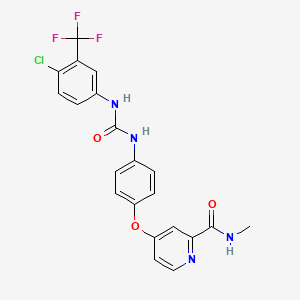
| Formula | C21H16ClF3N4O3 |
|---|---|
| Molecular weight | 464.83 g/mol |
| IUPAC name | 4-[4-[[4-chloro-3-(trifluoromethyl)phenyl]carbamoylamino]phenoxy]-N-methylpyridine-2-carboxamide |
| CAS | 284461-73-0 |
| PubChem CID | 216239 |
| InChIKey | MLDQJTXFUGDVEO-UHFFFAOYSA-N |
| logP | 5.55 (XLogP 4.1) |
| Polar surface area | 92.35 Ų |
| H-bond acceptors / donors | 4 / 3 |
| Drug-likeness (QED) | 0.46 |
| Lipinski violations | 1 |
SMILES
CNC(=O)c1cc(Oc2ccc(NC(=O)Nc3ccc(Cl)c(C(F)(F)F)c3)cc2)ccn1Biology & Pharmacokinetics
Pharmacokinetics
| BBB penetrant | Yes |
|---|
Enzyme interactions
| Enzyme | Role | Detail |
|---|---|---|
| CYP1A2 | Inhibitor | — |
| CYP1A2 | Substrate | — |
| CYP2B6 | Inhibitor | — |
| CYP2C19 | Inhibitor | — |
| CYP2C8 | Inhibitor | — |
| CYP2C9 | Inhibitor | — |
| CYP3A4 | Substrate | — |
Receptor binding (top 30)
| Target | Action | Affinity |
|---|---|---|
| Raf-1 proto-oncogene, serine/threonine kinase (RAF1) | Inhibitor | pIC50 8.2 |
| discoidin domain receptor tyrosine kinase 2 (DDR2) | Inhibitor | pIC50 8.0 |
| ret proto-oncogene (RET) | Inhibitor | pIC50 7.9 |
| Fms-related tyrosine kinase 4 (FLT4) | Binding | pKi 7.8 |
| Fms-related tyrosine kinase 3 (FLT3) | Binding | pKi 7.7 |
| B-Raf proto-oncogene, serine/threonine kinase (BRAF) | Inhibitor | pIC50 7.7 |
| Platelet-derived growth factor receptor, beta polypeptide (PDGFRB) | Binding | pKi 7.4 |
| fms related receptor tyrosine kinase 3 (FLT3) | Inhibitor | pIC50 7.2 |
| platelet derived growth factor receptor beta (PDGFRB) | Inhibitor | pIC50 7.2 |
| kinase insert domain receptor (KDR) | Inhibitor | pKd 7.2 |
| KIT proto-oncogene, receptor tyrosine kinase (KIT) | Inhibitor | pIC50 7.2 |
| kinase insert domain receptor (KDR) | Inhibitor | pIC50 7.1 |
| Kinase insert domain receptor (a type III receptor tyrosine kinase) (KDR) | Binding | pKi 7.0 |
| cyclin dependent kinase 8 (CDK8) | Inhibitor | pKd 7.0 |
| cyclin dependent kinase 19 (CDK19) | Inhibitor | pKd 7.0 |
Transporters
BCRP (Inhibitor)BCRP (Inhibitor)BSEP (Inhibitor)BSEP (Inhibitor)MATE1 (Inhibitor)MATE2 (Inhibitor)MDR1 (Inhibitor)MRP1 (Inhibitor)MRP2 (Inhibitor)MRP4 (Inhibitor)NTCP (Inhibitor)OAT3 (Inhibitor)OATP1A2 (Inhibitor)OATP1B1 (Inhibitor)OATP1B1 (Inhibitor)OATP1B3 (Inhibitor)OATP1B3 (Inhibitor)OATP2B1 (Inhibitor)OCT1 (Inhibitor)OCT2 (Inhibitor)OCT3 (Inhibitor)OCTN2 (Inhibitor)P-gp (Inhibitor)BCRP (Substrate)BSEP (Substrate)MDR1 (Substrate)MRP2 (Substrate)MRP3 (Substrate)MRP4 (Substrate)OAT2 (Substrate)OATP1B1 (Substrate)OATP1B3 (Substrate)OATP2B1 (Substrate)OCT(unspecified) (Substrate)OCT1 (Substrate)P-gp (Substrate)Transporter(unspecified) (Substrate)
Drug–drug interactions (100+, DDInter)
| Interacting drug | Severity | Management |
|---|---|---|
| Amiodarone | major | |
| Amisulpride | major | |
| Anagrelide | major | |
| Arsenic trioxide | major | |
| Bedaquiline | major | |
| Bepridil | major | |
| Berotralstat | major | |
| Cabozantinib | major | |
| Carboplatin | major | |
| Ceritinib | major | |
| Chloroquine | major | |
| Cisapride | major | |
| Citalopram | major | |
| Clozapine | major | |
| Colchicine | major | |
| Crizotinib | major | |
| Deferiprone | major | |
| Disopyramide | major | |
| Dofetilide | major | |
| Dolasetron | major | |
| Dronedarone | major | |
| Droperidol | major | |
| Edoxaban | major | |
| Efavirenz | major | |
| Escitalopram | major | |
| Fingolimod | major | |
| Gatifloxacin | major | |
| Grepafloxacin | major | |
| Halofantrine | major | |
| Haloperidol | major | |
| Hydroxychloroquine | major | |
| Ibutilide | major | |
| Iloperidone | major | |
| Ivabradine | major | |
| Ivosidenib | major | |
| Lefamulin | major | |
| Leflunomide | major | |
| Levacetylmethadol | major | |
| Lomitapide | major | |
| Lumefantrine | major |
Showing 40 of 100+.
Registered Products (2)
| Brand | Form / strength | Pack | Agent | Citizen (JOD) |
|---|---|---|---|---|
| Nexavar | Tablet 200 mg | 60 tab | Khoury Drug Store | — |
| Sorafenib Pharmacare | Tablet 200 mg | 60 tab | Sabbagh Drug Store | — |