Talazoparib
JFDA label: Talzenna capsules
Mechanism of Action
Inhibitor of Poly [ADP-ribose] polymerase 1 — Poly [ADP-ribose] polymerase-1 inhibitor; Inhibitor of Poly [ADP-ribose] polymerase 2 — Poly [ADP-ribose] polymerase 2 inhibitor
| Target | Action | Gene / class |
|---|---|---|
| Poly [ADP-ribose] polymerase 1 efficacy | INHIBITOR | PARP1 |
| Poly [ADP-ribose] polymerase 2 efficacy | INHIBITOR | PARP2 |
Indications
Off-label
- Breast Neoplasms
- Carcinoma, Non-Small-Cell Lung
- Carcinoma, Renal Cell
- Carcinoma, Squamous Cell
- Endometrial Neoplasms
- Glioblastoma
- Hemangiosarcoma
- Hereditary Breast and Ovarian Cancer Syndrome
- Melanoma
- Neoplasms
- Ovarian Neoplasms
- Pheochromocytoma
- Prostatic Neoplasms
- Prostatic Neoplasms, Castration-Resistant
- Small Cell Lung Carcinoma
- Triple Negative Breast Neoplasms
- Urinary Bladder Neoplasms
Contraindications
Source: openFDA
- None. None. ( 4 ) Absolute
Adverse Reactions
Vascular disorders (1)
Common Venous Thromboembolism
Nervous system disorders (1)
Very Common Dizziness
Blood and lymphatic system disorders (8)
Very Common Neutropenia · Resulted In Dose Reduction Of Talzenna Were Anemia · Sulted In Dose Interruption Of Talzenna Were Anemia
Common And Platelet Count Decreased · N Permanent Discontinuation Of Talzenna Were Anemia · Of Patients Included Anemia · Platelet Count Decreased
Uncommon And Febrile Neutropenia
Gastrointestinal disorders (6)
Very Common Dyspepsia · Ients Who Received Talzenna Included Abdominal Pain
Common And Stomatitis · Stomatitis · Talzenna With Enzalutamide Included Abdominal Pain · Vomiting
Skin and subcutaneous tissue disorders (1)
Common Alopecia
Musculoskeletal and connective tissue disorders (1)
Common And Fracture
Investigations (1)
Very Common Neutrophil Count Decreased
General disorders and administration site conditions (3)
Very Common Dysgeusia
Common And Fatigue · And Pyrexia
Dosing
Source: openFDA
Warnings & Precautions
Source: openFDA
Warnings & Precautions
• Myelodysplastic Syndrome/Acute Myeloid Leukemia (MDS/AML) : MDS/AML occurred in patients exposed to TALZENNA, and some cases were fatal. Monitor patients for hematological toxicity and discontinue if MDS/AML is confirmed. ( 5.1 ) • Myelosuppression : TALZENNA may affect hematopoiesis and can cause anemia, neutropenia, and/or thrombocytopenia. ( 5.2 ) • Embryo-Fetal Toxicity : TALZENNA can cause fetal harm. Advise of the potential risk to the fetus and to use effective contraception. ( 5.3 , 8.1 , 8.3 )
Myelodysplastic Syndrome/Acute Myeloid Leukemia Myelodysplastic Syndro
Myelodysplastic Syndrome/Acute Myeloid Leukemia Myelodysplastic Syndrome/Acute Myeloid Leukemia (MDS/AML), including cases with a fatal outcome, has been reported in patients who received TALZENNA. Overall, MDS/AML has been reported in 0.4% (3 out of 788) of solid tumor patients treated with TALZENNA as a single agent in clinical studies. In TALAPRO-2, MDS/AML occurred in 2 out of 511 (0.4%) patients treated with TALZENNA and enzalutamide and in 0 out of 517 (0%) patients treated with placebo and enzalutamide [see Adverse Reactions (6.1) ] . The durations of TALZENNA treatment in these five patients prior to developing MDS/AML were 0.3, 1, 2, 3, and 5 years, respectively. Most of these patients had received previous chemotherapy with platinum agents and/or other DNA damaging agents including radiotherapy. Do not start TALZENNA until patients have adequately recovered from hematological toxicity caused by previous chemotherapy. Monitor blood counts monthly during treatment with TALZENNA. For prolonged hematological toxicities, interrupt TALZENNA and monitor blood counts weekly until recovery. If counts do not recover within 4 weeks, refer the patient to a hematologist for further investigations including bone marrow analysis and blood sample for cytogenetics. If MDS/AML is confirmed, discontinue TALZENNA.
Myelosuppression Myelosuppression consisting of anemia, neutropenia, a
Myelosuppression Myelosuppression consisting of anemia, neutropenia, and/or thrombocytopenia, have been reported in patients treated with TALZENNA [see Adverse Reactions (6.1) ] . Grade ≥3 anemia, neutropenia, and thrombocytopenia were reported, respectively, in 39%, 21%, and 15% of patients receiving TALZENNA as a single agent. Discontinuation due to anemia, neutropenia, and thrombocytopenia occurred, respectively, in 0.7%, 0.3%, and 0.3% of patients. In TALAPRO-2, Grade ≥3 anemia, neutropenia, and thrombocytopenia were reported, respectively, in 45%, 18%, and 8% of patients receiving TALZENNA and enzalutamide. Overall, 39% of patients (199/511) required a red blood cell transfusion, including 22% (111/511) who required multiple transfusions. Discontinuation due to anemia, neutropenia, and thrombocytopenia occurred, respectively, in 7%, 3%, and 0.4% of patients. Withhold TALZENNA until patients have adequately recovered from hematological toxicity caused by previous therapy. Monitor blood counts monthly during treatment with TALZENNA. If hematological toxicities do not resolve within 28 days, discontinue TALZENNA and refer the patient to a hematologist for further investigations including bone marrow analysis and blood sample for cytogenetics [see Dosage and Administration (2.5) ] .
Embryo-Fetal Toxicity Based on its mechanism of action and findings fr
Embryo-Fetal Toxicity Based on its mechanism of action and findings from animal data, TALZENNA can cause fetal harm when administered to a pregnant woman. In an animal reproduction study, administration of talazoparib to pregnant rats during the period of organogenesis caused fetal malformations and structural skeletal variations, and embryo-fetal death at exposures that were 0.24 times the area under the concentration-time curve (AUC) in patients receiving the recommended human dose of 1 mg daily. Apprise pregnant women and females of reproductive potential of the potential risk to a fetus. Advise females of reproductive potential to use effective contraception during treatment and for 7 months following the last dose of TALZENNA [see Use in Specific Populations (8.1 , 8.3) , Clinical Pharmacology (12.1) ] . Based on findings from genetic toxicity and animal reproduction studies, advise male patients with female partners of reproductive potential or who are pregnant to use effective contraception during treatment and for 4 months following the last dose of TALZENNA [see Use in Specific Populations (8.1 , 8.3) , Nonclinical Toxicology (13.1) ] .
Pregnancy & Lactation
Lactation
The manufacturer recommends that breastfeeding be discontinued during talazoparib therapy and for one month after the last dose.
Chemistry & Properties
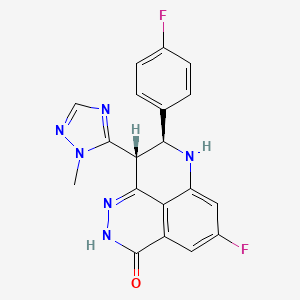
| Formula | C19H14F2N6O |
|---|---|
| Molecular weight | 380.36 g/mol |
| IUPAC name | (11S,12R)-7-fluoro-11-(4-fluorophenyl)-12-(2-methyl-1,2,4-triazol-3-yl)-2,3,10-triazatricyclo[7.3.1.05,13]trideca-1,5(13),6,8-tetraen-4-one |
| CAS | 1207456-01-6 |
| PubChem CID | 135565082 |
| InChIKey | HWGQMRYQVZSGDQ-HZPDHXFCSA-N |
| logP | 2.63 (XLogP 2.3) |
| Polar surface area | 88.49 Ų |
| H-bond acceptors / donors | 6 / 2 |
| Drug-likeness (QED) | 0.56 |
| Lipinski violations | 0 |
SMILES
Cn1ncnc1[C@H]1c2n[nH]c(=O)c3cc(F)cc(c23)N[C@@H]1c1ccc(F)cc1Biology & Pharmacokinetics
Pharmacokinetics
| BBB penetrant | No |
|---|
Enzyme interactions
| Enzyme | Role | Detail |
|---|---|---|
| CYP3A4 | Substrate | — |
Transporters
BCRP (Inhibitor)BCRP (Inhibitor)BSEP (Inhibitor)BSEP (Inhibitor)MATE1 (Inhibitor)MATE2 (Inhibitor)MDR1 (Inhibitor)MRP1 (Inhibitor)OAT1 (Inhibitor)OAT3 (Inhibitor)OATP1B1 (Inhibitor)OATP1B1 (Inhibitor)OATP1B3 (Inhibitor)OCT2 (Inhibitor)P-gp (Inhibitor)BCRP (Substrate)MDR1 (Substrate)P-gp (Substrate)
Drug–drug interactions (100+, DDInter)
| Interacting drug | Severity | Management |
|---|---|---|
| Adalimumab | major | |
| Amiodarone | major | |
| Bacillus calmette-guerin substrain tice live antigen | major | |
| Baricitinib | major | |
| Carvedilol | major | |
| Certolizumab pegol | major | |
| Cladribine | major | |
| Clarithromycin | major | |
| Clozapine | major | |
| Deferiprone | major | |
| Etanercept | major | |
| Fingolimod | major | |
| Golimumab | major | |
| Infliximab | major | |
| Itraconazole | major | |
| Leflunomide | major | |
| Measles virus vaccine live attenuated | major | |
| Mumps virus strain B level jeryl lynn live antigen | major | |
| Natalizumab | major | |
| Ozanimod | major | |
| Rotavirus vaccine | major | |
| Rubella virus vaccine | major | |
| Samarium (153Sm) lexidronam | major | |
| Siponimod | major | |
| Smallpox (Vaccinia) Vaccine, Live | major | |
| Talimogene laherparepvec | major | |
| Teriflunomide | major | |
| Tofacitinib | major | |
| Typhoid vaccine (live) | major | |
| Upadacitinib | major | |
| Varicella Zoster Vaccine (Recombinant) | major | |
| Verapamil | major | |
| Yellow Fever Vaccine | major | |
| Abiraterone | moderate | |
| Afatinib | moderate | |
| Alefacept | moderate | |
| Alemtuzumab | moderate | |
| Alpelisib | moderate | |
| Anakinra | moderate | |
| Anthrax vaccine | moderate |
Showing 40 of 100+.
Registered Products (2)
| Brand | Form / strength | Pack | Agent | Citizen (JOD) |
|---|---|---|---|---|
| Talzenna capsules | Capsule 0.25 mg | 30 cap | Petra Drug Store | — |
| Talzenna capsules | Capsule 1 mg | 30 cap | Petra Drug Store | — |