Temozolomide
Active form: Mtic.
JFDA label: TEMODAL Capsules
Mechanism of Action
Inhibitor of DNA — DNA inhibitor
| Target | Action | Gene / class |
|---|---|---|
| DNA efficacy | INHIBITOR |
Indications
Approved
- Anaplastic astrocytoma
- Glioblastoma multiforme
Off-label
- Anaplastic oligodendroglioma
- Cutaneous T-cell lymphomas, advanced (mycosis fungoides [MF] and Sézary syndrome [SS]
- Ewing’s sarcoma (recurrent or progressive)
- Glioblastoma multiforme, recurrent
- Low-grade astrocytoma
- Low-grade oligodendroglioma
- Melanoma, advanced or metastatic
- Metastatic CNS lesions
- Neuroblastoma (pediatric)
- Neuroendocrine tumors, advanced (carcinoid or islet cell)
- Primary CNS lymphoma, refractory
- Soft tissue sarcomas, extremity/retroperitoneal/intra-abdominal
- Soft tissue sarcomas, hemangiopericytoma/solitary fibrous tumor
Contraindications
Source: Lexicomp
- Additional contraindications (not in U.S. labeling): Not recommended in patients with severe myelosuppression Absolute
- Hypersensitivity (eg, allergic reaction, anaphylaxis, urticaria, Stevens-Johnson syndrome, toxic epidermal necrolysis) to temozolomide or any component of the formulation Absolute
- hypersensitivity to dacarbazine (both drugs are metabolized to MTIC) Absolute
Adverse Reactions
Cardiac disorders (1)
Very Common Peripheral edema
Nervous system disorders (16)
Very Common ataxia · dizziness · Fatigue · headache · hemiparesis · seizure
Common abnormal gait · Amnesia · anxiety · confusion · depression · drowsiness · insomnia · memory impairment · paresis · paresthesia
Renal and urinary disorders (4)
Common mastalgia · urinary frequency · Urinary incontinence · urinary tract infection
Blood and lymphatic system disorders (5)
Very Common leukopenia · Lymphocytopenia · neutropenia · thrombocytopenia
Common Anemia
Immune system disorders (1)
Common Hypersensitivity reaction
Metabolism and nutrition disorders (2)
Common Hypercorticoidism · weight gain
Gastrointestinal disorders (9)
Very Common anorexia · constipation · diarrhea · Nausea · vomiting
Common abdominal pain · dysgeusia · dysphagia · Stomatitis
Skin and subcutaneous tissue disorders (5)
Very Common Alopecia · skin rash
Common erythema · Pruritus · xeroderma
Musculoskeletal and connective tissue disorders (4)
Very Common Weakness
Common arthralgia · Back pain · myalgia
Eye disorders (3)
Common Blurred vision · diplopia · visual disturbance
Infections and infestations (1)
Very Common Viral infection
General disorders and administration site conditions (2)
Very Common Fever
Common Radiation injury
Respiratory, thoracic and mediastinal disorders (5)
Common cough · dyspnea · Pharyngitis · sinusitis · upper respiratory tract infection
Dosing
Source: Lexicomp
Warnings & Precautions
Source: Lexicomp
Bone marrow suppression
Myelosuppression may occur; may require treatment interruption, dose reduction and/or discontinuation; monitor blood counts. An increased incidence has been reported in geriatric and female patients. Prolonged pancytopenia resulting in aplastic anemia has been reported (may be fatal); concurrent use of temozolomide with medications associated with aplastic anemia (eg, carbamazepine, co-trimoxazole, phenytoin) may obscure assessment for development of aplastic anemia. ANC should be ≥1,500/mm3 and platelets ≥100,000/mm3 prior to treatment.
Gastrointestinal toxicity
Temozolomide is associated with a moderate emetic potential (Dupuis 2011; Hesketh 2017; Roila 2016); antiemetics are recommended to prevent nausea and vomiting.
Hepatotoxicity
Hepatotoxicity has been reported; may be severe or fatal. Monitor liver function tests at baseline, halfway through the first cycle, prior to each subsequent cycle, and at ~2 to 4 weeks after the last dose. Postmarketing reports of hepatotoxicity have included liver function abnormalities, hepatitis, hepatic failure, cholestasis, hepatitis cholestasis, jaundice, cholelithiasis, hepatic steatosis, hepatic necrosis, hepatic lesion, and hepatic encephalopathy (Sarganas 2012).
Pneumonia
Pneumocystis jirovecii pneumonia (PCP) may occur; risk is increased in those receiving steroids or longer dosing regimens. Monitor all patients for development of PCP (particularly if also receiving corticosteroids). PCP prophylaxis is required in patients receiving radiotherapy in combination with the 42-day temozolomide regimen.
Secondary malignancies
Rare cases of myelodysplastic syndrome and secondary malignancies, including myeloid leukemia, have been reported. Disease-related concerns:
Hepatic impairment
Use with caution in patients with severe hepatic impairment.
Renal impairment
Use with caution in patients with severe renal impairment; has not been studied in dialysis patients. Concurrent drug therapy issues:
Drug-drug interactions
Potentially significant interactions may exist, requiring dose or frequency adjustment, additional monitoring, and/or selection of alternative therapy. Consult drug interactions database for more detailed information. Dosage form specific issues:
Polysorbate 80
Some dosage forms may contain polysorbate 80 (also known as Tweens). Hypersensitivity reactions, usually a delayed reaction, have been reported following exposure to pharmaceutical products containing polysorbate 80 in certain individuals (Isaksson 2002; Lucente 2000; Shelley 1995). Thrombocytopenia, ascites, pulmonary deterioration, and renal and hepatic failure have been reported in premature neonates after receiving parenteral products containing polysorbate 80 (Alade 1986; CDC 1984). See manufacturer’s labeling. Other warnings/precautions:
Infusion time
Bioequivalence has only been established when IV temozolomide is administered over 90 minutes; shorter or longer infusion times may result in suboptimal dosing.
Temozolomide resistance
Increased MGMT (O-6-methylguanine-DNA methyltransferase) activity/levels within tumor tissue is associated with temozolomide resistance. Glioblastoma patients with decreased levels (due to methylated MGMT promoter) may be more likely to benefit from the combination of radiation therapy and temozolomide (Hegi 2008; Stupp 2009). Determination of MGMT status may be predictive for response to alkylating agents.
Pregnancy & Lactation
Pregnancy
Adverse events were observed in animal reproduction studies. May cause fetal harm when administered to pregnant women. Male and female patients should avoid pregnancy while receiving temozolomide.
Lactation
It is not known if temozolomide is excreted in breast milk. Due to the potential for serious adverse reactions in the nursing infant, the manufacturer recommends a decision be made whether to discontinue nursing or to discontinue the drug, taking into account the importance of treatment to the mother.
Monitoring
| Clinical pearl | CBC with differential and platelets (prior to each cycle; weekly during glioma concomitant phase treatment; at or within 48 hours of day 22 and weekly until ANC >1,500/mm3 and platelets >100,000/mm3 for glioma maintenance and astrocytoma treatment). Monitor liver function tests at baseline, halfway through the first cycle, prior to each subsequent cycle, and at ~2 to 4 weeks after the last dose. Monitor adherence. |
|---|
Chemistry & Properties
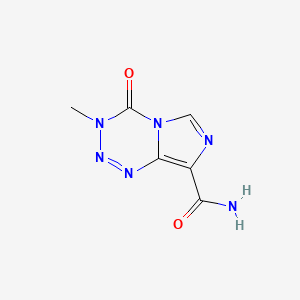
| Formula | C6H6N6O2 |
|---|---|
| Molecular weight | 194.15 g/mol |
| IUPAC name | 3-methyl-4-oxoimidazo[5,1-d][1,2,3,5]tetrazine-8-carboxamide |
| CAS | 85622-93-1 |
| PubChem CID | 5394 |
| InChIKey | BPEGJWRSRHCHSN-UHFFFAOYSA-N |
| logP | -2.08 (XLogP -1.1) |
| Polar surface area | 108.17 Ų |
| H-bond acceptors / donors | 7 / 1 |
| Drug-likeness (QED) | 0.56 |
| Lipinski violations | 0 |
SMILES
Cn1nnc2c(C(N)=O)ncn2c1=OBiology & Pharmacokinetics
Pharmacokinetics
| BBB penetrant | Yes (logBB -0.47) |
|---|
Enzyme interactions
| Enzyme | Role | Detail |
|---|---|---|
| CYP1A2 | Substrate | — |
Transporters
BCRP (Inhibitor)BSEP (Inhibitor)BSEP (Inhibitor)MRP1 (Inhibitor)MRP2 (Inhibitor)MRP3 (Inhibitor)MRP4 (Inhibitor)OATP1B1 (Inhibitor)OATP1B3 (Inhibitor)P-gp (Inhibitor)BCRP (Substrate)MDR1 (Substrate)P-gp (Substrate)Transporter(unspecified) (Substrate)
Drug–drug interactions (100+, DDInter)
| Interacting drug | Severity | Management |
|---|---|---|
| Adalimumab | major | |
| Bacillus calmette-guerin substrain tice live antigen | major | |
| Baricitinib | major | |
| Certolizumab pegol | major | |
| Cladribine | major | |
| Clozapine | major | |
| Deferiprone | major | |
| Etanercept | major | |
| Fingolimod | major | |
| Golimumab | major | |
| Infliximab | major | |
| Leflunomide | major | |
| Lomitapide | major | |
| Measles virus vaccine live attenuated | major | |
| Mipomersen | major | |
| Mumps virus strain B level jeryl lynn live antigen | major | |
| Natalizumab | major | |
| Ozanimod | major | |
| Pexidartinib | major | |
| Rotavirus vaccine | major | |
| Rubella virus vaccine | major | |
| Samarium (153Sm) lexidronam | major | |
| Siponimod | major | |
| Smallpox (Vaccinia) Vaccine, Live | major | |
| Talimogene laherparepvec | major | |
| Teriflunomide | major | |
| Thalidomide | major | |
| Tofacitinib | major | |
| Typhoid vaccine (live) | major | |
| Upadacitinib | major | |
| Varicella Zoster Vaccine (Recombinant) | major | |
| Yellow Fever Vaccine | major | |
| Aldesleukin | moderate | |
| Alefacept | moderate | |
| Alemtuzumab | moderate | |
| Anakinra | moderate | |
| Anthrax vaccine | moderate | |
| Asparaginase Erwinia chrysanthemi | moderate | |
| Asparaginase Escherichia coli | moderate | |
| Azathioprine | moderate |
Showing 40 of 100+.
Registered Products (16)
| Brand | Form / strength | Pack | Agent | Citizen (JOD) |
|---|---|---|---|---|
| Tegozol | Capsule 5 mg | 5 cap | Hikma Pharmaceuticals Co.Ltd/Jordan | 10.220 |
| Gliotem | Capsule 20 mg | 5 cap | Reda Jardaneh Drug Store | 22.260 |
| Tolid | Capsule 20 mg | 5 cap | MS PHARMA/JORDAN | 22.260 |
| Tegozol | Capsule 20 mg | 5 cap | Hikma Pharmaceuticals Co.Ltd/Jordan | 28.620 |
| TEMODAL Capsules | Capsule 20 mg | 5 cap | Adatco Drug Store | 31.800 |
| TEMAZ 100 | Capsule 100.000 mg | 5 cap | Omicron Pharma | 46.970 |
| Gliotem | Capsule 100 mg | 5 cap | Reda Jardaneh Drug Store | 54.800 |
| Zema | Capsule 100 mg | 5 cap | ORIENT DRUG STORE CO | 54.800 |
| Tegozol | Capsule 100 mg | 5 cap | Hikma Pharmaceuticals Co.Ltd/Jordan | 70.450 |
| TEMODAL Capsules | Capsule 100 mg | 5 cap | Adatco Drug Store | 78.280 |
| Gliotem | Capsule 250 mg | 5 cap | Reda Jardaneh Drug Store | — |
| TEMODAL Capsules | Capsule 250 mg | 5 cap | Adatco Drug Store | — |
| Tegozol | Tablet 250 mg | 5 tab | Hikma Pharmaceuticals Co.Ltd/Jordan | — |
| Tolid | Capsule 250 mg | 5 cap | MS PHARMA/JORDAN | — |
| Tolid | Capsule 100 mg | 5 cap | MS PHARMA/JORDAN | — |
| Zema | Capsule 250 mg | 5 cap | ORIENT DRUG STORE CO | — |